What is the difference between PoC and PMR446?
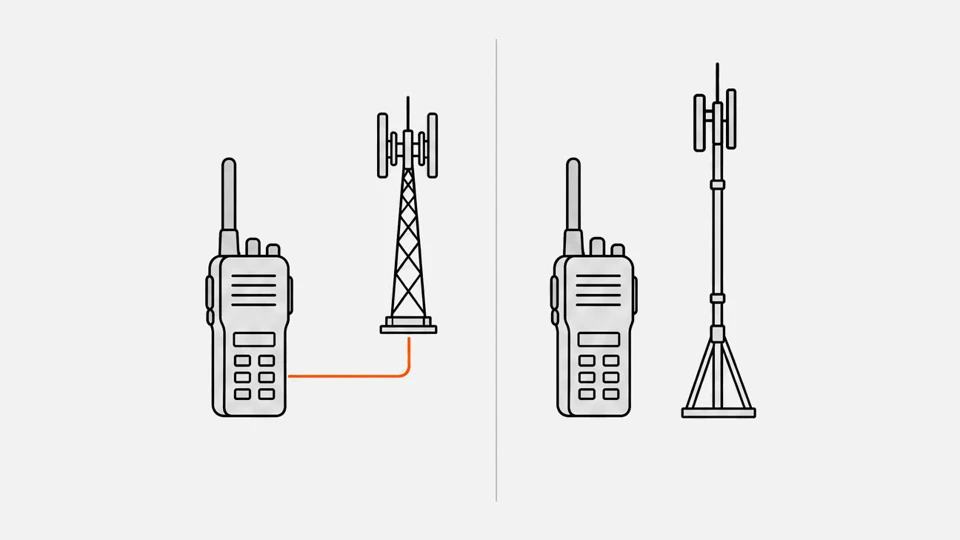
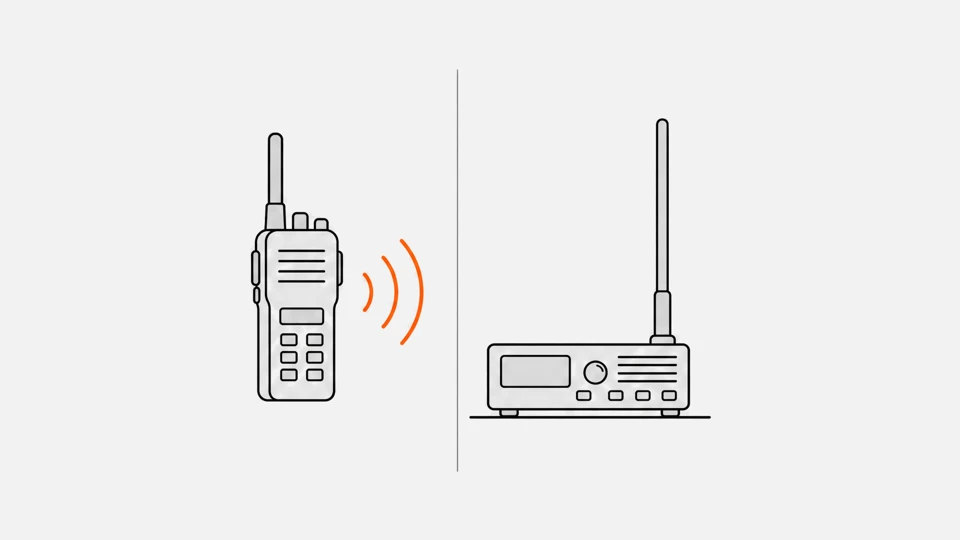
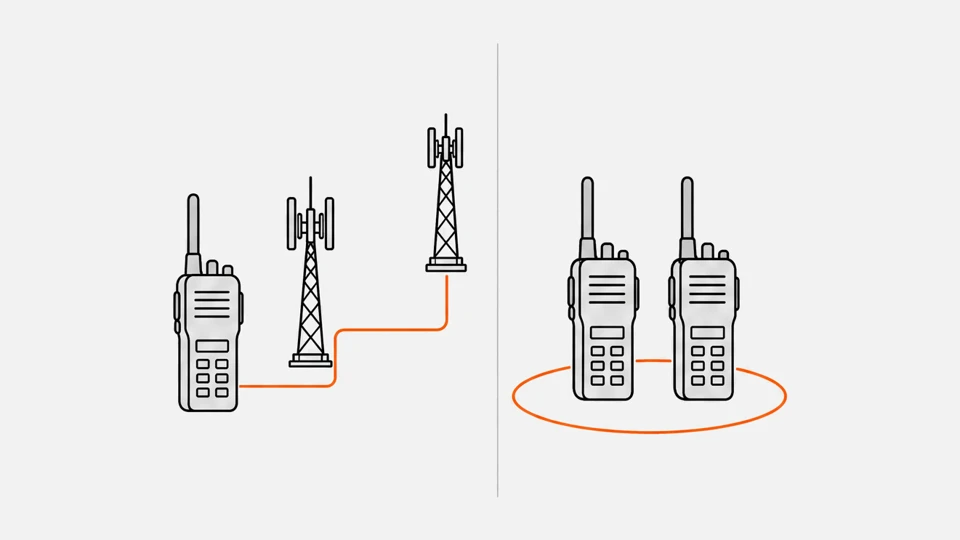
PMR446 is a license-free walkie-talkie service on 446.0–446.2 MHz. Radios talk directly at up to 0.5 W ERP, with no network and no fee. A PoC radio sends your voice as data over a mobile or Wi-Fi network, through a server, to your group. PMR446 covers one site; PoC covers anywhere with signal.123
CEPT, the European body of national regulators, sets the PMR446 rules: hand-held radios, a built-in antenna, no repeaters and no use as part of a network.1 A PoC radio does not use that band, so these limits do not apply. Latvia's spectrum regulator lists CE marking and an EU declaration of conformity among its purchase checks for mobile 3G/4G/5G devices, not a radio permit.4
Choose PoC if…
- Your people work in different towns, regions or countries
- You need distance that does not depend on terrain
- You want location, messages or a dispatcher
- Your sites have mobile or Wi-Fi signal and a monthly fee is fine
Choose PMR446 if…
- Everyone works on one site, within a few hundred meters
- The site has weak or no mobile signal
- You want no monthly fee, SIM card or account
- You accept an open channel
How do PoC and PMR446 compare at a glance?
Neither is better everywhere. PMR446 wins on running cost, simplicity and independence from any network. PoC wins on distance, location and dispatch tools. The deciding questions are how far apart your people work and whether they always have mobile or Wi-Fi signal.
| Criterion | PoC | PMR446 |
|---|---|---|
| Range | As far as mobile or Wi-Fi coverage3 | A few hundred meters in town, a few kilometers in open country2 |
| Needs a mobile network | Yes, or Wi-Fi3 | No1 |
| Radio license | Not needed4 | Not needed with compliant radios1 |
| Running cost | A monthly fee per user | None2 |
| Setup | SIM, PTT account, groups | Same channel on every radio |
| Delay | Under 1 second on 4G (Zello)5 | Direct, no server1 |
| Who can listen | Your group, through a provider's server3 | Anyone on your channel in range1 |
| Extras | Location, messages, dispatcher console6 | Basic functions and a set of channels1 |
Technical details
| Detail | PoC | PMR446 |
|---|---|---|
| How the call travels | LTE or Wi-Fi data to a PTT server | Radio to radio, simplex, 446.0–446.2 MHz1 |
| Power and antenna | Not set by PMR446 rules | 0.5 W ERP maximum, built-in antenna1 |
| Channels | Groups on the PTT server | 16 analog channels at 12.5 kHz spacing (our count); digital variants at 12.5 and 6.25 kHz1 |
| Delay | Under 0.5 s on Wi-Fi, under 1 s on 4G, 2 s or more on 2G (Zello)5 | Not specified in the decision |
| Data use | 12–45 kbps while talking; 70–100 MB per user per month on average (Zello)7 | None |
| Standards | Varies by service | ETSI EN 303 405; TS 102 490 (dPMR446); TS 102 361-1 (DMR Tier 1)1 |
| Encryption | Set by the service; Zello Work states 256-bit AES for audio3 | Not in the decision; CTCSS is squelch, not encryption8 |
How far does PMR446 reach compared with PoC?
PMR446 reaches a few hundred meters in town and up to a few kilometers in the countryside, says Latvia's spectrum regulator. A PoC radio reaches as far as the mobile or Wi-Fi signal at each end, so two people in different cities can share a group. For PoC the limit is signal, not distance.234
Sources disagree. A UK retailer guide quotes 1–6 km (0.6–3.7 mi) in built-up areas and up to 5–8 km (3–5 mi) in open terrain, as estimates in optimal conditions.9 An amateur radio club tested on flat land and called 500 m (about 1,600 ft) a good rule of thumb, with a longest data point of about 1 mile (1.6 km).10
Digital sets, including DMR Tier 1, aim for better service out to the range limit, not a longer range.1 CEPT is revising the decision to allow 1 W ERP. That work item was still in progress on 10 October 2026, and the published decision says 0.5 W.11 See the PMR446 guide and the long-range walkie-talkie guide.
Which works without a mobile network?
PMR446 does. The radios talk directly to each other on one channel, with no base station, repeater or operator in between. A PoC radio needs mobile data or Wi-Fi, and with neither there is no call. Hybrid radios with a DMR or analog radio can fall back to direct talk, within radio range.1312
In our database, 41 of the 291 current PoC radios are hybrids.12 Check the analog side: radios above 0.5 W ERP or with a detachable antenna fall outside the PMR446 exemption.1 For licensed digital radios with repeaters, see PoC vs DMR.
What does each cost to run?
PMR446 has no running cost: no license, subscription or SIM. PoC is billed per user. Published plans in October 2026 ran from €4.50 to €25 per user per month excluding VAT, and a data SIM may cost extra. For ten users that is €540 to €3,000 a year.2131415
- PoC Me: Lite is €4.50 per user per month on a one-year term.13
- Instavox: €8 to €25 per user per month, depending on plan and SIM option.14
- Zello Work: Core is $8 per user per month ($6.80 billed annually); Plus is $15 ($12.75 annually).6
- Data SIM: Zello reports 70–100 MB per user per month on average.7 A French retailer says a data-only SIM is enough, at about €2–5 a month.15
Yearly totals are our arithmetic: €4.50 × 10 × 12 = €540; €25 × 10 × 12 = €3,000.
How hard is each to set up?
PMR446 takes minutes: charge the radios, set the same channel on each and press the key. PoC needs more steps: a data SIM in each radio, an account with a PTT service and groups set up by an administrator. The radio must also support your operator's LTE bands.61512
National rules still apply to PMR446: Latvia, for example, bars changing the factory channels.2 For PoC, check band support in the LTE band checker. To pick a type, try the radio type picker.
Which is more private?
Neither is private by default, for different reasons. A PMR446 channel is open: anyone in range on it can listen, and CTCSS “privacy” codes only mute your own receiver. A PoC service can encrypt calls, but the audio passes through a provider's server, so read what each provider states.138
ETSI describes CTCSS as a way to enable or disable a receiver's audio on a specific tone, and does not describe scrambling or encryption.8 The tone controls only the receiver, so it does not stop another radio from listening.
Zello Work states 256-bit AES for audio. Channel messages are encrypted from sender to server and server to recipient, not end to end; 1:1 messages are end to end unless the network enables Message Vault.3 These are vendor statements, not audits.
Which should a team choose?
A team on one site can start with PMR446: within a few hundred meters it needs no signal, SIM or fee. A team spread across towns, regions or countries needs PoC, because PMR446 cannot reach that far. A hybrid radio fits a team with a long route and dead zones.2312
- One site: PMR446 fits when everyone stays within a few hundred meters of each other.
- Spread team: PoC fits delivery, field service or patrols across districts.
The license-free radios guide covers the PMR446 rules.
Questions
Sources
- PMR446 radios, licensing and range (in Latvian) · Elektroniskie sakari, Latvia
- Overview of Zello Work · Zello Work Help Center
- Mobile 3G/4G/5G devices: what to check before buying (in Latvian) · Elektroniskie sakari, Latvia
- What is the current latency? · Zello Work Help Center
- Zello Work pricing · Zello
- How much data bandwidth does the app use? · Zello Work Help Center
- Long range two-way radios guide · Onedirect UK
- PMR446 coverage experimentation · Avalon Amateur Radio Club
Show all 16 sources
- Work item FM62_03: PMR446 evolution · CEPT ECC
- Radio specifications and LTE bands of 73 operators in 22 countries · poc-radio knowledge base
- Instavox plans (in French) · Instavox
- Inrico S100 4G radio (SIM requirements) · Passion Radio
- Radio gateways for Zello · Zello