What are the main types of two-way radio?
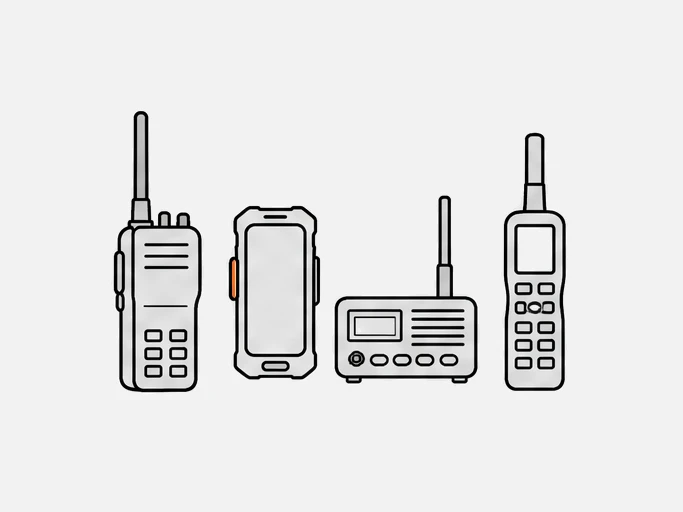
The main types are license-free handhelds (PMR446 and FRS), licensed business radios (analog and DMR), TETRA networks, PoC radios on 4G/LTE, satellite push-to-talk and hybrids that join two of these. The table compares how each connects, how far it reaches and what it costs.
| Type | How it connects | Reach | License or access | Running cost |
|---|---|---|---|---|
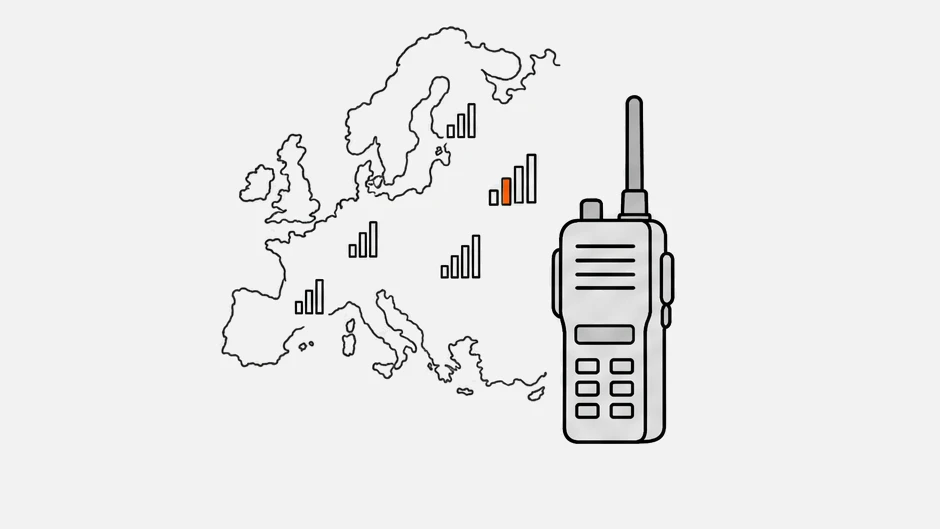
| PMR446 (Europe) and FRS (US) | Direct, handheld only, built-in antenna. PMR446: 0.5 W, no repeaters.1 FRS: 0.5–2 W ERP.2 | PMR446: a few hundred meters in town, a few km in open country3 | None.14 GMRS needs one.5 | None |
| Business analog (VHF, UHF) | Direct or through a repeater; Latvia lists 30–87.5, 146–174 and 406–470 MHz6 | A few km in town; a few tens of km in the countryside with vehicle or fixed units6 | Permit6 | Permit fees |
| DMR | Digital; Tier II and III fit two voice slots in 12.5 kHz7 | Like analog; repeaters extend it | Tier I none; Tier II and III individual license7 | License fees (Tier II, III) |
| TETRA | Trunked network, four channels per 25 kHz carrier;8 direct mode available9 | Network coverage9 | Through a network provider or a licensed private network10 | Service or network fees |
| PoC / LTE | Mobile data or Wi-Fi to a PTT server | Wherever there is mobile data or Wi-Fi | None; SIM and PTT service11 | Example: $8–15 per user per month, Zello Work, October 202612 |
| Satellite PTT | Satellite network; Iridium runs 66 cross-linked satellites13 | Where the network covers; Iridium says every part of the world13 | Service plan | Service plan |
| Hybrid (PoC plus DMR or analog) | Both links in one device14 | PoC with signal, direct radio without | Direct side follows its own rules | Service fee, plus any license fee |
| Amateur (ham) | Direct, through repeaters, or on shortwave off the ionosphere;21 handhelds are typically 5 W20 | A handheld a few miles by itself;20 shortwave around the globe21 | License after an exam;22 no business use23 | License fee: $35 for 10 years in the US24 |
How do handheld, mobile and base radios differ?
A handheld (portable) radio runs on a battery and goes with the person. A mobile radio is fixed in a vehicle and draws on its power. A base station sits at a fixed site, such as a control room. Mobile and base units transmit with more power, so they reach farther on the same band.
- Handheld — Motorola rates its R7 at 5 W on VHF and 4 W on UHF.15
- Mobile and base — Hytera rates its HM785, built for vehicles and control rooms, at up to 50 W on VHF and 45 W on UHF.16
PoC devices come in the same forms. Of the 291 current models in our database, 174 are PoC handhelds, 39 are PTT phones and 27 are vehicle-mounted.14
Which two-way radios need no license?
PMR446 radios in Europe, FRS radios in the US and PoC radios need no radio license. Business analog and DMR radios need a permit, and the US GMRS service needs an individual license. TETRA access comes through a network provider or a licensed private network, and satellite through the provider. Police, fire and ambulance radio is covered in public safety radio.
GMRS shares channels with FRS. Its license holder must be 18 or older, and the license covers family members.5
Amateur (ham) radio needs a license after an exam, and it may not be used for business.2223 See What is ham radio? The license checker shows the rules for each radio type in 15 countries.
How does a call travel on each type?
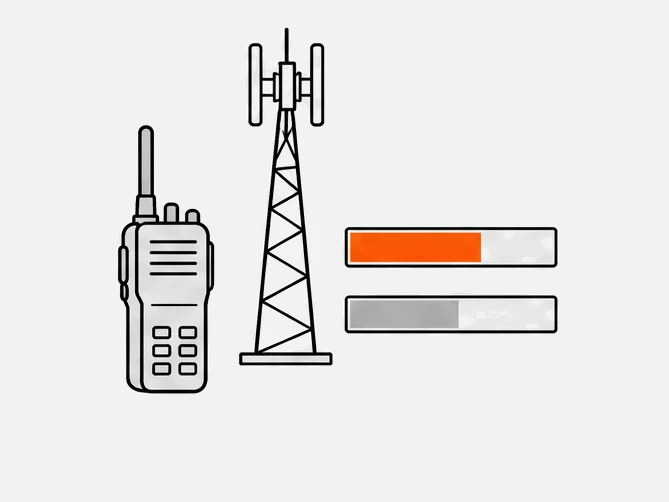
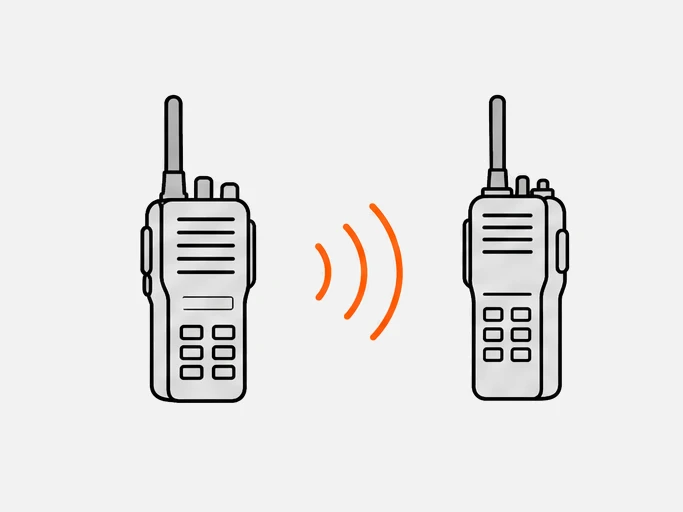
On a direct radio, your voice goes straight to the other radios, or through a repeater. On a PoC radio, it goes over the mobile network to a PTT server and on to the group. On a satellite radio, it goes up to a satellite and back down. Pick a type below.
A PoC call adds the mobile network and a server; Zello states a delay under 1 second on 4G.17 See push-to-talk for how the key and group work.
What are the pros and cons of a direct radio?
A direct radio (PMR446, FRS, analog or DMR) needs no mobile network, SIM or monthly service fee, and it works where there is no signal. Its range is set by power, antenna and terrain, and a wide area needs repeaters and a license.
Good at
Compare in detail: PoC vs DMR and PoC vs PMR446.
How do you choose the right type?
Match the type to three things: distance, coverage and license. One site and a few hundred meters suits license-free handhelds. A few kilometers with a license suits analog or DMR. A team across regions with mobile signal suits PoC. Beyond mobile coverage, use satellite or a hybrid.
- MixIf part of the job has signal and part has none, a hybrid radio carries both.
The radio type tool runs these questions for you, and the radio catalog lists models by type. For the mobile side, see 4G LTE walkie-talkies.
Questions
What is the difference between a two-way radio and a walkie-talkie?
"Walkie-talkie" is the everyday name for a handheld two-way radio. "Two-way radio" also covers vehicle and base units. See two-way radio vs walkie-talkie and what is a two-way radio.
Which type has the longest range?
PoC and satellite, because the network sets the range, not the radio. PoC reaches wherever there is mobile data or Wi-Fi; Iridium says its network covers every part of the world.13 Direct radios reach a few km in town.6
Can different types talk to each other?
Not directly. The three DMR tiers do not interoperate.7 A radio gateway can bridge a PoC group to a DMR or analog channel, and Zello lists tested gateways.19
What is a PTT phone?
A rugged phone with a hardware key for push-to-talk that runs a PoC app. In our database, 39 of the 291 current models are PTT phones.14
What is a hybrid radio?
One device with a PoC radio and a DMR or analog radio: the mobile network where there is signal, direct radio where there is none. In our database, 41 of the 291 current models are hybrids.14
Sources
- 47 CFR Part 95, Subpart B: Family Radio Service (FRS) · eCFR, US Government
- PMR446 radios, licensing and range (in Latvian) · Elektroniskie sakari, Latvia
- 47 CFR 95.305: Authorization to operate Personal Radio Services · eCFR, US Government
- 47 CFR 95.1705: GMRS individual licenses · eCFR, US Government
- Professional PMR radios and permits (in Latvian) · Elektroniskie sakari, Latvia
- TETRA · TCCA
- 400 MHz spectrum · RTR, Austria
Show all 24 sources
- Mobile 3G/4G/5G devices: what to check before buying (in Latvian) · Elektroniskie sakari, Latvia
- Zello Work pricing · Zello
- Defining satellite push-to-talk (PTT) · Iridium
- Radio specifications of 354 PoC radios and PTT phones · poc-radio knowledge base
- MOTOTRBO R7 data sheet · Motorola Solutions
- What is the current latency? · Zello Work Help Center
- UHF vs. VHF radios: differences and finding the best fit · Motorola Solutions
- Radio gateways for Zello · Zello
- On the Air: repeaters · ARRL
- 47 CFR 97.503: Element standards · eCFR, US Government
- 47 CFR 97.113: Prohibited transmissions · eCFR, US Government
- 47 CFR 1.1102: Schedule of charges for wireless applications · eCFR, US Government