Why is it called ham radio?
Ham is not an acronym, so ham radio does not stand for anything. The ARRL, the US national association for amateur radio, says "ham" began as telegraph slang for a poor operator, a "plug". Early amateurs took the word over, and its first meaning faded.1
The ARRL's account: early wireless operators were landline telegraphers who brought their slang along. Broad spark signals from powerful amateur stations could jam everyone else in town. Frustrated commercial operators called the interference "hams", and amateurs, possibly not knowing the real meaning, adopted the word.1
Several acronym stories circulate. The sources I checked reject them:
- Hertz, Armstrong and Marconi. Armstrong was an unknown high school student when the term appeared.2
- "Home Amateur Mechanic" magazine. Neither the Library of Congress nor WorldCat lists a publication with that title.2
- The Harvard "Hyman-Almy-Murray" station. The tale surfaced in 1948. Harvard Wireless Club members found no record of Hyman appearing before Congress.23
Do you need a license for ham radio?
Yes. Operating a ham station takes a national license, earned by exam. The US has three classes you can earn today, the UK has three levels, and in Europe each country issues its own license, while CEPT rules let a licensed ham operate abroad on short visits.456
| Country | License levels | Exam | Term and fee | Max power |
|---|---|---|---|---|
| US (FCC) | Technician, General, Amateur Extra4 | Volunteer examiners; no Morse code47 | 10 years; $3548 | 1.5 kW PEP ceiling; 200 W in some segments4 |
| UK (Ofcom) | Foundation, Intermediate, Full5 | RSGB exam5 | No end date if you confirm details every five years; online application free5 | 25 W, 100 W, 1,000 W PEP9 |
| Europe (CEPT) | National license6 | Exam to the HAREC syllabus10 | Set by each country; visitors pay no fee6 | Set by each national license |
United States. Novice and Advanced licenses can still be renewed, but no new ones are issued.4 A Technician or General exam has 35 questions and needs 26 right. Amateur Extra has 50 questions and needs 37.4 No US license class has needed a Morse code test since 2007.7 What the code is, where hams still use it and how to learn it: Morse code. An expired license can be renewed during a 2-year grace period.4 You can look up any license in the FCC's Universal Licensing System (ULS).11 Every license comes with a call sign, such as W1AW; how to read one, and the call signs of famous hams, are in Ham radio call signs. The ARRL counted 729,031 active US licenses held by individuals through October 10, 2026, about half of them Technicians.12
The worldwide total is often put at about 3 million, a figure the ARRL traces back to 2000. The ARRL's 2021 note says 1.75 million may be closer to the truth.13
United Kingdom. You pass an exam run by the Radio Society of Great Britain (RSGB), then apply to Ofcom.5 The power limits in the table apply on the main bands since February 21, 2024.9 Visitors from T/R 61-01 countries need no UK license for stays of less than three months.5
Europe. T/R 61-01 lets hams from CEPT member countries operate during short visits to other member countries without a separate permit, on top of their national license.6 T/R 61-02 defines HAREC, a certificate that you passed an exam meeting the harmonized syllabus. It helps you get a license where you stay longer.10
Classes, exams and fees in 14 countries are in How to get a ham radio license, and you can practice for the exam before you book it.
Not sure ham radio is the right fit? Pick your country, use, license and distance. For the rules of 15 countries, radio by radio, see the license checker.
Which radio service fits you?
- Amateur (ham) radio
- PoC radio (4G/LTE)
- CB radio
- FRS
- GMRS
- MURS
- PMR446
- Licensed business radio (analog or DMR)
How far can a ham radio reach?
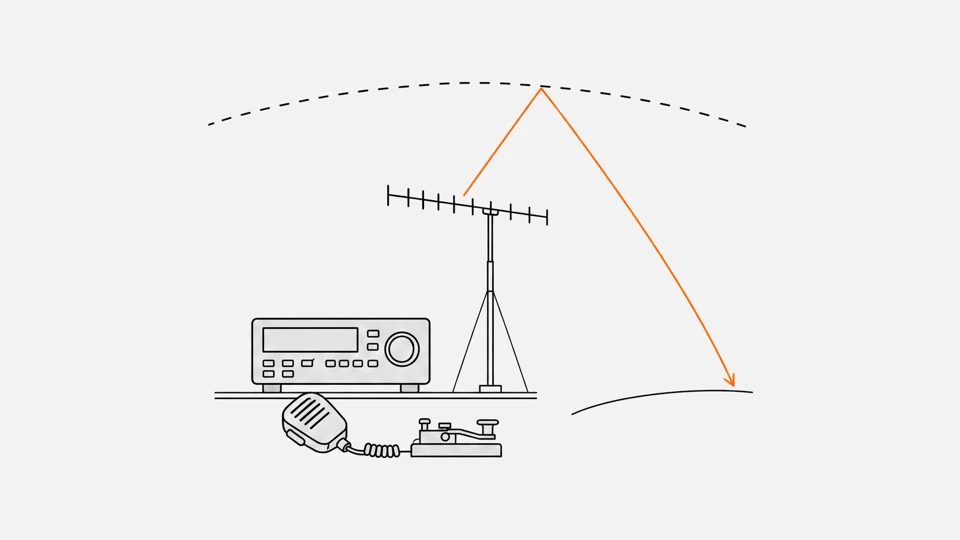
It depends on the setup. A handheld alone generally reaches only a few miles. Through a repeater it is heard over many square miles, and a linked repeater can connect you to people tens or thousands of miles away. On HF (3–30 MHz), signals bounce off the ionosphere and can circle the globe.1415
| Setup | Typical reach | What limits it |
|---|---|---|
| Handheld to handheld (simplex) | A few miles; the horizon is at most about 10.7 km (6.7 mi) at head height1416 | Line of sight, trees, buildings; a handheld may transmit with just 5 W14 |
| Handheld to a 30 m or 100 m antenna | Horizon of about 28 km (17 mi) and 47 km (29 mi)16 | Antenna height and terrain |
| Through a repeater | Heard over many square miles14 | Repeater height; IARU Region 1 says FM repeaters are not meant for DX contacts17 |
| HF skywave | Around the globe by repeated reflections15 | Band and time of day: the D layer absorbs low frequencies by day and fades after sunset15 |
The radio horizon in kilometers is about 4.12 times the square root of the antenna height in meters, added for both ends. Real range is shorter.16 For walkie-talkies in general, see How far can a walkie-talkie really reach? and the range calculator.
What are the ham radio bands?
Ham bands are named by wavelength, such as 40 m and 2 m, and sit in the HF, VHF and UHF ranges. The ITU splits the world into regions, so the US (Region 2) and Europe (Region 1) differ: 2 m is 144–148 MHz in the US and 144–146 MHz in Europe.418
| Band | US (Region 2), MHz | Europe (Region 1), MHz | Typical use |
|---|---|---|---|
| 160 m | 1.800–2.000 | 1.810–1.850 | Low HF, best at night15 |
| 80 m | 3.500–4.000 | 3.500–3.800 | Low HF, best at night15 |
| 40 m | 7.000–7.300 | 7.000–7.200 | HF |
| 20 m | 14.000–14.350 | 14.000–14.350 | Higher HF, daytime F layer15 |
| 10 m | 28.000–29.700 | 28.000–29.700 | Higher HF |
| 6 m | 50–54 | 50–52, secondary18 | VHF |
| 2 m | 144–148 | 144–146 | VHF handhelds and repeaters |
| 70 cm | 420–450 | 430–440 | UHF handhelds and repeaters |
The US column shows what Amateur Extra licensees may use. Technician licensees get 6 m and everything above it, plus four narrow HF segments.4 The 30 m, 17 m, 15 m and 12 m bands are the same in both regions.18
On 2 m and 70 cm, a repeater listens on one frequency, the input, and retransmits on another, the output.14 The standard US offset is 600 kHz on 2 m and 5 MHz on 70 cm, while IARU Region 1's 70 cm plan uses 7.6 MHz.1917 Many analog repeaters need a CTCSS tone, a sub-audible tone sent with your voice; see our CTCSS and DCS code list.14 The magazine CQ VHF covered this territory until it stopped as a separate title around the end of 2013.20
Channel charts for FRS, GMRS, MURS, PMR446 and CB are in our frequency charts.
How does ham radio compare with CB, GMRS, walkie-talkies and PoC?
Ham radio needs an exam and offers the most spectrum and the longest reach. CB, FRS and PMR446 need no license. GMRS needs a US license, and the rules set no test. A PoC radio needs no radio license, only a SIM and a push-to-talk service.2122
| Point | Ham | CB (US) | GMRS (US) | FRS / PMR446 | PoC radio |
|---|---|---|---|---|---|
| License | National license4 | None21 | Individual, age 18+, covers family21 | None2122 | No radio license; SIM and PTT service |
| Exam | Yes4 | None | None in the rules21 | None | None |
| Max power | 1.5 kW PEP US ceiling4 | 4 W AM or FM; 12 W PEP SSB21 | 0.5 to 50 W, by channel and radio21 | FRS 0.5 or 2 W ERP; PMR446 0.5 W ERP2122 | Not a radio limit |
| Typical reach | A few miles on a handheld; worldwide on HF1415 | Direct, radio to radio; outdoor antenna up to 18.3 m (60 ft)21 | Direct or through repeaters21 | PMR446: a few hundred meters in town, a few km in open country23 | Wherever there is mobile data or Wi-Fi |
| Business use | No, non-commercial by law24 | Yes, personal and business21 | No new licenses to companies21 | Yes, both allow it2122 | Yes |
| Running cost | $35 per 10 years (US)8; free online (UK)5 | None | $35 per 10 years8 | None | Monthly service fee |
Choose ham if you want long reach, digital modes or home-built gear, and you will pass an exam. Choose GMRS if you want a US family system with repeaters and a $35 license with no test in the rules. Choose PoC if your group is spread across a city or country with mobile coverage and you want no radio license. For one site or a trail, license-free PMR446 or FRS fits. More in PoC radio and PoC vs DMR.
What is digital and internet-linked ham radio?
Digital ham radio sends voice as data. DMR, D-STAR and Yaesu System Fusion are the main digital voice modes on repeaters, and EchoLink, IRLP and AllStarLink join radios over the internet. RepeaterBook lists 4,716 DMR, 3,608 System Fusion and 2,555 D-STAR repeaters worldwide as of October 12, 2026.1425
- DMR. Digital Mobile Radio. BrandMeister is a worldwide network that links amateur DMR repeaters and hotspots, and it accepts only DMR IDs registered in the RadioID database.26 How DMR IDs, talkgroups and hotspots work is in ham radio DMR.
- D-STAR. An open digital voice and data protocol established by the Japan Amateur Radio League (JARL).27
- System Fusion. Yaesu says it introduced its C4FM digital system in 2013. The radios also work on analog FM.28
- EchoLink. Free software that lets licensed hams talk over the internet. Every user is validated as a license holder.29
- IRLP. The Internet Radio Linking Project, invented by David Cameron, VE7LTD, in Canada in 1997.30
- AllStarLink. A network of repeaters, remote bases and hotspots linked by voice over IP, built on the open-source Asterisk phone software.31
A PoC radio does the same kind of job, linking people far apart, over LTE and without a radio license.
What is APRS?
APRS, the Automatic Packet Reporting System, sends short data packets over ham radio to show positions on a map. Bob Bruninga, WB4APR, developed it. It began in 1982 as a map program and got its name in 1992. North America uses 144.390 MHz for APRS, and Europe uses 144.800 MHz.3217
APRS adds position data to packet beacons, so stations, objects and their movements appear on a map. A GPS receiver can supply the position, and the system can also track a hidden transmitter.33 APRS-IS, run by volunteer amateurs, connects APRS radio networks worldwide over the internet.34
Xastir is an open-source APRS client released under the GPL-2.0 license.35
What are ham radio contests and DX?
DX is ham shorthand for distance. DXers chase far-away stations to earn the ARRL's DXCC award, which needs confirmed contacts with 100 countries. The current list has 340 entities. Contests such as the CQ World Wide DX Contest turn the chase into a weekend race.363738
- CQ World Wide DX Contest. It calls itself the largest amateur radio competition in the world, with over 35,000 participants. SSB runs on the last full weekend of October (October 24–25, 2026), CW on the last full weekend of November. The modern contest began in 1948.39
- ARRL Field Day. An annual event since 1933, where hams set up temporary stations in public places.40
- QSL cards. QSL is a Q code that means "I am acknowledging receipt". A card confirms a contact.41 The ARRL's Logbook of The World (LoTW) does this electronically. It began operating on September 15, 2003.42
- Logging software. N1MM Logger+ is free contest logging software.43
- DX expeditions. The rarest entities have no resident hams, so teams travel there, often to uninhabited islands, and make tens of thousands of contacts in a few weeks. How such a trip is licensed, shipped, powered and confirmed: How do DX expeditions work?
What is QRP and homebrew ham radio?
QRP means low-power operating. The letters come from the Q code QRP, "shall I decrease transmitter power?", and QRO is the opposite. QRP ARCI, a low-power club with more than 16,000 members, defines QRP as 5 watts or less. Many QRP operators build their own radios.4144 See the Q-code list.
Kits make building simple. QRP Labs sells the QCX+, a single-band 5 W CW transceiver kit with a choice of 80, 60, 40, 30, 20 or 17 m. Its output is about 3–5 W, depending on the supply voltage.45
An SSB transceiver is a bigger build than a CW kit, but hams still make them from scratch. A single-band design for 40 m usually has a VFO for tuning, a crystal oscillator for the intermediate frequency, a crystal filter that removes the unwanted sideband, and a small power amplifier. M0DAD, a British ham, built a 2 W SSB/CW rig for 40 m on the twin crystal filter design by Drew Diamond, VK3XU, using junk-box parts in the case of an old tape deck. He tested it stage by stage: the VFO, then the IF oscillator, then the transmitter.51
In the US, a ham may build a transmitter. Part 97 lists self-training and technical investigation as purposes of the service and has no equipment-authorization rule for amateur transmitters. It requires certification for external RF power amplifiers but exempts one constructed or modified by an amateur.4
What is the difference between ham radio and shortwave listening?
Shortwave listening (SWL) is receive-only. Listeners tune broadcasts between 1,700 kHz and 30 MHz and transmit nothing. Ham radio is two-way: licensed operators talk on the ham bands. The two share the shortwave range but use different bands, and a listener can also tune in ham stations.46
| Service | Example bands, MHz |
|---|---|
| Shortwave broadcasting (ITU) | 5.9–6.2 (49 m), 9.4–9.9 (31 m), 11.6–12.1 (25 m)47 |
| Ham (US plan) | 3.5–4.0 (80 and 75 m), 7.0–7.3 (40 m), 14.0–14.35 (20 m)4 |
The bands overlap in places: 7.2–7.3 MHz is ham in the US plan and broadcasting in ITU Regions 1 and 3.474 CQ's publisher wrote in 2013, "Most of us started out as shortwave listeners".20
What you can hear on shortwave, the broadcast bands and how to start listening are on What is shortwave radio?.
Can a business use ham radio?
No. Ham radio is non-commercial by law. The ITU defines the amateur service as pursued without pecuniary interest. US rule 97.113 bars transmissions for pay and on behalf of an employer. The UK license allows only self-training or leisure use, not commercial purposes of any kind.48249
The US rules carve out narrow exceptions: an employer's emergency drill, a teacher using the station in class, and occasional notices that ham gear is for sale.24 Business options:
- PoC radio over the mobile network, with no radio license.
- DMR and other licensed business radio. In the US this falls under 47 CFR Part 90.49 In the UK, a business needs an Ofcom Business Radio license; the "Simple UK Light" type costs £75 for five years.50
- License-free radios: PMR446 in Europe; FRS, MURS or CB in the US.
Questions
Is ham radio free?
The license costs little: $35 in the US and nothing for an online application in the UK. The radio is extra.85
Can I transmit on ham frequencies without a license?
No. US rules require a station to be under the control of a person named in an amateur license before it transmits on amateur frequencies.4
How long does a ham license last?
A US license lasts 10 years, with a 2-year renewal grace period. A UK license has no end date if you confirm your details to Ofcom every five years.45
Sources
- Etymology of ham radio · Wikipedia
- 47 CFR Part 97: Amateur Radio Service · eCFR, FCC
- Amateur radio guidance: licensing guidance for licensees · Ofcom (archived copy)
- Amateur Service Rules, 72 FR 3081 (2007-01-24) · Federal Register
- Amateur Radio Wireless Telegraphy Licence Conditions Booklet OFW611 · Ofcom (archived copy)
Show all 51 sources
- FCC Application Fee · ARRL
- FCC License Counts · ARRL
- IARU Region 1 VHF Handbook V10.02 (March 2024) · IARU Region 1
- 47 CFR Part 95: Personal Radio Services · eCFR, FCC
- PMR446 radios, licensing and range (in Latvian) · Elektroniskie sakari, Latvia
- 47 CFR 97.113: Prohibited transmissions · eCFR, FCC
- RepeaterBook statistics by country · RepeaterBook
- BrandMeister news · BrandMeister
- D-STAR · Icom America
- What is System Fusion? · Yaesu
- EchoLink validation policy · EchoLink
- Internet Radio Linking Project · Wikipedia
- AllStarLink · AllStarLink Inc.
- APRS developer Bob Bruninga, WB4APR, SK · ARRL News
- APRS mode · ARRL
- APRS-IS · APRS-IS
- Xastir APRS client repository · GitHub
- Chasing DX · ARRL
- DXCC award · ARRL
- ARRL Field Day · ARRL
- N1MM Logger+ · N1MM
- About QRP ARCI · QRP ARCI
- QCX+ transceiver kit · QRP Labs
- Shortwave listening · Wikipedia
- 47 CFR 90.35: Industrial/Business Pool · eCFR, FCC
- Guidance for Business Radio · Ofcom
- Homebrew 40m SSB/CW transceiver · M0DAD, Delboy Online, archived