How does Morse code work?
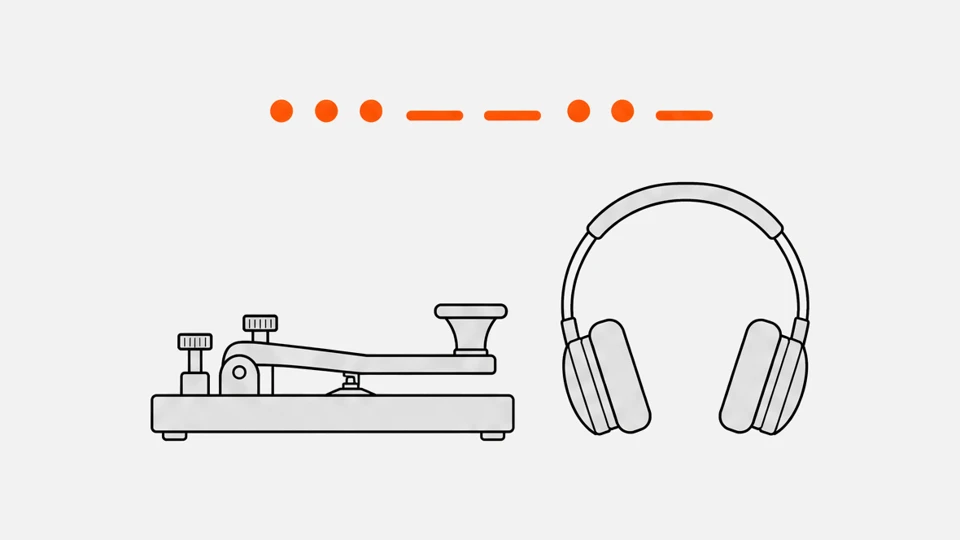
Every letter, figure and sign is a short pattern of dots and dashes. The timing carries the meaning: a dash lasts three dots, and the silences between signals have fixed lengths too. The ITU, the UN agency for telecommunications, sets the code and its timing in Recommendation M.1677-1.1
| Part | How long | Example |
|---|---|---|
| Dot | 1 unit | E is one dot |
| Dash | 3 units | T is one dash |
| Gap inside a letter | 1 unit | between the dot and dash of A (·−) |
| Gap between letters | 3 units | between the letters of a word |
| Gap between words | 7 units | between two words |
Source: ITU-R M.1677-1.1
Speed is counted in words per minute (WPM). The ITU sets no speed unit. Hams use the ARRL's standard word PARIS, which takes exactly 50 units, so one dot lasts 1,200 ÷ WPM milliseconds: 240 ms at 5 WPM, 60 ms at 20 WPM.12
The most common English letters got the shortest codes. E is a single dot and T a single dash, while Q and Y take four signals each.3
The Morse code alphabet
The International Morse code has 26 letters, 10 figures and about a dozen punctuation marks. Each figure is five signals long, so numbers are easy to tell from letters. Tap a letter to hear it.1
The only accented letter in the ITU table is É (··−··). The newest sign is @ (·−−·−·), added in 2004 for email addresses.13 Punctuation, prosigns such as SK (end of contact) and the full table are in the Morse code translator.
Who invented Morse code?
Samuel F. B. Morse and his partner Alfred Vail, in the United States. On May 24, 1844, Morse sent "What hath God wrought?" over an experimental line from Washington, D.C., to Baltimore. The Library of Congress credits Morse with the code; Vail's family argued for decades that Vail designed the alphabet.456
Morse's first plan sent only numbers, which the operator looked up in a code book. Vail's supporters, among them the Franklin Institute, credited Vail with the alphabet of dots and dashes.6 The code we use today is a later European version:
- 1844. The first public message, Washington to Baltimore.4 The American code of this time had dashes of different lengths and uneven gaps. It survived on US railroads as American Morse.3
- 1848. Friedrich Clemens Gerke rewrote the code for the Hamburg–Cuxhaven line: one dot, one dash three dots long.37
- 1865. The International Telegraph Union was founded in Paris on May 17. Its rules made Morse code the international standard.8
- 1906. The Berlin radiotelegraph conference adopted SOS worldwide.9
- 1999. Ships switched to the satellite-based GMDSS on February 1.11
- 2003 and 2007. Europe and then the US dropped the Morse test for ham licenses.1316
Why is SOS the distress signal?
SOS (···−−−···) became the worldwide distress signal in 1906. It is one signal, not three letters: the dots and dashes run on with no letter gaps. The Berlin convention set it from July 1, 1908. Before that, Marconi operators sent CQD.9103
The Titanic's radio operator Jack Phillips sent both, CQD and SOS, in April 1912, according to junior operator Harold Bride.3012 From February 1, 1999, ships call for help through GMDSS, the Global Maritime Distress and Safety System, by satellite and digital selective calling.11 The French Navy had already sent its last Morse message on January 31, 1997.3
SOS works without a radio. You can flash it with a torch or a mirror, or knock it.3 In 1966 Jeremiah Denton, a US Navy pilot held as a prisoner of war, blinked T-O-R-T-U-R-E in Morse during a filmed interview. It was the first clear proof for US intelligence that prisoners were tortured.24
Do you need Morse code for a ham license?
In most countries, no. The 2003 World Radiocommunication Conference let each country decide whether hams must know Morse. Europe's CEPT license dropped the requirement on September 15, 2003. The US cut its test to 5 WPM in 2000 and removed it on February 23, 2007.13141516
| Country | Morse test today |
|---|---|
| United States | None. Until April 15, 2000, General needed 13 WPM and Extra 20 WPM141516 |
| CEPT countries in Europe | Not needed for the CEPT license since 200313 |
| Germany | An optional exam at 5 WPM (standard or Farnsworth timing) or 12 WPM; no class requires it31 |
| Canada | An optional 5 WPM qualification that opens all bands, as an alternative route32 |
| India | The General grade exam also tests Morse33 |
Classes and exams in 14 countries are in How to get a ham radio license, and you can practice for the written exam.
Where is Morse code used today?
Mostly by hams, on the air as CW. Aircraft navigation beacons still identify themselves in Morse, and a network of 18 ham beacons sends call signs in Morse around the clock. Phones offer Morse as a way to type for people who cannot easily use a keyboard.17192122
| Where | How Morse is used |
|---|---|
| Ham radio | A CW signal is 50 Hz wide or less, so dozens of contacts fit in the space of one voice signal. It gets through weak conditions at low power and needs no computer1718 |
| Ham beacons | The NCDXF/IARU network: 18 beacons on 14.100, 18.110, 21.150, 24.930 and 28.200 MHz send their call sign at 22 WPM, then four dashes at 100 W, 10 W, 1 W and 0.1 W, every three minutes on each band. Listeners use them to check how far a band reaches1920 |
| Aviation | VOR and NDB beacons and ILS localizers send a two- or three-letter Morse identifier. An ILS identifier starts with I (··); pilots check it to confirm the right station21 |
| Accessibility | Since 2018 Google's Gboard keyboard can type in Morse. Google built it with Tania Finlayson, who has cerebral palsy and has used Morse since the 1980s2223 |
| Signalling | SOS by light or sound, when there is no radio3 |
Ships and the US Coast Guard no longer listen for Morse.311 Your call sign in Morse, and how it sounds on air, is in the call sign generator.
How do you learn Morse code?
Learn it by ear, not from a chart. The two methods most hams use are Koch and Farnsworth: both send each letter at full speed from day one, so you learn its sound as a whole instead of counting dots. In Koch's 1936 study, learners knew the alphabet at about 12 WPM after 24 to 28 half-hour sessions.252
The Koch method. Ludwig Koch's learners started at full speed with just two letters. A new letter came only when they made no more than 10% mistakes in a test. He reported the alphabet learned in 12 to 14 hours of practice.25
Farnsworth timing. Letters are sent fast and the gaps between them are stretched, for example 20 WPM letters at an overall 10 WPM. As you improve, the gaps shrink. The method is named after Donald R. "Russ" Farnsworth, W6TTB.23
- Learn by soundUse a trainer that sends letters at 15–20 WPM with Farnsworth spacing, and write what you hear.
- Add letters slowlyStart with two and add one when you get 90% of the test right, as Koch did.
- Practice oftenShort sessions work: Koch's learners practiced in half-hours.
- Listen to real trafficW1AW code practice and recorded runs, then real contacts on the CW bands.
Where to practice, all free:261427282923
- W1AW, the ARRL's station, sends code practice on air on 1.8025, 3.5815, 7.0475, 14.0475, 18.0775, 21.0675, 28.0675, 50.350 and 147.555 MHz, from 5 to 35 WPM. The ARRL keeps MP3 files of past runs from 5 to 40 WPM.
- LCWO.net (Learn CW Online): a Koch course in the browser, speed practice and MP3 files.
- CW Academy by CWops: free online classes for beginners three times a year, in January–February, May–June and September–October.
- Morse Code Ninja: practice audio, including short stories at 15 to 50 WPM.
- Google's Morse typing trainer, for those who type in Morse on Gboard.
Translate text to Morse code
Type a word or a phrase and you get the Morse code; paste dots and dashes and you get the text. Press Play to hear it, slow the speed, or stretch the gaps the Farnsworth way to practice copying by ear.
Spacing below the speed leaves longer gaps between letters and words, as in the Farnsworth method: the letters keep their full-speed sound. Tap any code in the table above to hear it.
The same translator, with the full table of punctuation and prosigns, is on its own page: Morse code translator.
Does a PoC radio use Morse code?
No. A PoC radio sends your voice over the mobile network through a push-to-talk app; there is no Morse mode and no license test. Morse belongs to ham radio, where you need a license to transmit. If you want to talk across a city or a country without an exam, see What is a PoC radio? and What is ham radio?.
Questions
How do you write SOS in Morse code?
···−−−···: three dots, three dashes, three dots, sent as one signal with no gaps between the letters.310
What does CW mean?
Continuous wave, the ham name for Morse sent on the air by switching a carrier on and off.17
How long does it take to learn Morse code?
In Koch's 1936 study, learners copied the whole alphabet at about 12 WPM after 12 to 14 hours of practice, in half-hour sessions.25
What is the difference between American and International Morse?
American Morse, the 1844 version used on US railroads, has dashes of different lengths and uneven gaps. International Morse, from the 1848 German revision, has one dot, one dash and fixed gaps.3
Sources
- Recommendation ITU-R M.1677-1: International Morse code (2009) · ITU (web archive copy)
- A Standard for Morse Timing Using the Farnsworth Technique, QEX, April 1990 · ARRL, Jon Bloom KE3Z
- Morse code · Wikipedia
- Today in History, May 24: What Hath God Wrought? · Library of Congress (web archive copy)
- Invention of the Telegraph, Samuel F. B. Morse Papers · Library of Congress (web archive copy)
- Friedrich Clemens Gerke · Wikipedia
- ITU is born (1865) · ITU History Portal
- SOS · Wikipedia
Show all 33 sources
- Harold Bride's report to the Marconi Company (transcription) · wormstedt.com
- Learning Morse Code · ARRL
- Amateur Service Rules, 65 FR 6548 (2000) · Federal Register, FCC
- Amateur Service Rules, 72 FR 3081 (2007) · Federal Register, FCC
- Morse · RSGB
- Morse typing trainer · Google
- Eyewitness: Jeremiah A. Denton Jr. · US National Archives
- Ludwig Koch, 1936: study of receiving Morse code (English translation) · Long Island CW Club
- W1AW operating schedule · ARRL
- LCWO.net: Learn CW Online · LCWO
- CW Academy · CWops
- Morse Code Ninja · AD0WE
- Titanic Inquiry: testimony of Harold Bride, US Senate, day 2 · Titanic Inquiry Project
- Vfg 29/2024: amateur radio exams (in German) · Bundesnetzagentur
- RIC-3: Information on the Amateur Radio Service · ISED Canada
- Telecommunications (Amateur Services) Rules, 2024 · Gazette of India (copy on ARSI)