How does PMR446 work?
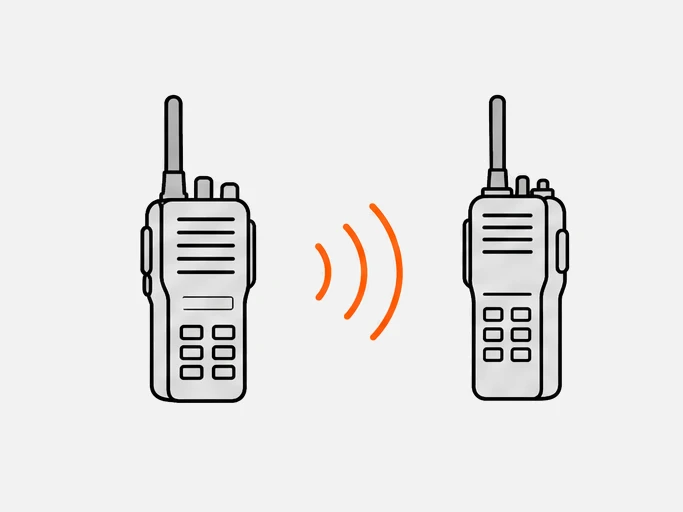
You choose a channel, press the push-to-talk key and speak. Every PMR446 radio in range on that channel hears you. A channel is a single frequency, so only one person talks at a time. The rules allow hand-held radios only, with no base stations, no repeaters and no network.1
See also types of two-way radio and What is a two-way radio?
Do you need a license to use PMR446?
No. In 2015 CEPT, the association of European telecom regulators, told its members to exempt PMR446 radios from individual licensing and to allow free carriage and use.1 Latvia and France confirm no permit and no fee.23 Keep the radio as sold: Latvia bars changing its factory channels.2 More in license-free radios, or check any country in the license checker.
What are the PMR446 channels and frequencies?
Analog PMR446 has 16 channels, spaced 12.5 kHz apart, from 446.00625 to 446.19375 MHz. The CEPT decision fixes the lowest carrier and the spacing but gives no channel numbers, so the table numbers them from the lowest. We calculated the frequencies from those two values.1
| Channel | MHz | Channel | MHz |
|---|---|---|---|
| 1 | 446.00625 | 9 | 446.10625 |
| 2 | 446.01875 | 10 | 446.11875 |
| 3 | 446.03125 | 11 | 446.13125 |
| 4 | 446.04375 | 12 | 446.14375 |
| 5 | 446.05625 | 13 | 446.15625 |
| 6 | 446.06875 | 14 | 446.16875 |
| 7 | 446.08125 | 15 | 446.18125 |
| 8 | 446.09375 | 16 | 446.19375 |
Older analog radios use only channels 1–8, the original analog band of 446.0–446.1 MHz.1
What are digital PMR446, DMR Tier I and dPMR446?
Digital PMR446 sends voice as data in the same band. Two standards apply: DMR Tier I with 12.5 kHz channels on the same 16 frequencies as analog, and dPMR446 with 6.25 kHz channels. The decision names better audio, battery life and short messages as the gains.14
| Mode | Spacing | Channels (calculated) | Lowest carrier, MHz | Standard |
|---|---|---|---|---|
| Analog FM | 12.5 kHz | 16 | 446.00625 | ETSI EN 303 405 |
| DMR Tier I | 12.5 kHz | 16 | 446.00625 | ETSI TS 102 361-1 |
| dPMR446 | 6.25 kHz | 32 | 446.003125 | ETSI TS 102 490 |
dPMR446 channels run from 446.003125 to 446.196875 MHz in 6.25 kHz steps. Digital use of 446.0–446.1 MHz began on 1 January 2018; earlier digital radios use only 446.1–446.2 MHz.1 The DMR Association describes Tier I as license-free, 0.5 W at most, with no repeaters.5
How far does PMR446 reach?
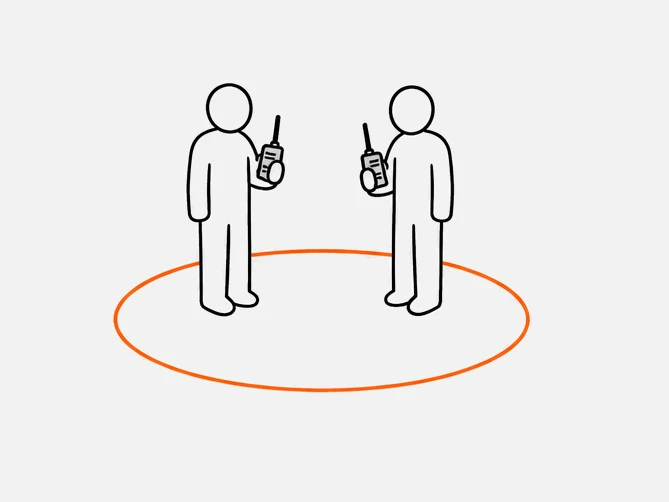
The Latvian spectrum regulator gives a few hundred meters in town and up to a few kilometers in the countryside.2 Power and antenna are fixed by the rules, and digital modes improve quality out to the range limit "rather than greater absolute range".1 Manufacturers publish higher figures, and they differ:
| Manufacturer document | Range stated |
|---|---|
| Kenwood white paper, 2016 | Up to 6 km (3.7 mi), depending on terrain and environment6 |
| Uniden PMR446HR-2CK manual | Up to 10 km (6.2 mi) on the cover, up to 8 km (5 mi) in the specifications7 |
A rare weather pattern can carry a signal much farther. On August 5, 2003, a PMR446 user on a former colliery spoil heap in Blyth, on the north-east coast of England, talked for ten minutes with a station near Amsterdam, about 536 km (333 mi) across the North Sea. Tropospheric ducting over the sea made it possible, and he used an ordinary Motorola T6222 handheld. Later that day he reached the same Dutch station again and they talked for almost an hour.12
For longer distances, see long-range walkie-talkies.
What are PMR446 privacy codes (CTCSS and DCS)?
CTCSS and DCS are tones and codes sent with your voice so that a receiver plays the audio only when the code matches. They filter what you hear. They do not scramble the voice, so a radio with the code off still hears the call.87
ETSI lists 39 CTCSS tones, from 67.0 to 250.3 Hz, and 83 DCS codes.8 Makers sell them as privacy codes or sub codes.6 The Uniden manual counts 38 tones and 83 DCS codes, and its OFF setting receives every call, whatever code the sender uses.7
How is PMR446 different from FRS?
FRS is the U.S. license-free service on 22 channels near 462 and 467 MHz. Power (ERP) is 0.5 W on channels 8–14 and 2 W on the rest, with a non-removable antenna. PMR446 sits at 446 MHz, so the two cannot talk to each other.9
| PMR446 (Europe) | FRS (U.S.) | |
|---|---|---|
| Band | 446.0–446.2 MHz | 462.5500–462.7250 and 467.5625–467.7125 MHz |
| Channels | 16 analog, 16 DMR Tier I, 32 dPMR446 | 22, each 12.5 kHz |
| Max power | 0.5 W ERP | 0.5 W ERP on 8–14; 2 W ERP on 1–7 and 15–22 |
| Individual license | None | None10 |
How is PMR446 different from a PoC radio?
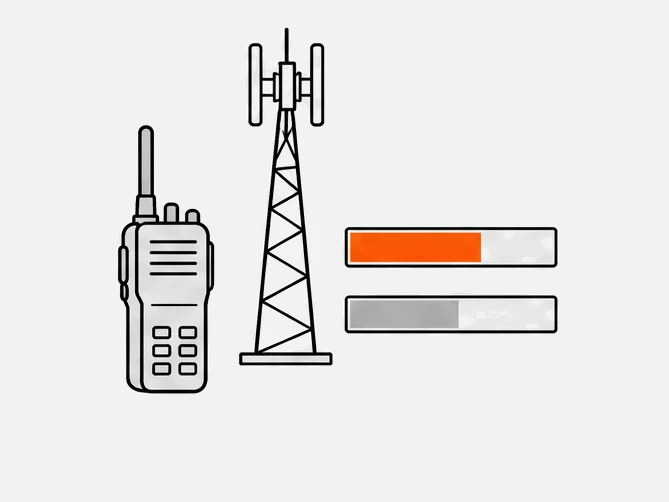
A PMR446 radio talks to other radios directly, needs no network and has no running cost, but reaches a few hundred meters to a few kilometers. A PoC radio sends voice over the mobile network, so it reaches wherever there is coverage, for a monthly fee per user.126
| PMR446 | PoC radio | |
|---|---|---|
| Connection | Radio to radio, one channel | Mobile network and a PTT server |
| Range | A few hundred meters to a few kilometers | Wherever mobile data or Wi-Fi reaches |
| Without signal | Works | No call |
| Running cost | None | Monthly fee per user |
| Choose it for | One site, an event, a trail | Teams spread across a city or country |
More in PoC vs PMR446.
What are the pros and cons of PMR446?
PMR446 needs no license, SIM or subscription and works where mobile signal is patchy. Range is short, though, and everyone nearby shares each channel. On one site, at an event or on a trail that trade works; across a city it does not.
Good at
Questions
What does PMR446 stand for?
PMR is private mobile radio in ETSI's standard; Kenwood's white paper writes personal mobile radio. The 446 refers to the 446 MHz band.46
Can I add a bigger antenna or a booster?
No. The decision allows an integral antenna only, 500 mW ERP at most, and excludes base stations and repeaters.1
Can I use my PMR446 radio in another European country?
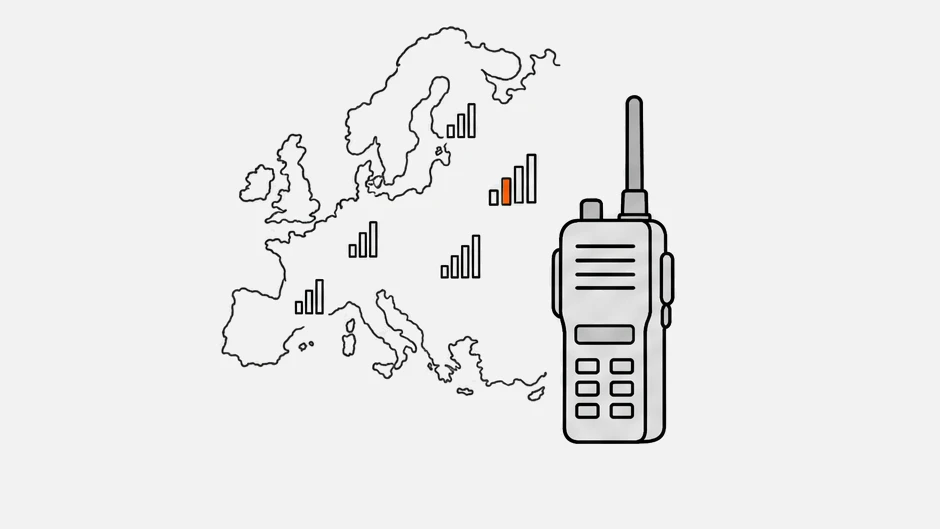
The decision asks all CEPT countries to allow free carriage and use of PMR446 equipment. Check the national rule before you travel.1
Will the PMR446 power limit rise to 1 W?
CEPT is revising the decision to allow 1 W ERP. Its work item lists a public consultation for 30 October 2026 and completion by 26 February 2027. Until a new decision is published, the limit stays 0.5 W.11
Sources
- PMR446 radios, licensing and range (in Latvian) · Elektroniskie sakari, Latvia
- The DMR Standards: Tier I · DMR Association
- PMR446 white paper: a guide to the new PMR446 frequencies (2016) · Kenwood Communications UK
- Uniden PMR446HR-2CK user manual · Uniden (copy hosted by RigPix)
- 47 CFR Part 95, Subpart B: Family Radio Service · eCFR, FCC
Show all 12 sources
- ECC work item FM62_03: PMR446 evolution · CEPT ECC
- Delboy's DX contact UK to Amsterdam, 5 August 2003 · Delboy Enterprises, archived