What is the difference between PoC and DMR?
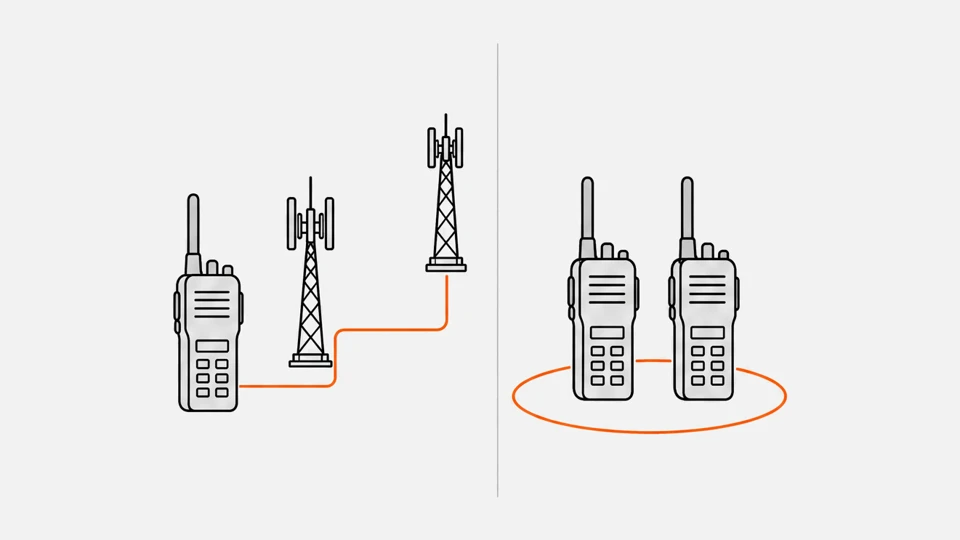
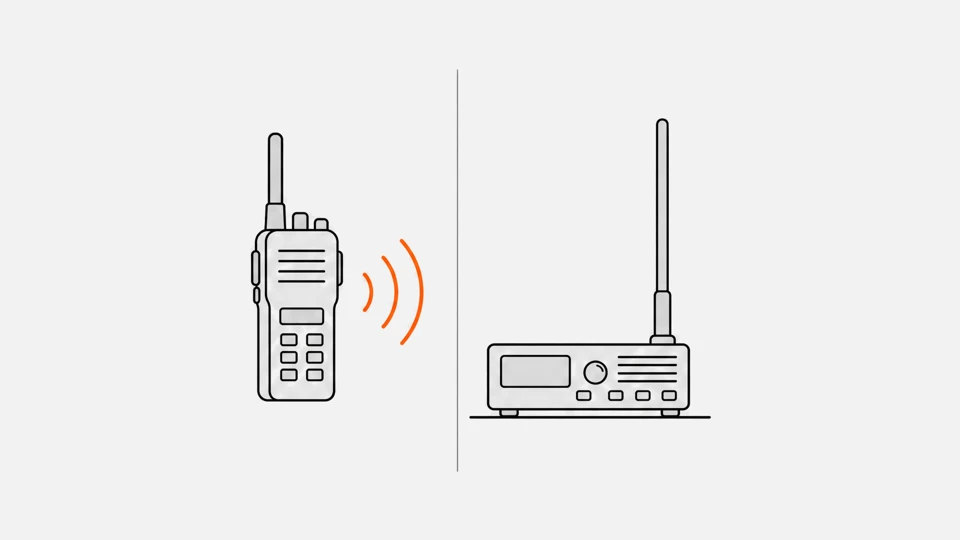
A PoC radio sends your voice as data over the mobile network to a push-to-talk server, so its range follows mobile coverage.1 A DMR radio sends voice on its own 12.5 kHz radio channel, directly or through a repeater. It needs no mobile network, but business channels need a license.2
On Tier II and III, each DMR channel carries two calls in alternating 30 ms time slots.2 See what is a PoC radio and what is DMR.
Choose PoC if…
- Your team works across cities, regions or countries
- Mobile coverage is reliable where your people work
- You want photos and other data alongside voice calls
- You would rather pay a monthly fee per user than hold a radio license and run repeaters
Choose DMR if…
- Your team works in one area, such as a site, a campus or a city
- Calls must work with no mobile network at all
- You can get a business radio license and a repeater site
- You would rather pay license fees and buy equipment than pay a fee per user every month
How do PoC and DMR compare point by point?
PoC reaches as far as mobile coverage and costs a monthly fee per user. DMR reaches as far as its radios and repeaters and costs license fees instead. Zello states PoC delay under a second on 4G; DMR works with no network. The second table adds standards and numbers.
| Criterion | PoC | DMR |
|---|---|---|
| How the voice travels | Over mobile data or Wi-Fi to a server1 | On a radio channel, radio to radio or through a repeater2 |
| Range | As far as mobile data or Wi-Fi reaches | Set by power, antenna and terrain; a repeater extends it23 |
| With no mobile signal | No call | Direct mode still works2 |
| Radio license | Not needed4 | Tier I none; Tiers II and III individual license2 |
| Running cost | €4.50–25 per user per month; a separate data SIM adds more56 | License fees, for example €22 per unit plus €22 in Ireland7 |
| Voice delay | Under 1 second on 4G (Zello)1 | No published figure found |
| Group size | Up to 7,000 users active in one Zello channel8 | Group calls to a talkgroup; one repeater carries two calls93 |
| Data and location | Photos to 300 KB, location every 10 seconds1011 | Short messages of about 1 KB, position reports9 |
Technical details
| Parameter | PoC | DMR |
|---|---|---|
| Standard | Set by the platform; public safety uses 3GPP MCPTT12 | ETSI TS 102 361-1 to -4; Part 1 is V2.7.1, May 202629 |
| Channel and access | LTE data on your operator's bands: B3 (1800 MHz) at 71 and B20 (800 MHz) at 63 of 73 operators in our database13 | 12.5 kHz carrier, two-slot TDMA, 30 ms slots in a 60 ms frame, 4-level FSK at 4,800 symbols per second2 |
| Voice codec | MCPTT requires AMR-WB; EVS is optional14 | Not set in Part 1; DMR Association members agreed on AMBE+29 |
| Data rate | Zello voice: 12–45 kbps while talking10 | One normal burst: 264 bits, 4.4 kbit/s2 |
| Access-time target | MCPTT: under 300 ms for 95% of requests12 | None in Part 1 |
| Tiers | Not applicable | I (446 MHz, 0.5 W, direct), II (direct or repeater), III (trunked)29 |
Which has better coverage, PoC or DMR?
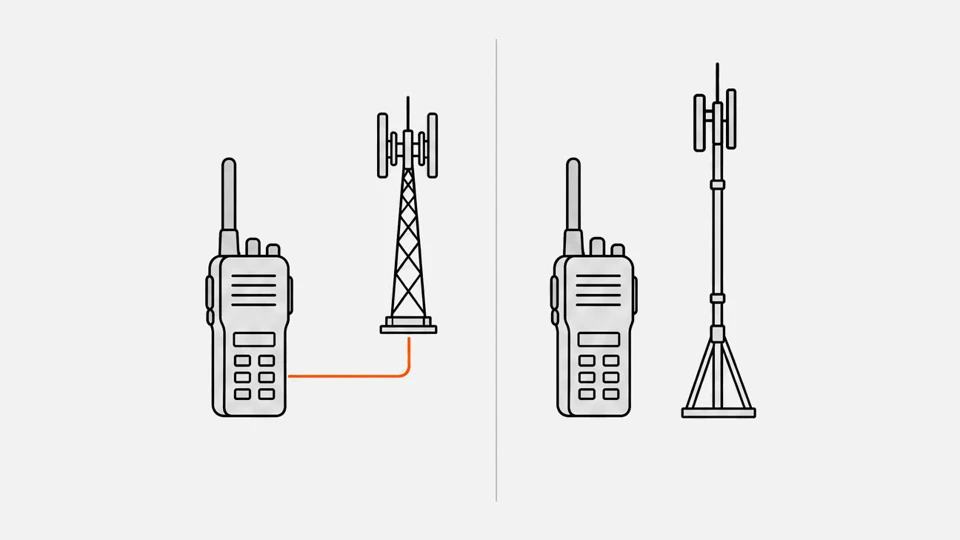
It depends on where the team works. PoC covers every place with mobile data or Wi-Fi, so one group can span a country. DMR covers the area its radios and repeaters reach. ETSI says DMR aims for good quality out to the range boundary, not for much more range than analog.3
A DMR handheld's reach follows its power: Hytera lists 1 W or 4 W on UHF and 1 W or 5 W on VHF for its PDC680,15 while Tier I is capped at 0.5 W with a built-in antenna and no repeater.9 A PoC radio has no such cap, but mobile dead zones stay dead, and the radio must support your operator's LTE bands.13
What happens without mobile signal?
A PoC radio cannot place a call without mobile data or Wi-Fi. DMR radios in direct mode talk to each other with no network at all; ETSI defines direct mode as communication outside the control of a network. Through a repeater, calls depend on that repeater.2
About two thirds of the 291 current PoC models in our database also join Wi-Fi.13
Is PoC slower than DMR?
PoC adds network delay. Zello states under half a second on Wi-Fi, under one second on 4G and two seconds or more on 2G.1 The ETSI documents we read give no DMR call setup time, so we cannot size the gap. A direct DMR call has no server in the path.2
The 3GPP public-safety standard targets under 300 ms to the go-ahead to speak for 95 percent of requests. That is a target, not a measurement of PoC services.12 We have not measured either system.
Which costs less to run?
PoC costs a service fee per user every month; DMR costs license fees and repeaters. PoC plans run from €4.50 to €25 per user per month excluding VAT.56 Ireland's regulator charges €22 per unit plus a fixed €22 for a business radio license.7 The lower total depends on fleet size and term.
- PoC: Zello Work costs $8 (Core) or $15 (Plus) per user per month billed monthly.16 Instavox lists each plan €6–7 cheaper without a SIM.6 Zello reports 70–100 MB per user per month on average.10
- DMR: Latvia's regulator requires a permit for professional PMR radios and sets fees in a price list.17 Repeaters and sites cost extra; we found no official price.
- Ten radios, our arithmetic: Ireland's formula gives 10 × €22 + €22 = €242 for the license term, which ComReg's page does not state. Ten PoC users cost €45–250 every month.
How do group size, dispatch and data differ?
DMR defines individual, group, all-call and broadcast voice calls, and one repeater carries two calls at once. PoC platforms set their own limits: Zello allows up to 7,000 users active in one channel. DMR messages stay near 1 KB; Zello adds photos to 300 KB, live location and a desktop dispatcher app.9381018
DMR short data can use the second slot beside a voice call.9 Zello reports location every 10 seconds by default,11 and its Dispatch Hub, a Windows and macOS app, adds a shared call queue and a map.18
When does a hybrid PoC + DMR radio make sense?
A hybrid radio suits teams that move in and out of mobile coverage: PoC where there is signal, DMR where there is none. Business-channel DMR still needs a license and PoC a service fee.2 In our database, 41 of 291 current models pair LTE with a DMR or analog radio.13
Hytera says its PDC680 registers on its DMR trunking network and on LTE with one ID and switches automatically.15 Telox says the BN500 runs both modes at once, with separate DMR and PoC keys.19 A gateway is another bridge: Instavox offers one linking DMR and its LTE service both ways.20 These are manufacturer claims.
Which radio type fits your team?
Pick PoC when people are spread across regions and mobile coverage holds. Pick DMR when one area needs calls that never depend on a network. If both apply, consider a hybrid radio or a gateway. See types of two-way radio for the rest.
For license-free radios, read PoC vs PMR446 and PMR446. Hybrid models are in the radio catalog, and the radio type tool narrows the choice.
Questions
Can a PoC radio talk to a DMR radio?
Not directly. A gateway can bridge a PoC group and a DMR channel; Instavox, for example, offers one that works both ways.20 A hybrid radio holds both links in one case.
Do PoC radios need a license?
No. The radio uses the mobile operator's network, so you need a SIM and a PTT service. Latvia's regulator lists purchase checks such as CE marking and a declaration of conformity, but no permit.4
Sources
- What is the current latency? · Zello Work Help Center
- Mobile 3G/4G/5G devices: what to check before buying (in Latvian) · Elektroniskie sakari, Latvia
- PoC Me plans (in French) · PoC Me
- Instavox plans (in French) · Instavox
- Business Radio licensing · ComReg, Ireland
- Overview of Zello Work · Zello Work Help Center
- How much data bandwidth does the app use? · Zello Work Help Center
Show all 20 sources
- How can I minimize battery impact from location tracking? · Zello Work Help Center
- Radio specifications and LTE bands of 73 operators in 22 countries · poc-radio knowledge base
- PDC680 dual-mode rugged radio · Hytera
- Zello Work pricing · Zello
- Professional PMR radios and permits (in Latvian) · Elektroniskie sakari, Latvia
- Getting started as a dispatcher: Dispatch Hub · Zello Work Help Center
- Radio network gateway (in French) · Instavox