What is PPDR?
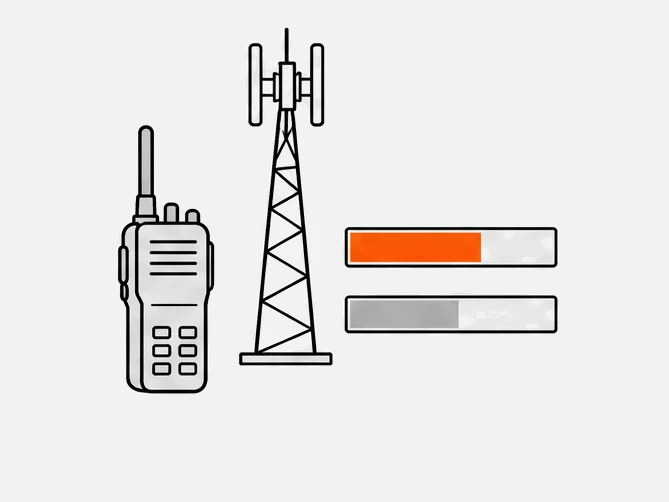
PPDR stands for public protection and disaster relief. The ITU defines public protection radio as radio used by agencies responsible for law and order, protection of life and property and emergencies, and disaster relief radio as radio used by agencies dealing with a serious disruption of the functioning of society.1
The same ITU resolution says PPDR systems mainly carry narrowband and wideband voice and data, that the need for broadband is growing, and that some commercial terrestrial and satellite systems already complement the dedicated ones.1 Those three threads, narrowband, broadband and commercial networks, run through the rest of this page.
Which radio systems do emergency services use?
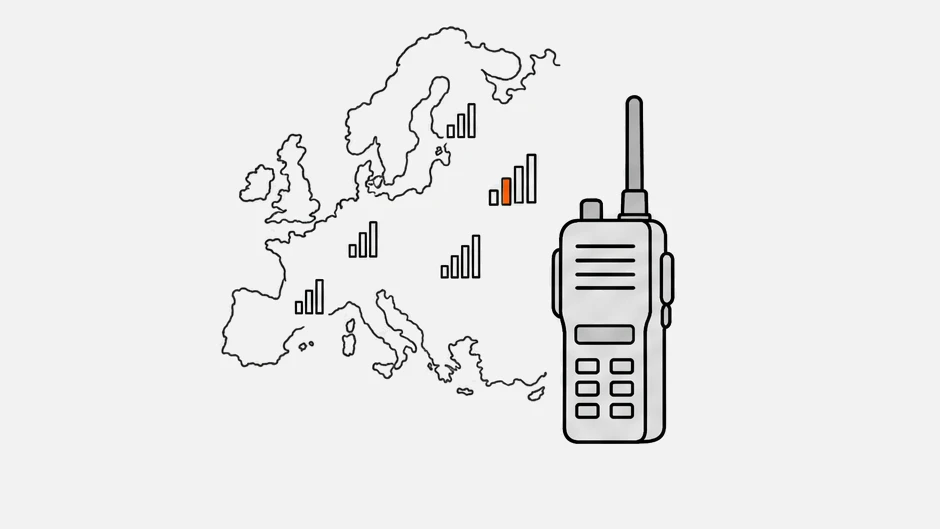
Most emergency services talk on dedicated digital narrowband networks. Europe mainly uses TETRA, an ETSI standard with four channels on each 25 kHz carrier, and TETRAPOL, which Airbus lists as nationwide in six countries. North America uses P25, a suite of more than 80 standards documents published by TIA.234
| System | Standard | How a radio channel is shared | Where it runs |
|---|---|---|---|
| TETRA | ETSI EN 300 3922 | TDMA, 4 physical channels per 25 kHz carrier2 | Europe and many other regions; see What is TETRA? |
| TETRAPOL | TETRAPOL Forum specifications, sold by Airbus3 | One channel per carrier (FDMA), 12.5 or 10 kHz depending on the project; see TETRA and TETRAPOL22 | Nationwide networks in Switzerland, the Czech Republic, Spain, Slovakia, Mexico and France3 |
| P25 (Project 25) | TIA-102 suite, over 80 documents45 | Phase 1: FDMA, one transmission per channel. Phase 2: TDMA, two per channel, trunked only4 | North America; the US SAFECOM program backs it for interoperability6 |
| DMR | ETSI TS 102 361 | TDMA, 2 slots per 12.5 kHz | Business and industry more than emergency services |
Narrowband is built for voice and short data. CEPT notes that ECC Report 199, approved in May 2013, set out the user requirements and spectrum needs for European broadband PPDR, and its decision plans for administrations that need 2×10 MHz for it.7
How do commercial networks carry public safety traffic?
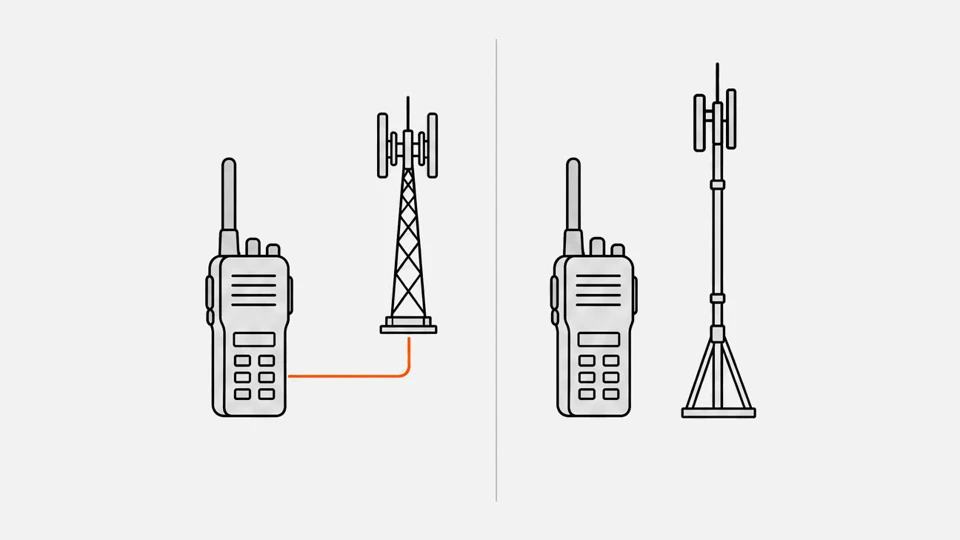
A commercial 4G or 5G network can carry public safety traffic if it gives responders priority. CEPT names three models for broadband PPDR: a dedicated network, a commercial network serving both PPDR and ordinary users, or a hybrid of the two. Finland, the UK, France and the US all build on commercial operators.79111213
| Country | Network | Commercial operator | Where it stands |
|---|---|---|---|
| Finland | Virve 2 | Elisa's radio network as a service, Ericsson core; 10-year contract announced April 20208 | Ready for use, June 20259 |
| United States | FirstNet | AT&T, 25-year contract awarded March 2017; 20 MHz allocated by law in 201210 | Band 14 build-out launched nationwide and the FirstNet Core delivered in March 201810 |
| United Kingdom | Emergency Services Network (ESN) | EE/BT Mobile Services provides the coverage11 | Will replace Airwave, today's TETRA network; Airwave to close when it is safe to do so11 |
| France | Réseau Radio du Futur (RRF) | Bouygues Telecom and Orange 4G/5G, with national roaming on Free and SFR12 | Run by ACMOSS, an agency of the Interior Ministry12 |
Priority is the part that makes a shared network usable in an emergency. In Finland, Virve users' traffic is temporarily prioritized in Elisa's networks during an emergency.9 The UK business case says ESN adds priority and pre-emption so emergency services keep network access during congestion.11 FirstNet lists priority and preemption among the functions of its core.13
In LTE these rules have names. Each bearer carries an Allocation and Retention Priority (ARP) with a level from 1 to 15 and flags for whether it may pre-empt others or be pre-empted. 3GPP also defines traffic classes for push-to-talk:14
| QoS class (QCI) | Used for | Priority | Delay budget |
|---|---|---|---|
| 65 | Mission-critical push-to-talk voice (MCPTT) | 0.7 | 75 ms |
| 69 | Mission-critical signaling (MCPTT, MCVideo) | 0.5 | 60 ms |
| 66 | Non-mission-critical push-to-talk voice | 2 | 100 ms |
What is a hybrid public safety network?
A hybrid network joins a dedicated professional radio network, such as TETRA, with commercial mobile networks, so each carries the traffic it handles best. The EU-funded HELP project studied this in 2011–2012, looking for synergies between commercial and PMR networks in emergencies, and ETSI took it up as a network-sharing use case.1516
HELP ran from 1 February 2011 to 30 April 2012 under the EU's security research program, coordinated by the Universitat Politècnica de Catalunya in Spain. It cost €1.35 million, of which the EU paid €0.99 million.15
ETSI's TR 102 970 (January 2013), part of its Reconfigurable Radio Systems work, which also covers cognitive radio, collects use cases for sharing spectrum and networks among public safety, commercial and military users. Its scope is non-mission-critical operations, and it summarizes HELP as network sharing between PMR and commercial cellular networks.16
The EU later funded BroadWay (2018–2023), a pre-commercial procurement coordinated by the Public Safety Communication Europe Forum, to develop technologies for a pan-European interoperable broadband system for PPDR. It cost €13.1 million, €11.8 million of it from the EU.17
What is MCPTT?
MCPTT, mission-critical push-to-talk, is the 3GPP standard for push-to-talk over LTE and 5G, completed in March 2016 in Release 13. It sets targets such as access time under 300 ms for 95% of requests and mouth-to-ear delay under 300 ms, and it includes a direct mode between devices.1819
| MCPTT target (TS 22.179) | Value |
|---|---|
| Access time | Under 300 ms for 95% of requests; 99% for emergency and imminent-peril group calls19 |
| End-to-end access time | Under 1,000 ms19 |
| Mouth-to-ear latency | Under 300 ms for 95% of voice bursts19 |
In off-network mode, devices talk over a direct path that does not cross the network infrastructure. The standard is meant for public safety and also for commercial users such as utilities and railways.19 Mission-critical data and video followed in Release 14.18 The basics of floor control are in what is push-to-talk.
TETRA and P25 do not switch off overnight. 3GPP TS 23.283 defines how mission-critical systems interwork with land mobile radio through an interworking function, covering MCPTT and short data.20 More on the TETRA side is on the TETRA page.
Where do PoC radios fit in public safety?
A PoC radio runs push-to-talk as a service over ordinary mobile data. That suits teams whose calls are not mission critical. 3GPP gives non-mission-critical push-to-talk voice its own traffic class, QCI 66, and FirstNet lets agencies run push-to-talk apps with their own talk groups and links to land mobile radio.1421
The FirstNet Authority describes a police department that used app talk groups to keep its operational LMR channels clear.21 ETSI's network-sharing work, too, is scoped to non-mission-critical operations.16 Mission-critical voice stays on TETRA, TETRAPOL, P25 or MCPTT with network priority.
For the radio itself, see what is a PoC radio?, and for the trade-offs against a dedicated radio network, PoC vs DMR. Some push-to-talk platforms, such as TASSTA, bridge app users to TETRA, DMR and P25 networks.
Questions
What frequencies does broadband PPDR use in Europe?
CEPT's ECC/DEC/(16)02 sets conditions for broadband PPDR in the 700 MHz range, including 698–703/753–758 MHz and 733–736/788–791 MHz, and in the 400 MHz range, for example 450.5–456/460.5–466 MHz, with LTE channels of 1.4, 3 or 5 MHz.7
What is FirstNet?
FirstNet is the US public safety broadband network. A 2012 law allocated it 20 MHz of spectrum; in March 2017 the FirstNet Authority awarded AT&T a 25-year contract, and in March 2018 the Band 14 build-out launched nationwide.10 Priority and preemption are among its core functions.13
What is the UK Emergency Services Network?
ESN is the UK program that will replace Airwave, the TETRA network of Britain's emergency services. Its coverage comes from EE/BT, and it adds priority and pre-emption so the emergency services keep access when the network is congested.11
Can TETRA radios talk to MCPTT users?
Through an interworking function. 3GPP TS 23.283 specifies how mission-critical systems interwork with land mobile radio systems such as TETRA and P25 for push-to-talk and short data.20 Bridges from push-to-talk platforms to TETRA also exist.
Do PoC radios get priority on public safety networks?
Not by default. 3GPP separates mission-critical push-to-talk (QCI 65) from non-mission-critical push-to-talk voice (QCI 66), which has a lower priority and a longer delay budget.14 Priority on a national network such as Virve 2 or ESN belongs to the services entitled to it.911
Sources
- TETRAPOL · Airbus
- P25 frequently asked questions, version 1.9 (2025) · P25 Technology Interest Group
- P25 TIA standards accepted, April 2025 · P25 Steering Committee
- SAFECOM: Project 25 · CISA
- History of FirstNet · FirstNet Authority
Show all 22 sources
- Emergency Services Network: summary business case, 27 July 2026 · UK Home Office
- Réseau Radio du Futur (in French) · ACMOSS, French Interior Ministry
- Three years of public-private partnership for public safety's network · FirstNet Authority
- BroadWay: pan-European interoperable broadband mobile system for PPDR, project 786912 · CORDIS, European Commission
- Mission critical services · 3GPP
- Early benefits of FirstNet: collaboration and push-to-talk apps · FirstNet Authority
- TETRAPOL PAS 0001-2 v3.0.0: Radio Air Interface · TETRAPOL Forum, hosted by Airbus