What is cognitive radio?
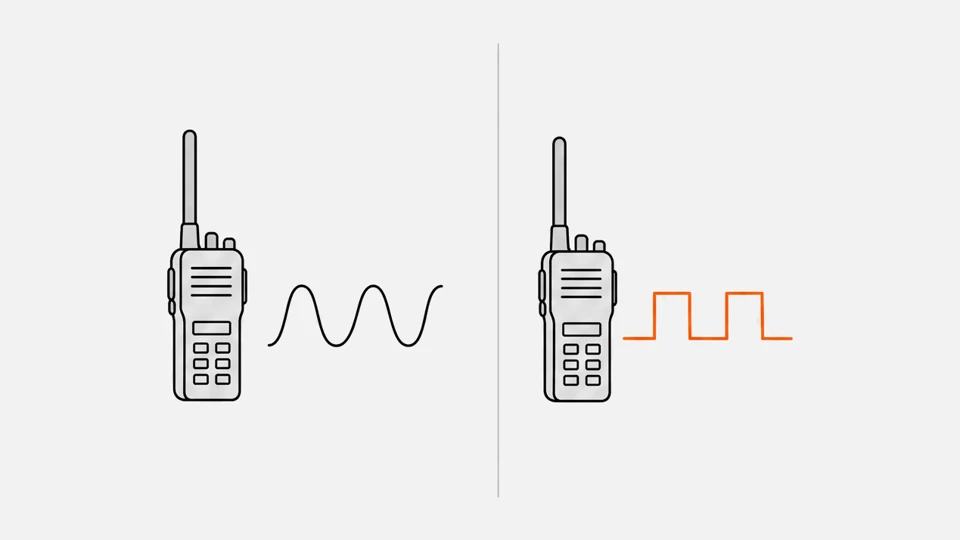
Cognitive radio is a radio system that knows its operating and geographic environment, the rules it must follow and its own state, and adjusts itself to them. ITU-R set this definition in Report SM.2152 in 2009, next to its definition of software-defined radio, which cognitive radio builds on.1
The ITU wording adds that the system adjusts its parameters dynamically and autonomously and learns from the results.1 Software-defined radio is the hardware side of the idea: a radio whose frequency range, modulation or output power can be set or changed by software. A cognitive radio decides on those settings itself.
| Software-defined radio | Cognitive radio system | |
|---|---|---|
| What it is | A transmitter or receiver whose RF parameters are set or changed by software1 | A radio system that learns its environment, the rules and its own state1 |
| What it can change | Frequency range, modulation type, output power1 | The same parameters and protocols, chosen from what it has learned1 |
| Who decides | The operator or user who loads the settings | The radio system, dynamically and autonomously1 |
The term comes from Joseph Mitola III and Gerald Maguire of KTH in Stockholm, who described it in a 1999 IEEE article as a software radio that reasons about its radio environment.2 Simon Haykin's 2005 paper set two goals for it: reliable communication whenever and wherever needed, and efficient use of the radio spectrum.3
How does a cognitive radio find free spectrum?
A cognitive radio looks for spectrum holes: channels assigned to a primary user but idle at a given time and place. It finds them by sensing the band, by asking a geolocation database which channels are free, or both. A secondary user then transmits there without disturbing the license holder.34
Haykin splits the work into three tasks: analyzing the radio scene, estimating the state of the channel, and controlling transmit power together with dynamic spectrum management.3 He also quotes the FCC's 2002 Spectrum Policy Task Force, which found that access to spectrum was a bigger problem than physical scarcity.3
In practice, regulators have leaned on databases. In 2010 the FCC finalized its TV white space rules with devices that find their location and look up the unused channels in a database, and it dropped the requirement for such devices to sense TV signals as well.4
Where is cognitive radio used today?
The clearest real uses are TV white spaces and CBRS. White space devices pick idle TV channels from a database, under FCC rules from 2008 and 2010, UK rules from 2015 and ETSI EN 301 598. In the US, a Spectrum Access System shares the 3,550–3,700 MHz CBRS band among three tiers of users.4578
| System | Band | How it finds free spectrum | Since |
|---|---|---|---|
| TV white spaces, US | Unused TV channels | Geolocation and a database lookup4 | 2008, final rules 20104 |
| TV white spaces, UK | 470–790 MHz | A master device queries an approved database; slave devices take their settings from the master5 | December 20155 |
| IEEE 802.22 (rural wireless broadband) | TV bands, 54–862 MHz | Cognitive radio policies and procedures written into the standard6 | July 20116 |
| ETSI EN 301 598 (Europe) | 470–790 MHz | Devices controlled by a TV white space database7 | January 20187 |
| CBRS, US | 3,550–3,700 MHz | A Spectrum Access System coordinates three tiers8 | September 20199 |
CBRS is the most developed case. The FCC calls the Spectrum Access System an advanced, highly automated frequency coordinator. Incumbents come first: authorized federal users, such as Defense Department radar, and grandfathered satellite earth stations.8 Priority Access licensees get a 10 MHz channel in one census tract for three years within up to 70 MHz, and General Authorized Access users may work across the whole 150 MHz.8 In January 2020 the FCC certified CommScope, Federated Wireless, Google and Sony to run Spectrum Access Systems commercially.9
What are opportunistic networks?
An opportunistic network is a temporary, coordinated extension of an operator's infrastructure, created on demand among nearby devices and network elements and released when it is no longer needed. The EU research project OneFIT (2010–2012) studied how cognitive management systems decide when to form such a network, then create, maintain and release it.1011
OneFIT ran from 1 July 2010 to 31 December 2012 under the EU's Seventh Framework Programme, coordinated by the University of Piraeus Research Center. It cost €6.77 million, of which the EU paid €3.97 million.10 Its aim was to use network resources better while cutting transmission power, energy use and the total cost of ownership.10
In the project's own papers, an opportunistic network can include terminals organized without infrastructure as well as parts of the operator's network, and the cognitive management systems that run it have self-management and learning functions.11
ETSI studied the same family of ideas as Reconfigurable Radio Systems. Its 2009 summary covered software-defined radio and cognitive radio and set up a working group on public safety among others.12 How emergency services combine their own radio networks with commercial ones is the subject of public safety radio.
How this relates to PoC radio
A PoC radio does not hunt for free spectrum. It is an LTE device on a mobile operator's licensed bands, and push-to-talk runs as a service on top. That is why the LTE band checker compares a radio's bands with each operator's, and why 4G LTE walkie-talkies are judged by them.
The smart parts of a mobile network sit on the network side. 3GPP's self-organizing network (SON) features, first introduced in Release 8, automate how operators manage their networks.13 LTE Release 13 added licensed-assisted access (LAA), where LTE also uses unlicensed spectrum and listens before it talks to share the band fairly with Wi-Fi.14
CBRS does reach some push-to-talk devices. In our database, 6 of the 291 current models list LTE Band 48, which 3GPP defines as 3,550–3,700 MHz TDD, the CBRS range: five PTT phones from Hytera and Sonim and one handheld, the Point Mobile PM95.1516 Elsewhere, the bands are fixed by the operator's license.
Questions
Is cognitive radio the same as software-defined radio?
No. ITU-R defines a software-defined radio as one whose RF parameters, such as frequency range, modulation and output power, are set or changed by software. A cognitive radio system goes further: it learns its environment, the rules and its own state, and adjusts itself.1
Who invented cognitive radio?
Joseph Mitola III and Gerald Maguire of KTH in Stockholm introduced the term in IEEE Personal Communications in 1999.2 Simon Haykin's 2005 paper in the IEEE Journal on Selected Areas in Communications set out its tasks, from radio-scene analysis to dynamic spectrum management.3
Do white space and CBRS devices need a license?
White space devices in the US work as unlicensed devices that follow a database,4 and the UK exempts them from licensing under its 2015 regulations.5 In CBRS, Priority Access is licensed per census tract, while General Authorized Access needs no individual license but follows the Spectrum Access System.8
Sources
- IEEE 802.22-2011: Cognitive wireless RAN MAC and PHY specifications for operation in the TV bands · IEEE Standards Association
Show all 16 sources
- Radio specifications of current PoC radio models · poc-radio knowledge base