What is a two-way radio?
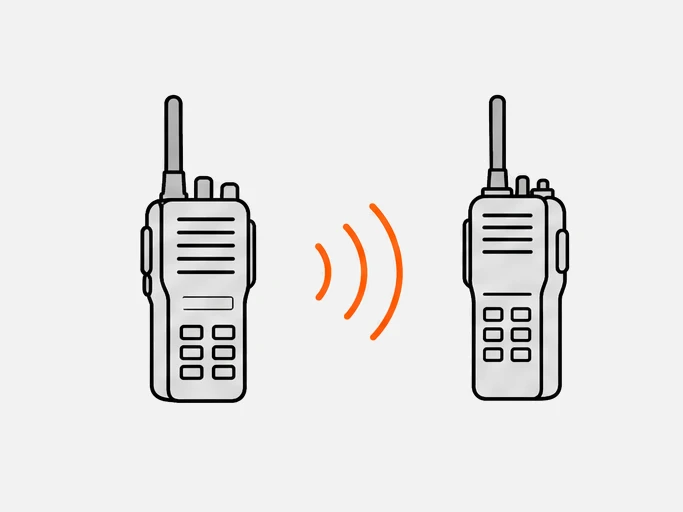
A two-way radio is a radio that transmits and receives voice, so people on one channel can hold two-way communication with each other instead of only listening. U.S. rules define the land mobile service as communication between base stations and mobile stations, or between mobile stations.1
Radios come as handhelds, mobile radios made for use in motion, such as vehicle radios, and base stations at a fixed site.2 A handheld is a small mobile station you operate while holding it.2
How does a two-way radio work?
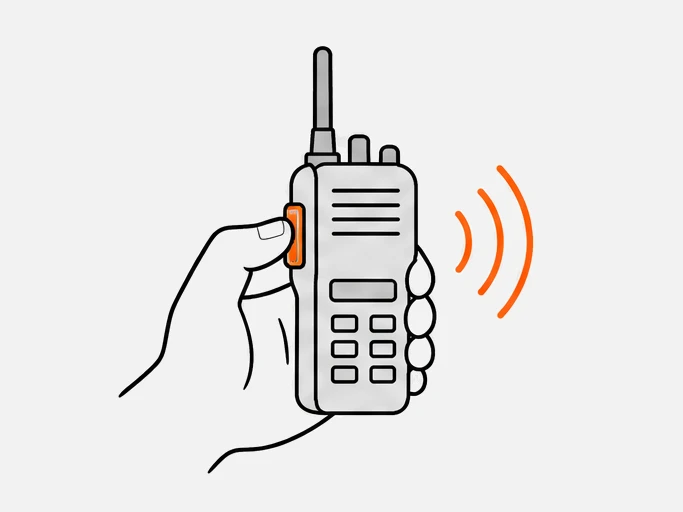
You press the push-to-talk (PTT) key, the radio switches from receiving to transmitting, and every radio tuned to the same channel hears you. When you let go, it returns to receiving. Engineers call this simplex operation: transmission alternates between directions, here by manual control.1
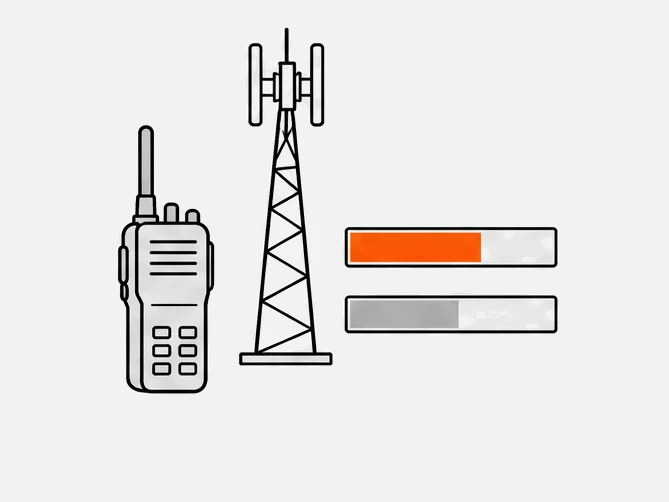
Radios can talk in two ways. In direct mode, one frequency carries the call straight between radios, so range depends on power, antenna and terrain. Through a repeater, a fixed station on high ground receives on one channel and retransmits on another, usually at higher power.2 DMR calls these peer-to-peer and repeater modes.3
Analog radios send voice as a radio wave that follows your voice. Digital radios such as DMR convert it to data first. DMR tier II and III radios use two time slots on a 12.5 kHz channel.3
What types of two-way radio are there?
Two-way radios differ in how the call travels. License-free handhelds such as PMR446 and FRS talk radio to radio over short distances. Business radios add licensed channels and repeaters. Network radios, PoC over mobile data and satellite push-to-talk, carry the call over a network instead.
| Type | How the call travels | License | Limits |
|---|---|---|---|
| PMR446 (Europe) | Radio to radio, 446.0–446.2 MHz | None4 | 0.5 W ERP, built-in antenna, no repeaters4 |
| FRS (US) | Radio to radio, 22 channels near 462 and 467 MHz | None2 | 2 W ERP on channels 1–7 and 15–22, 0.5 W on 8–14; fixed antenna2 |
| GMRS (US) | Radio to radio or through a repeater | Individual FCC license, 10-year term2 | Up to 50 W on main channels for mobile, repeater and base stations2 |
| Business radio, analog or DMR | Radio to radio or through a repeater | Individual license; FCC terms run up to 10 years56 | Range set by power, antenna and terrain |
| PoC | Mobile data network and a PTT server | None; it uses the operator's network7 | Needs mobile or Wi-Fi signal and a PTT service |
| Satellite PTT | Satellite network instead of ground towers | Varies by country and provider | Group calls, one speaker at a time8 |
The types of two-way radio guide covers each one in detail.
Is a walkie-talkie a two-way radio?
Yes. A walkie-talkie is a handheld two-way radio, and the FCC describes the consumer Family Radio Service as two-way voice communication between low-power hand-held radios.2 In everyday use, walkie-talkie usually means a consumer handheld, and two-way radio covers the whole family, including vehicle and base radios.
See two-way radio vs walkie-talkie for how the two names differ in use.
Do two-way radios need a license?
It depends on the radio and the country. PMR446 handhelds in CEPT countries and FRS handhelds in the US need no individual license. GMRS in the US needs an FCC license, and business channels need a license from the national regulator.426
National rules add conditions. In Latvia, PMR446 users must keep the factory channels, and professional radios must not be reprogrammed to act as PMR446 sets.9 A US GMRS license also lets the licensee's immediate family operate the station.2
What are the pros and cons of a two-way radio?
A two-way radio reaches a whole group with one key press and needs no mobile network. PMR446 and FRS sets need no license. The trade-offs are short range on those sets, one speaker at a time and a license on business channels.
Good at
Is a PoC radio a two-way radio?
Yes. A PoC radio has a push-to-talk key and group calls like any two-way radio, but it sends voice as data over a mobile network to a PTT server, not on its own frequency. Range follows mobile coverage, and on 4G the voice usually arrives in under a second.10
Some radios combine both: 41 of the 291 current models in our database pair LTE with DMR or analog radio.11 A PoC app can also reach radio users through a gateway; Zello lists third-party gateways that link it to radio networks.12
Read What is a PoC radio?, the guide to 4G LTE walkie-talkies, and the comparisons PoC vs DMR and PoC vs PMR446. To see which radios fit your operator's LTE bands, use the LTE band checker or browse the radio catalog.
Questions
What does two-way mean in a two-way radio?
The radio can both transmit and receive. Most two-way radios take turns, one direction at a time, which rules call simplex operation. A phone call is duplex: both sides can talk at once.1
How far can a two-way radio talk?
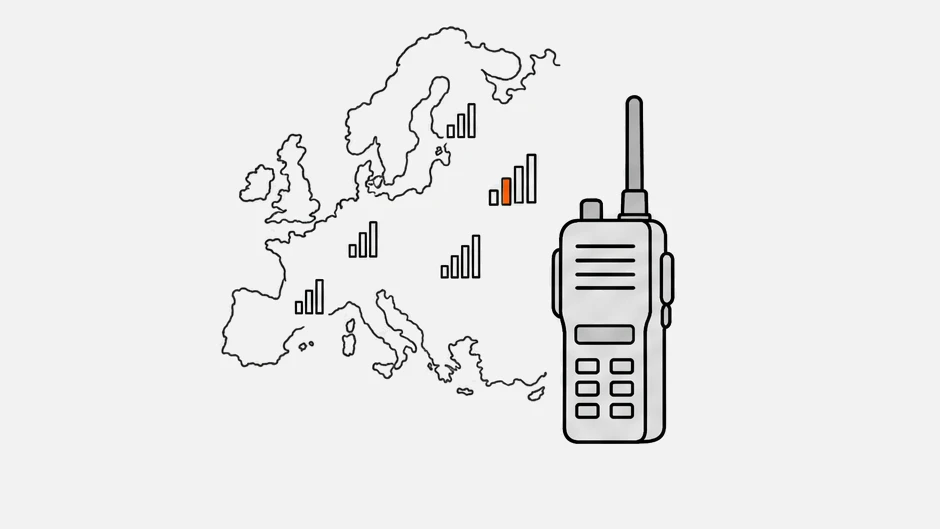
It depends on the type. PMR446 handhelds reach a few hundred meters in town and up to a few kilometers in the countryside.9 A repeater extends the range of licensed radios,2 and a PoC radio reaches as far as mobile coverage.10
Do two-way radios work without cell service?
Radio-to-radio types do. PMR446 and FRS handhelds talk directly and need no mobile network.42 PoC radios need mobile data or Wi-Fi; hybrids with DMR or analog fall back to direct radio.11
Can a two-way radio talk to a phone?
Not directly. A PoC app or a radio gateway can bridge the two, and Zello lists gateways for this.12
Can a business use license-free two-way radios?
In the US, yes: FRS rules name business activities among the permitted uses, within the 2 W power limit.2
Sources
- 47 CFR 2.1: Terms and definitions · eCFR, U.S. Federal Communications Commission rules
- 47 CFR Part 95: Personal Radio Services (§§ 95.303, 95.305, 95.503, 95.567, 95.587, 95.1705, 95.1767) · eCFR, U.S. Federal Communications Commission rules
- 47 CFR 90.149: License term · eCFR, U.S. Federal Communications Commission rules
- Professional PMR radios and permits (in Latvian) · Elektroniskie sakari, Latvia
- Mobile 3G/4G/5G devices: what to check before buying (in Latvian) · Elektroniskie sakari, Latvia
- Defining Satellite Push-to-Talk (PTT) · Iridium
- PMR446 radios, licensing and range (in Latvian) · Elektroniskie sakari, Latvia
- What is the current latency? · Zello Work Help Center
Show all 12 sources
- Radio specifications and LTE bands of 73 operators in 22 countries · poc-radio knowledge base
- Radio gateways for Zello · Zello