How does a PoC radio work?
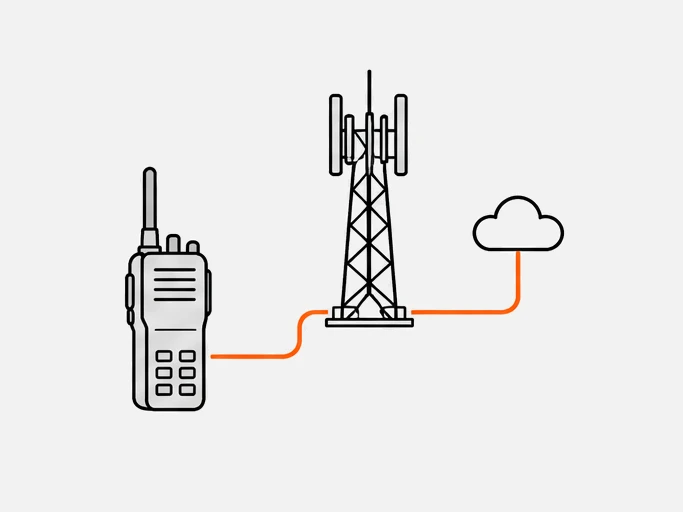
You press the push-to-talk key and speak. The radio turns your voice into data and sends it over the mobile network to a PTT server, which passes it to every radio in your group, usually within a second. When you let go, the channel is free for the next person.1
Because the network carries the call, a PoC radio has no range of its own. A dispatcher in Berlin and a driver in Munich can share one group, as long as both radios have a mobile or Wi-Fi connection. Public-safety networks use a 3GPP standard for the same idea, mission-critical push-to-talk (MCPTT).2
How is a PoC radio different from other two-way radios?
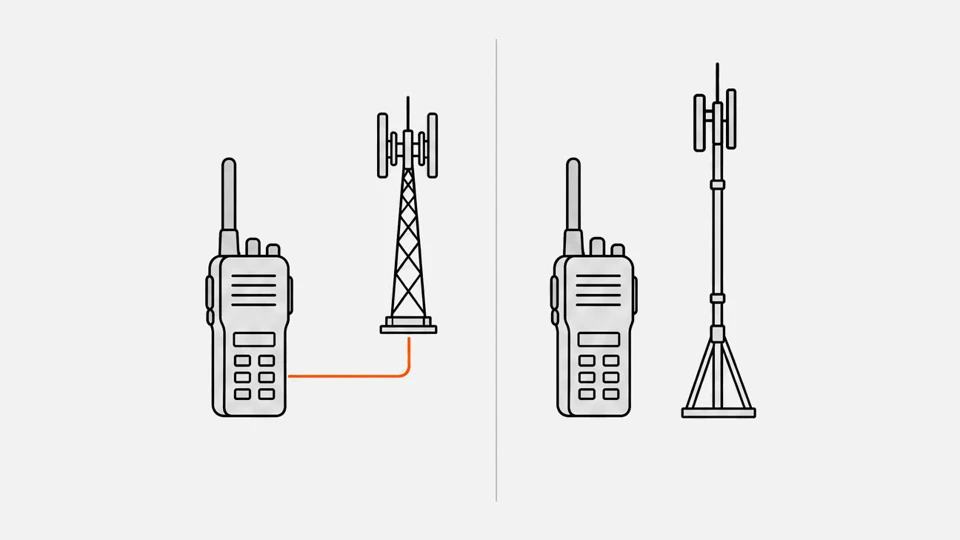
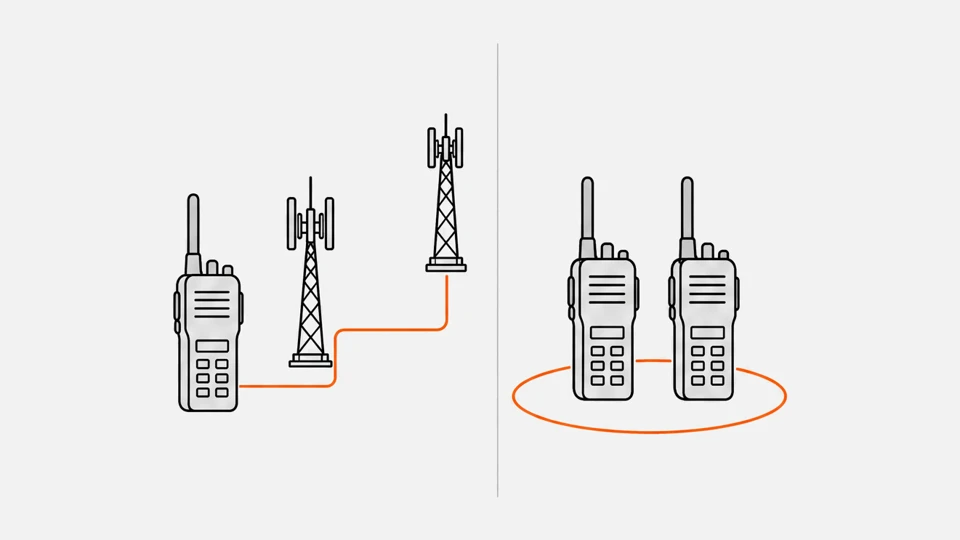
Classic two-way radios talk to each other directly on their own frequency, so range depends on power, antennas and terrain. A PoC radio swaps that for the mobile network and a PTT server. It has no range limit of its own, needs no radio license and costs a monthly fee per user.
| Radio type | Range | License | What you need | Running cost |
|---|---|---|---|---|
| PoC / 4G LTE | Wherever there is mobile data or Wi-Fi | Not needed | Radio, SIM, PTT service | About €5–25 per user per month |
| PMR446 | A few hundred meters in town, up to a few km in open country3 | Not needed in the EU4 | Radios only | None |
| DMR | Radio to radio; a repeater extends it | Needed on business channels5 | Radios, plus a repeater for wide coverage | License fees |
| Analog UHF/VHF | Radio to radio; set by power, antenna and terrain | Needed on business channels6 | Radios | License fees |
| TETRA | Coverage of the TETRA network | Access from the network operator | TETRA radios and a network contract7 | Contract fee |
| Satellite PTT | Wherever the satellite network covers | Set by the provider and the country | Satellite handset and a service plan8 | Service plan |
PMR446 radios need no network and no license fee, but the rules cap them at 0.5 W with a built-in antenna and no repeaters, so range stays short.4 A DMR radio can also run on PMR446 channels (DMR Tier 1) within the same limits.4 Hybrid radios put both in one case: 41 of the 291 current models in our database combine LTE with a DMR or analog radio.9 See also PoC vs PMR446 and PoC vs DMR.
What are the pros and cons of a PoC radio?
A PoC radio reaches as far as mobile coverage, needs no radio license and adds location, messages and dispatch. It stops working without signal, costs a monthly fee per user and has a short delay that direct radios do not have. Whether that trade is worth it depends on where your team works.
Good at
- A team can talk across a country or between countries: range is the mobile network, not the radio.
- No radio license: the call uses the operator's network, so you need a SIM and a PTT service.10
- Group calls, private calls, location and messages on one device.
- Dispatchers can listen and talk from a browser or a desktop app.
Weak at
- No signal, no call: basements and remote valleys can be dead zones.
- A monthly service fee. In October 2026 published plans ran from €4.50 (PoC Me) to €25 (Instavox) per user per month excluding VAT, and $8–15 on Zello Work; a data SIM may cost extra.111213
- A short delay before the voice arrives: Zello states under 1 second on 4G and 2 seconds or more on 2G.1
- The radio must support your operator's LTE bands: 177 of 237 current models with a published band list include B20 (800 MHz), which 63 of 73 operators in our database use.9
What do you need to use a PoC radio?
You need four things: a PoC radio or a phone with a push-to-talk key, a SIM card with mobile data, a PTT service that carries the calls and, if someone coordinates the team, a dispatcher console. The radio must support the LTE bands of your mobile operator.
- A PoC radio or a phone with a PTT keyAbout two thirds of the 291 current models in our database run Android and a PTT app; others use a closed system from their maker.9
- A SIM card with mobile dataVoice uses little data: Zello reports 12–45 kbps while you talk and 70–100 MB per user per month on average.14
- A PTT serviceThe app and server that carry the calls, such as Privox, RealPTT, TASSTA, WalkieFleet or Zello.
- A dispatcher console, if someone coordinates the teamA desktop or browser app to see the group, listen and talk.
Will a PoC radio work in your country?
Yes, if the radio supports at least one LTE band your mobile operator runs. B3 (1800 MHz) is in use at 71 of the 73 operators in our database and B20 (800 MHz) at 63. Pick a country and a radio to check the match.9
Questions
What does PoC mean?
PoC stands for push-to-talk over cellular: you press a key, talk, and your voice travels as data over a mobile network. It is also written PTT over cellular.
What is a cellular radio?
"Cellular radio", "network radio" and "4G LTE walkie-talkie" are other names for a PoC radio. A phone with a PTT app does the same job; the radio usually adds a hardware push-to-talk key and a rugged case.
Do PoC radios need a license?
No. A PoC radio uses the mobile operator's network and spectrum, so you need a SIM and a PTT service, not a radio license. Latvia's spectrum regulator, for example, lists purchase checks such as CE marking and a declaration of conformity for devices on mobile networks, but no permit.10
How far can a PoC radio talk?
As far as the mobile network reaches. Two radios with signal can talk across a country, or between countries if the SIM can roam; the limit is coverage at each end, not distance.
Can a PoC radio talk to an ordinary walkie-talkie?
Not directly. A radio gateway connected to both systems can bridge a PoC group to a radio channel; Zello, for example, lists gateways that link its channels to two-way radios.15
Does it work without mobile signal?
Many PoC radios also connect over Wi-Fi: 187 of the 291 current models in our database list it. With neither mobile data nor Wi-Fi there is no call; hybrid radios with DMR or analog fall back to direct radio.9
Sources
- What is the current latency? · Zello Work Help Center
- PMR446 radios, licensing and range (in Latvian) · Elektroniskie sakari, Latvia
- Professional PMR radios and permits (in Latvian) · Elektroniskie sakari, Latvia
- TETRA technology · ETSI
- What is Satellite PTT? · Iridium
- Radio specifications and LTE bands of 73 operators in 22 countries · poc-radio knowledge base
- Mobile 3G/4G/5G devices: what to check before buying (in Latvian) · Elektroniskie sakari, Latvia
Show all 15 sources
- PoC Me plans (in French) · PoC Me
- Instavox plans (in French) · Instavox
- Zello Work pricing · Zello
- How much data bandwidth does the app use? · Zello Work Help Center
- Radio gateways for Zello · Zello