What does DMR stand for?
DMR stands for Digital Mobile Radio. It is a standard from ETSI, the European standards body, first published in April 2005 and last revised in May 2026. DMR is a technology, not a brand: Hytera and Motorola Solutions (MOTOTRBO) are among the makers that build radios to it.123
The standard has four parts: the air interface, voice services, data and trunking.1 A DMR radio is any two-way radio built to it, one of several types of two-way radio. Radios from different makers can work together: in the DMR Association's test scheme, two manufacturers show that the listed functions interoperate.4
How does DMR work?
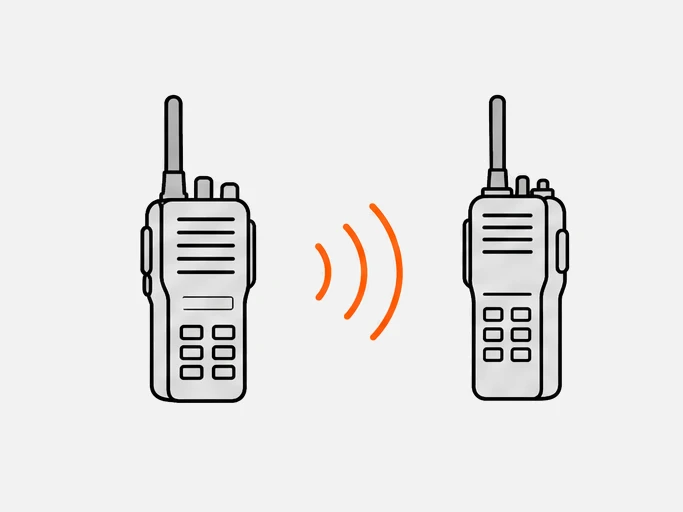
A DMR radio turns speech into digital data and sends it on a 12.5 kHz channel. The channel is split in time into two 30 ms slots, and each slot can carry its own call. Radios talk directly or through a repeater, which relays the call so it reaches farther.1
| Parameter | DMR |
|---|---|
| Channel width | 12.5 kHz1 |
| Time slots per channel | 2 slots of 30 ms; one frame is 60 ms1 |
| Modulation | 4-level FSK, 4,800 symbols per second at 2 bits each1 |
| Calls per channel | 2, one per slot: the equivalent of 6.25 kHz per call5 |
| Modes | Direct (radio to radio), repeater or trunked, depending on the tier1 |
What are the DMR tiers?
DMR has three tiers. Tier I is license-free, low-power radio at 446 MHz with a built-in antenna and no repeater. Tier II is conventional business radio under an individual license, direct or through a repeater. Tier III is trunking, where a controller assigns channels automatically. The tiers do not interoperate.1
| Tier | License | Network | Frequencies |
|---|---|---|---|
| Tier I | Exempt from individual licensing6 | Direct mode, integral antenna, no repeater6 | 446.0–446.2 MHz, up to 500 mW e.r.p.6 |
| Tier II | Individual license1 | Direct mode or repeater1 | 66–960 MHz7 |
| Tier III | Individual license1 | Trunked, with a controller1 | 66–960 MHz7 |
Tier I is the DMR version of digital PMR446. All five current radios in our database that name a DMR tier list Tier II.8
Is DMR better than analog?
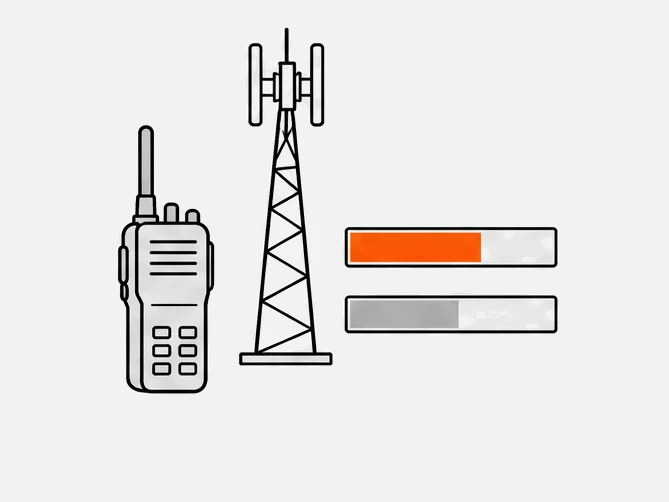
DMR improves audio and capacity more than range. ETSI's design aims were better audio quality, improved battery performance and good quality out to the edge of coverage, with the same range as analog. A 12.5 kHz DMR channel also carries two calls instead of one.5
Battery life is a claim to read with care. ETSI notes that a radio transmits for half the time, which offers "significant potential battery efficiency".5 The DMR Association claims up to 40 percent longer battery life than analog, for a duty cycle of 5 percent transmit, 5 percent receive and 90 percent idle. The figure is the industry group's own.9 More in digital vs analog radio.
Good at
- Two calls share one 12.5 kHz channel, in direct mode or through a repeater.5
- Group and individual calls, short data and emergency signalling are part of the standard.1
- Radios with an analog mode let a fleet move to digital in steps.3
- Encryption is available: the DMR Association lists ARC4, DES, AES-128 and AES-256.9
Do you need a license for DMR?
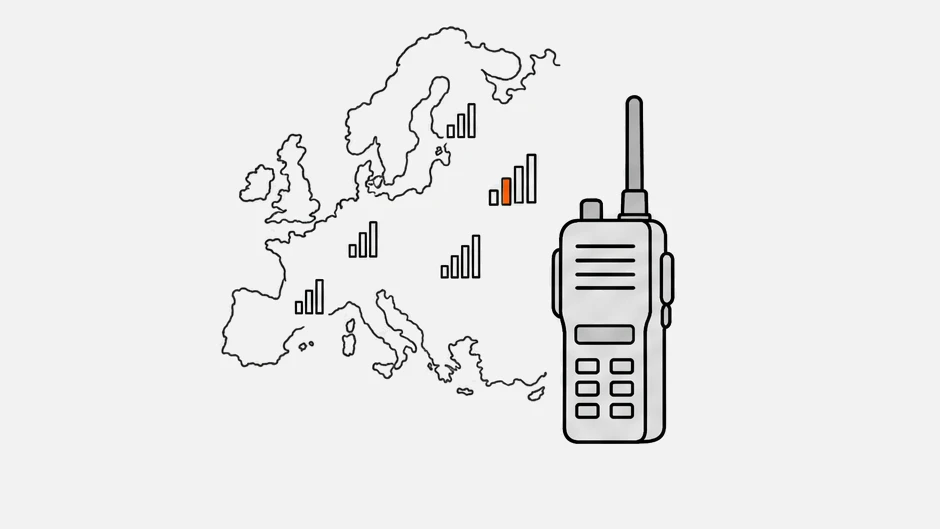
Tier I DMR on the 446 MHz PMR446 band is exempt from individual licensing under a CEPT decision. Tier II and III on business channels need an individual license, which Latvia and Germany issue as a frequency assignment. Bands, fees and procedures are set country by country.161011
Latvia's regulator requires a frequency-assignment permit for professional PMR radios in 30–87.5, 146–174 and 406–470 MHz, with fees from a public price list, and tells buyers to check for the CE mark and an EU declaration of conformity. Its page does not name DMR.10 Germany's Bundesnetzagentur says conventional digital business radio can be applied for as DMR Tier II or dPMR.11 A PoC radio needs no radio license, because its calls use the mobile operator's network.12
Hams use DMR on the amateur bands with their own license, a DMR ID and networks such as BrandMeister: see how ham radio DMR works.
How is DMR different from a PoC radio?
A DMR radio uses its own radio frequency, directly or through a repeater, so it works without mobile coverage but needs a license on business channels. A PoC radio sends voice as data over the mobile network, so it reaches as far as coverage and needs a SIM and a PTT service.
Choose DMR when your team works in one area, such as a site, a campus or a city, and calls must not depend on a mobile network. Choose PoC when people work across regions or countries. The full table is in PoC vs DMR; what is a PoC radio? explains the cellular side.
What is a hybrid PoC and DMR radio?
A hybrid radio combines a DMR radio and an LTE device in one case, so it can use either network. Hytera's PDC680, for example, registers on both with the same ID and switches between them automatically. In our database, 25 of the 291 current models list DMR.28
The radio catalog lists the models with a DMR option.
Questions
How far can a DMR radio talk?
As far as power, antenna and terrain allow, the same as analog: ETSI sets the protocol to match analog range.5 For professional PMR radios, Latvia's regulator gives a few kilometers in town and up to a few tens of kilometers in open country for vehicle-mounted and fixed units. It gives no figure for handhelds.10
What is a DMR repeater?
A repeater is a base station that relays calls so radios reach farther than radio to radio. Tier II systems can use one.1 In repeater mode both slots work, so one repeater channel carries two calls.5
Do DMR radios from different brands work together?
On the functions certified between makers, yes. The standard requires conforming radios to interoperate at the air interface, and a DMR Association certificate lists the tested functions for one hardware and software release.14
Can a DMR radio talk to an analog radio?
Yes, if the DMR radio has an analog mode and both sit on the same channel. Motorola says the ability to run both modes lets new digital radios work alongside existing analog ones.3
Sources
- PDC680 dual-mode rugged radio · Hytera
- MOTOTRBO CP100d series portable two-way radios · Motorola Solutions
- DMR interoperability certification · DMR Association
- The DMR standards · DMR Association
- Radio specifications of current PoC radio models · poc-radio knowledge base
- Key benefits of DMR · DMR Association
- Professional PMR radios and permits (in Latvian) · Elektroniskie sakari, Latvia
Show all 12 sources
- Betriebsfunk: Wichtige Hinweise zum Ausfüllen der Antragsunterlagen (in German) · Bundesnetzagentur, Germany
- Mobile 3G/4G/5G devices: what to check before buying (in Latvian) · Elektroniskie sakari, Latvia