Which LTE bands does a 4G walkie-talkie need in Europe?
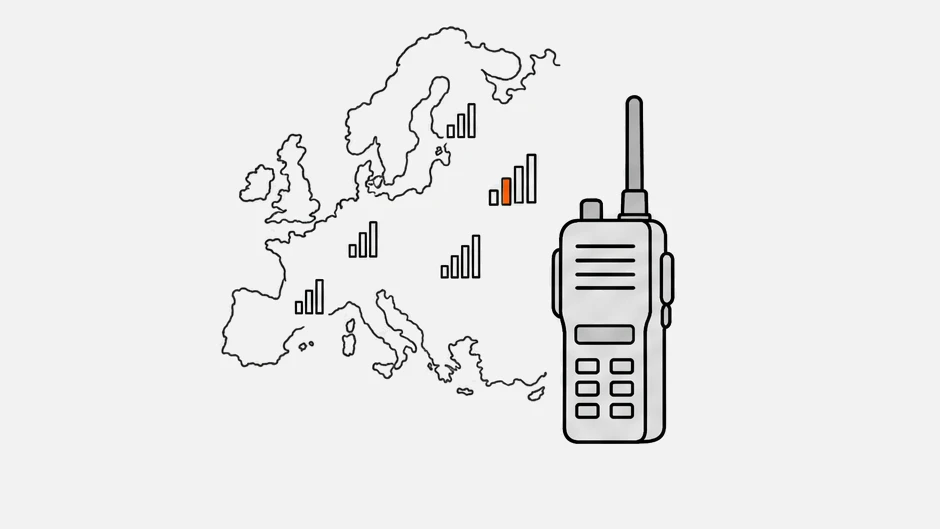
Look for band 20 (B20, 800 MHz) and band 3 (B3, 1800 MHz). B20 is marked in use at 63 of the 73 operators in our database, B3 at 71.1 Add band 28 (700 MHz) and band 8 (900 MHz) if your operator runs them: low bands reach farther and go deeper into buildings.2
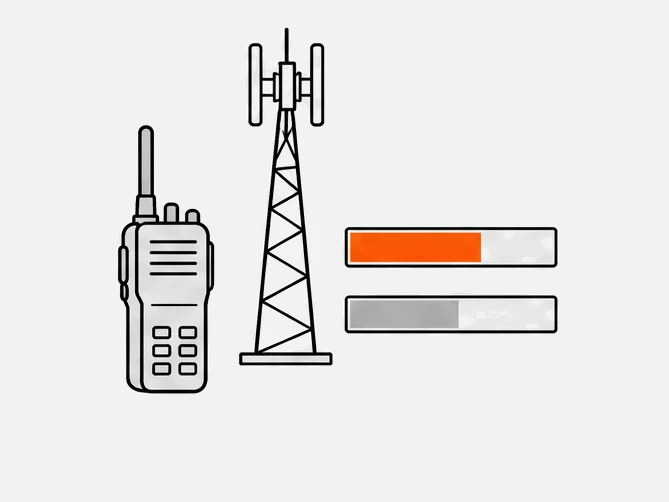
The FCC calls spectrum below 1 GHz coverage spectrum and the higher bands capacity spectrum.2 A PoC radio does not pick free spectrum by itself, as a cognitive radio would: it uses the bands its operator holds. The table gives each band's range in the 3GPP standard3 and the number of current models that list it.1
| Band | Frequency | Role | Models listing it (of 237) |
|---|---|---|---|
| B20 | 791–862 MHz | Coverage | 177 |
| B28 | 703–803 MHz | Coverage | 157 |
| B8 | 880–960 MHz | Coverage | 212 |
| B3 | 1710–1880 MHz | Capacity | 233 |
| B1 | 1920–2170 MHz | Capacity | 231 |
| B7 | 2500–2690 MHz | Capacity | 190 |
Of the 237 models, 60 omit B20, and 54 of those omit B28 too.1 The same model can also ship with different bands by region: Hytera lists B1/3/5/7/8/18/19/20/26/28 for the EU P50 and B2/3/4/5/7/12/13/17/26/28 for the US one.4 Claims can differ from certificates: Inrico's page lists B5 and B8 for the EU T320, but the EU certificate on file lists neither and expired on 2026-07-21.56 The EU radio directive requires the manual to state the bands and the maximum power.7
Will a 4G walkie-talkie work in your country?
Yes, if the radio supports at least one LTE band your operator runs. Ten of the 73 operators in our database are not marked as running B20, among them Free (France), Iliad (Italy) and 1&1 (Germany). Pick a country and a radio to see which bands match.1
Do 2G and 3G switch-offs affect a 4G walkie-talkie?
A radio with LTE and the right bands keeps working, because its push-to-talk runs on LTE data. A radio that connects only over 2G or 3G stops working when that network closes. In weak LTE areas a radio may fall back to 3G or 2G, and that fallback is going away.
Many LTE radios carry 2G and 3G modems too: the T320 certificate lists GSM and 3G bands next to LTE.6 The fallback is slower. Zello states under 2 seconds of delay on 3G and 2 seconds or more on 2G, against under 1 second on 4G.8 Announced switch-offs, read in October 2026:
| Operator | Switch-off | Planned date |
|---|---|---|
| Deutsche Telekom (Germany) | 2G | Expected 30 June 20289 |
| Orange (France) | 2G | Mainland from end of September 2026, fully by end of December 202610 |
| Orange (France) | 3G | From end of 202810 |
| KPN (Netherlands) | 2G | 1 December 202711 |
| UK mobile operators | 2G and 3G | Not offered past 203312 |
Is a 4G walkie-talkie really nationwide?
A 4G walkie-talkie has no range of its own, so "nationwide" means wherever your SIM has LTE signal. In May 2025 Germany's regulator reported 4G on 97.5% of the country's area from at least one operator, yet 2.1% had neither 4G nor 5G and just under 14% was covered by some operators but not all.13
The German map is built from data the four network operators supply, which the regulator checks against app reports and spot measurements.14 Sellers hedge too: Rapid Radios, a US seller, limits its nationwide claim to areas in range of an LTE tower and points buyers to the FCC National Broadband Map.15
Check coverage for your operator where your team works, not the national figure. Radios that add DMR or analog (41 of the 291 current models) can still talk directly when the network drops. See PoC vs DMR and the types of two-way radio.1
How does a 4G walkie-talkie use a SIM, data and Wi-Fi?
It needs a SIM with mobile data, and a data-only SIM is enough because voice travels as data. Zello reports 12–45 kbps while you talk and 70–100 MB per user per month on average. Wi-Fi gives a second path: 187 of the 291 current models list it.161
A French dealer says the Inrico T320 works with a data-only SIM or a voice-plus-data SIM and needs 3G, 4G or Wi-Fi coverage.17 Zello's bit rate follows the connection: 45 kbps when both sides are on Wi-Fi, 12 kbps if either is on 2G.16 Costs are in PoC radio SIM card and cost.
Android or RTOS: what does a 4G walkie-talkie run?
Of 291 current models, 197 run Android, 47 run another system (a real-time operating system, RTOS, Linux or maker firmware) and 47 do not say. Android lets a radio run a push-to-talk (PTT) app; a closed system works only with the service its maker supports.1
Android is no guarantee: only 92 of the 197 Android models say a third-party app can be installed, and 104 do not say.1 Ask the seller which services support the exact model, for example Privox, RealPTT, TASSTA, WalkieFleet or Zello. See push-to-talk and the radio catalog.
What do IP67, IP68 and battery claims tell you?
IP67 means dust-tight and immersion to 1 m for 30 minutes. IP68 means dust-tight and continuous immersion under conditions the maker sets, so it fixes no depth or time.18 Of 193 current models with a published rating, 95 list IP68, 25 IP67 and 54 IP54, which is splash-proof only.1
Sources differ: Inrico lists the T320 at IP65 and 9 hours of work time, its French dealer at IP54 and 14 hours of talk time.517 Compare capacity and duty cycle instead. The median of the 241 current models that publish a capacity is 4,000 mAh.1 Hytera states at least 20 hours for the 4,000 mAh PNC360S at a 10-10-80 duty cycle, Telox over 48 hours for the 4,000 mAh TE320 at the same cycle, which Telox defines as 10% transmit, 10% receive and 80% standby.1920 Hytera's EU page for the P50 still prints "xx hours" where the runtime belongs.4
What should you check before buying a 4G walkie-talkie?
Check six things: the LTE bands against your operator, the regional version, the band list in the manual, the system and PTT service, the SIM, and the rating and battery claims. Ask for test depth, time and duty cycle, not only "IP68" and "all-day battery".
- LTE bandsMatch B20 or B28, plus B3, to your operator in the LTE band checker.
- Regional versionConfirm the version for your region; one model can carry different bands in the EU and the US.
- Band listThe manual must state the bands and the maximum power.7
- System and PTT serviceCheck Android or RTOS, and that your service lists the exact model.
- SIMA data-only SIM is enough; confirm the SIM size and a data plan for your country.
- Rating and batteryAsk for the IP test depth and time, the capacity and the duty cycle behind the hours.
Questions
Is a 4G LTE walkie-talkie the same as a PoC radio?
In practice, yes. "4G LTE walkie-talkie", "LTE two-way radio" and "cellular radio" describe a PoC radio: voice travels as data over the mobile network. 41 of the 291 current models combine LTE with DMR or analog radio.1
Will a 4G walkie-talkie bought in the US work in Europe?
Often only in part. Hytera lists B20, B8 and B1 for the EU P50 but not for the US one, so compare the band list of the version you buy with your operator's bands.4
Sources
- Radio specifications and LTE bands of 73 operators in 22 countries · poc-radio knowledge base
- FCC 14-63: Policies Regarding Mobile Spectrum Holdings, Report and Order · Federal Communications Commission
- Hytera P50 PoC radio, EU page · Hytera
- Inrico T320 specifications · Inrico
- EU-type examination certificate 21-210840, Inrico T320 · Phoenix Testlab (hosted by Passion Radio)
- Directive 2014/53/EU (RED), Article 10(8) · European Union (copy at legislation.gov.uk)
- What is the current latency? · Zello Work Help Center
- 2G switch-off in the Telekom network (in German) · Deutsche Telekom
- Shutdown of 2G and 3G technologies · Orange Wholesale France
Show all 20 sources
- 2G sunset · KPN
- Joint statement on the sunsetting of 2G and 3G networks · UK Government
- Nationwide mobile measurement week · Bundesnetzagentur
- Mobilfunk-Monitoring (in German) · Bundesnetzagentur
- Rapid Radios FAQ · Rapid Radios
- How much data bandwidth does the app use? · Zello Work Help Center
- Inrico T320 LTE radio · Passion Radio
- Hytera PNC360S PoC radio, EU page · Hytera
- Telox TE320 · Telox