What is the difference between a two-way radio and a walkie-talkie?
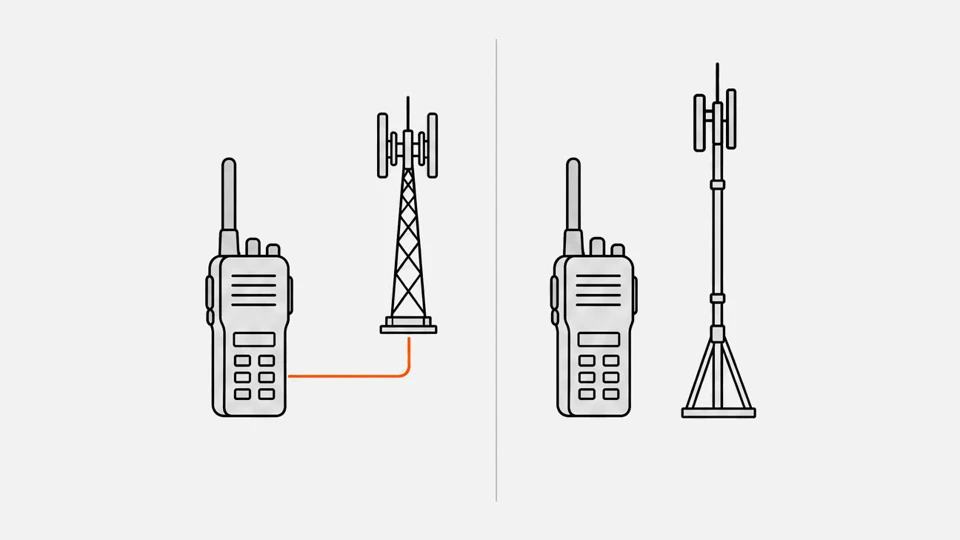
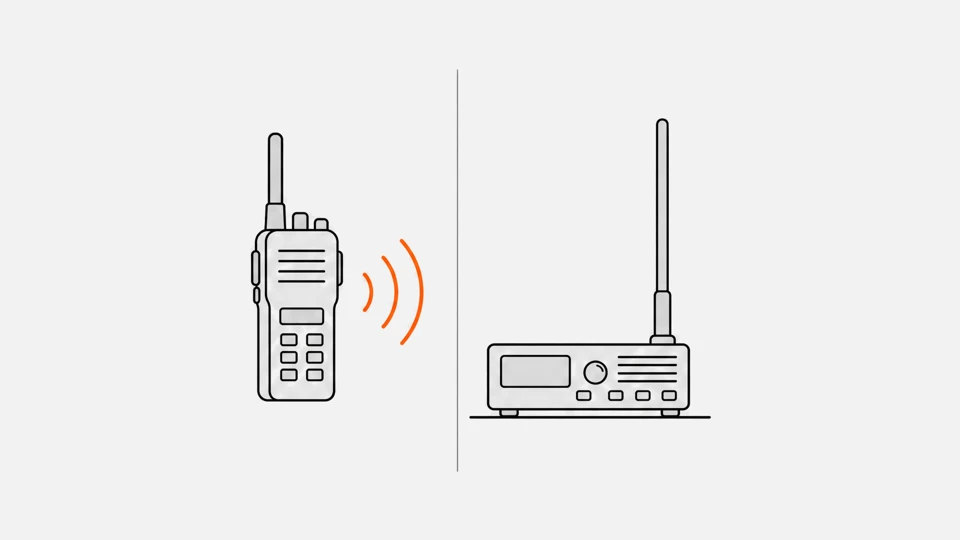
A walkie-talkie is a handheld two-way radio. "Two-way radio" is the wider term: it also covers vehicle radios and base stations at a fixed site. U.S. rules define a hand-held portable unit as a physically small mobile station that you operate while holding it.1
A base station sits at a fixed location; a mobile station is meant for use in motion.1 More in the two-way radio guide and types of two-way radio.
The two names also follow shop habit. A UK retailer says "walkie-talkie" often means a lower-powered, license-free handheld and "two-way radio" a higher-powered, licensed professional product.2 A French vendor draws the same line between consumer talkie-walkies and professional radios.3 Latvia's regulator splits it without those words: PMR446 is for non-professional use, while professional PMR means portable, fixed or vehicle-installed stations that need a permit.45 The words are not a standard, so check the specs, not the label.
Say “two-way radio” when…
- you mean the whole family: handhelds, vehicle radios, base stations and PoC radios
- you write a spec, a tender or a ticket and need the broad term
- you mean licensed business channels or repeaters
- you do not yet know if it will be a handheld
Say “walkie-talkie” when…
- you mean a handheld that you carry and press to talk
- you mean a license-free set, such as PMR446 or FRS
- you talk to people who use the everyday word
- you mean a PoC handheld that works like one
Is every walkie-talkie a two-way radio?
Yes. Every walkie-talkie sends and receives voice, so it is a two-way radio. The reverse is not true: vehicle radios and base stations are two-way radios, not walkie-talkies.23 The FCC's wording for the consumer Family Radio Service is two-way voice communication between low power hand-held radios.1
Can both people talk at the same time?
Usually not. Push-to-talk radios are simplex, also called half duplex: voice can travel in both directions, but not at the same time.6 Duplex, also called full duplex, lets both sides talk at once, as in a phone call.76 DMR radios generally work in half duplex.6
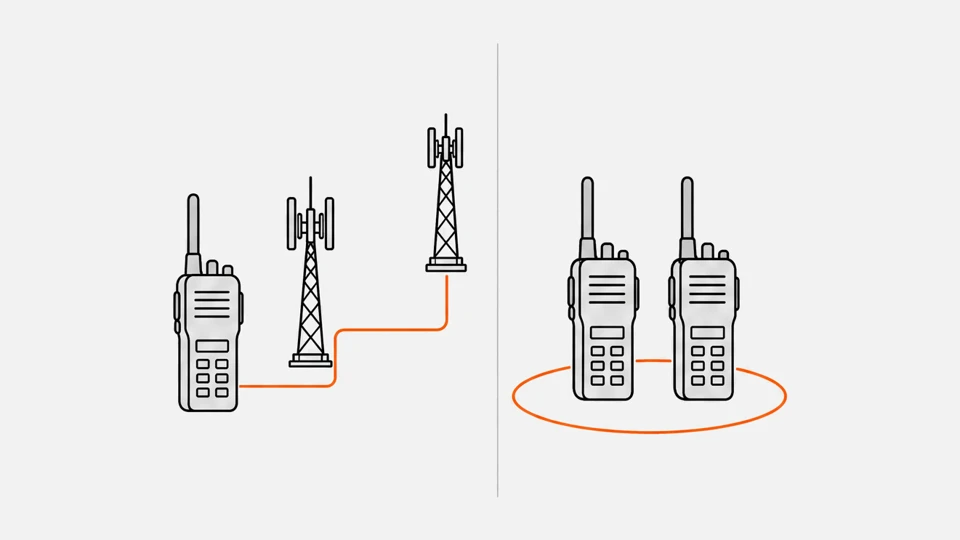
A repeater receives on one channel and retransmits on another, yet the call stays take-turns: simplex operation may use one frequency or two.71 Some PoC plans add full duplex: Instavox lists it in Premium.8
How do a two-way radio and a walkie-talkie compare?
Treat "two-way radio" as the family and "walkie-talkie" as its handheld member, usually the license-free consumer kind. The table below follows the shop meaning of each word, so exceptions exist: a U.S. GMRS handheld, for example, needs an FCC license.1
| Criterion | Two-way radio | Walkie-talkie |
|---|---|---|
| What it means | Any radio that sends and receives voice | A handheld radio you carry |
| Forms | Handheld, vehicle, base station, PoC radio, PTT phone | Handheld |
| Typical use | Security, police, ports, rail and other professionals5 | Hikes, trips, families and small events42 |
| License | Business channels need a license or permit;5 license-free sets exist too | None on PMR4469 and FRS sets; U.S. GMRS handhelds need one1 |
| Range | Professional PMR in Latvia: a few kilometers in town, up to a few tens of kilometers in the countryside for vehicle and fixed models5 | A few hundred meters in town, up to a few kilometers in the countryside4 |
| Who talks at once | One at a time; some PoC services add full duplex8 | One at a time |
| Running cost | Radios, plus license fees5 or a monthly service plan8 | Radios only; PMR446 has no fee in Latvia4 |
Technical details
| Criterion | Two-way radio | Walkie-talkie |
|---|---|---|
| Call mode | Simplex (half duplex); full duplex on some PoC plans68 | Simplex (half duplex)6 |
| Station types | Base station (fixed), mobile station (in motion), hand-held portable unit1 | Hand-held portable unit1 |
| Power | GMRS (U.S.): up to 50 W for mobile, repeater and base stations on main channels1 | PMR446: 0.5 W ERP, integral antenna.9 FRS: 2 W ERP on channels 1–7 and 15–22, 0.5 W on 8–14, non-removable antenna1 |
| Frequencies | Professional PMR, Latvia: 30–87.5, 146–174 and 406–470 MHz5 | PMR446: 446.0–446.2 MHz.9 FRS: 22 channels near 462 and 467 MHz1 |
| Repeaters | Used on licensed systems: input channel in, output channel out1 | Not allowed on PMR4469 |
| License | GMRS: individual FCC license, 10-year term;1 professional PMR in Latvia: permit5 | PMR446 and FRS: none91 |
Which is better for business?
Neither word decides it; the radio and its channel do. License-free handhelds suit small teams with simple needs.2 Licensed business systems add vehicle radios, base stations and repeaters that extend range.15 Rules differ by country: U.S. FRS rules name business activities, while Latvia's regulator calls PMR446 non-professional, mainly for hikes and trips.14
Where does a PoC radio fit?
A PoC radio is a two-way radio, often shaped like a walkie-talkie, that sends voice as data over a mobile network to a PTT server instead of on its own frequency. Range follows mobile coverage and no radio license is needed. A push-to-talk phone does the same on a phone.
The 291 current models in our database include 174 PoC handhelds, 27 vehicle units, 39 rugged or PTT phones and 41 that pair LTE with a DMR or analog radio.10 See also PoC vs PMR446, the PMR446 guide and the radio catalog.
Questions
Do walkie-talkies need a license?
Not on PMR446 in CEPT countries or on FRS in the U.S.91 U.S. GMRS handhelds need an individual FCC license, and business channels need a license or permit from the national regulator.15
Sources
- 47 CFR Part 95: Personal Radio Services (§§ 95.303, 95.503, 95.567, 95.587, 95.1705, 95.1767) · eCFR, U.S. Federal Communications Commission rules
- Walkie-Talkies vs Two-Way Radios: What's the Difference? · RadioTrader
- PMR446 radios, licensing and range (in Latvian) · Elektroniskie sakari, Latvia
- Professional PMR radios and permits (in Latvian) · Elektroniskie sakari, Latvia
- 47 CFR 2.1: Terms and definitions · eCFR, U.S. Federal Communications Commission rules
- Instavox plans (in French) · Instavox
- Radio specifications and LTE bands of 73 operators in 22 countries · poc-radio knowledge base