How far can a walkie-talkie really reach?
A handheld walkie-talkie reaches a few hundred meters in a town and a few kilometers in open country. With antennas at head height (about 1.5 m, 5 ft), two radios on flat ground cannot go much beyond 10 km (6 miles), because the Earth curves away between them, however strong the radio is.1 What each type does:
- License-free PMR446 (EU, UK): a few hundred meters in a city, up to a few kilometers in the countryside, at 0.5 W.23
- FRS and GMRS (US): Midland says its GXT1000 averages ½ to 2 miles in normal conditions.4
- Licensed UHF/VHF handhelds: one dealer guide quotes 8–12 km outdoors in optimal conditions.5
- 4G PoC and satellite radios: as far as the network covers, not as far as the radio transmits.
Why do boxes say "up to 35 miles"?
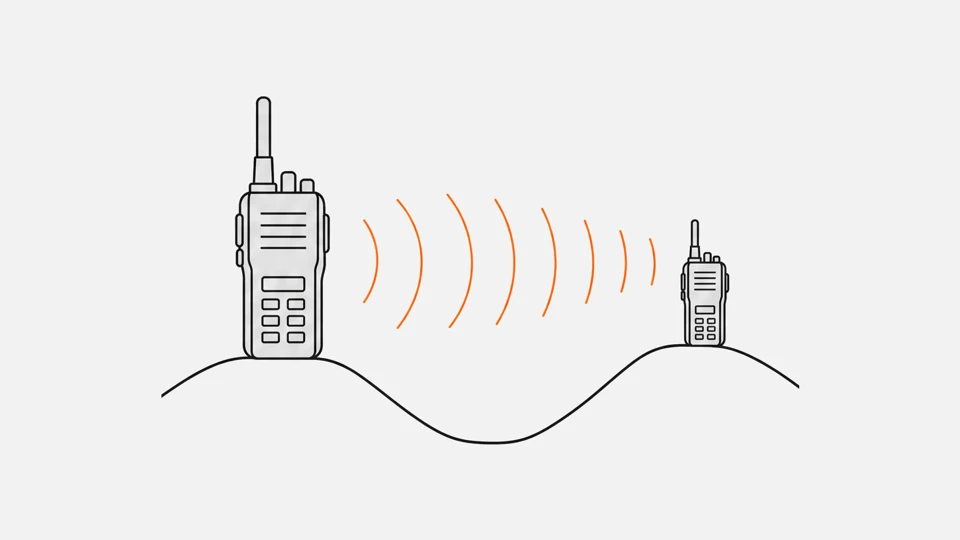
Because 35 miles is the best case, not the typical one. Motorola quotes up to 35 miles for its Talkabout T470, but its own table gives that for mountain to valley, against 6 miles over open water and 2 miles in a neighborhood. The footnote says the figure assumes optimum conditions and an unobstructed line of sight.6 Midland puts its 36-mile claim at mountaintop to mountaintop in perfect conditions.4
Geometry explains the gap. At these frequencies radio waves travel almost in a straight line; the atmosphere bends them slightly, which the ITU treats as an Earth with 4/3 of its real radius.1 That puts the radio horizon at about 4.12 × (√h1 + √h2) km, with antenna heights in meters. Two head-height antennas give 10 km, close to Motorola's 6 miles over water. Reaching 35 miles (56 km) over flat ground takes antennas about 47 m (153 ft) up at both ends. A radio on a 300 m mountain and one at head height in the valley below have a horizon of about 76 km (47 miles).
What limits walkie-talkie range?
Antenna height, terrain and obstacles limit range more than transmitter power. In free space, loss grows 20 dB per tenfold distance, so ten times the power gives only about 3.2 times the distance, and nothing past the horizon.7
- Power. PMR446 allows 0.5 W effective radiated power (ERP) and a fixed antenna.2 US FRS allows 0.5 W or 2 W ERP depending on the channel,8 and GMRS handhelds up to 5 W ERP on some channels.9
- Antenna height. The horizon grows with the square root of height: four times higher doubles it. Hold the radio up and stand on a rise.10
- Terrain. A hill or ridge across the path blocks the signal. Hilltop-to-hilltop links reach many kilometers.11
- Buildings, walls and floors. ITU-R P.1238 gives 9 dB of extra loss for one office floor at 900 MHz, 19 dB for two and 24 dB for three.12 ITU-R P.2109 puts modern energy-efficient buildings, with metallized glass or foil-backed panels, in a separate class with much higher entry loss.13 Every 6 dB of extra loss halves the free-space range, so 24 dB is four halvings: one sixteenth of the range.7
- Frequency. Motorola says VHF travels farther in open outdoor areas, while UHF passes through walls and concrete better.14 Free-space loss also rises with frequency: 9.5 dB more at 450 MHz than at 150 MHz.7
How far do radios reach in practice?
Most figures come from makers, dealers or regulator guidance, so the table says what kind each is. Maker claims are best cases and calculated rows are ceilings, not promises.
| Radio | Setting | Range | Kind of figure |
|---|---|---|---|
| PMR446 | City | A few hundred meters3 | Regulator guidance |
| PMR446 | Countryside | Up to a few kilometers3 | Regulator guidance |
| PMR446 | Flat farmland, receiver 25 m above sea level, others below 10 m | About 500 m typical, 1 mile at best10 | Amateur radio club test |
| PMR446 | Hilltop to hilltop | Many km; record 536 km (333 miles), UK to Netherlands, in unusual atmospheric conditions11 | Encyclopedia article |
| PMR446 | Dealer's estimate | 1–6 km in towns, 5–8 km open; its summary table says up to 30+ km5 | Dealer guide |
| FRS/GMRS | Neighborhood | Up to 2 miles6 | Maker claim |
| FRS/GMRS | Normal conditions | ½ to 2 miles4 | Maker FAQ |
| FRS/GMRS | Over open water | Up to 6 miles6 | Maker claim |
| FRS/GMRS | Mountain to valley | Up to 35 miles6 | Maker claim |
| Licensed UHF/VHF handheld | Outdoors, optimal conditions | 8–12 km5 | Dealer guide |
| Licensed business handheld (Motorola CP110, 1 or 2 W) | Inside buildings | Up to 250,000 sq ft over 20 floors (UHF) or 220,000 sq ft over 13 floors (VHF)15 | Maker claim, test conditions not stated |
| Any handheld | Flat ground, 1.5 m antennas | 10 km (6 miles) | Calculated ceiling1 |
| Any handheld | From a 100 m hilltop | 46 km (29 miles) | Calculated ceiling1 |
Do repeaters extend range?
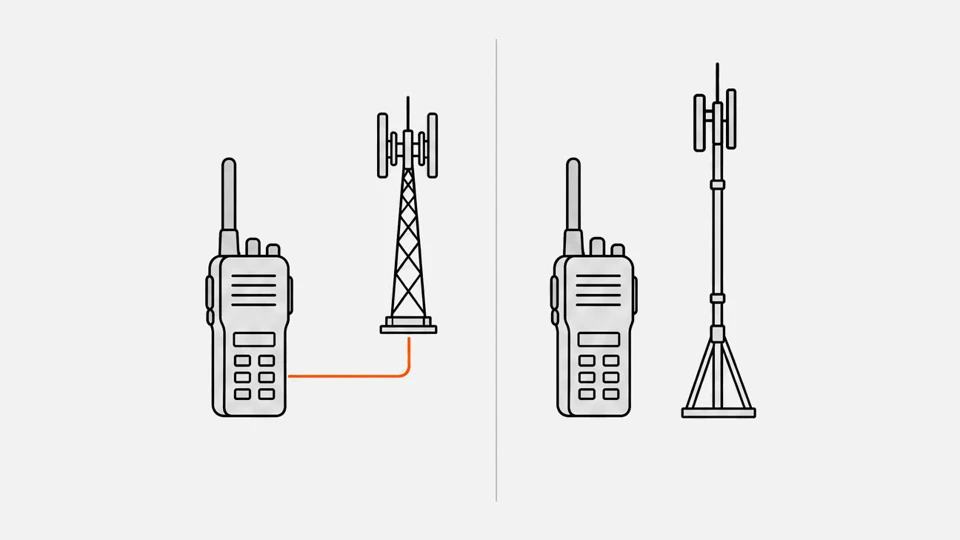
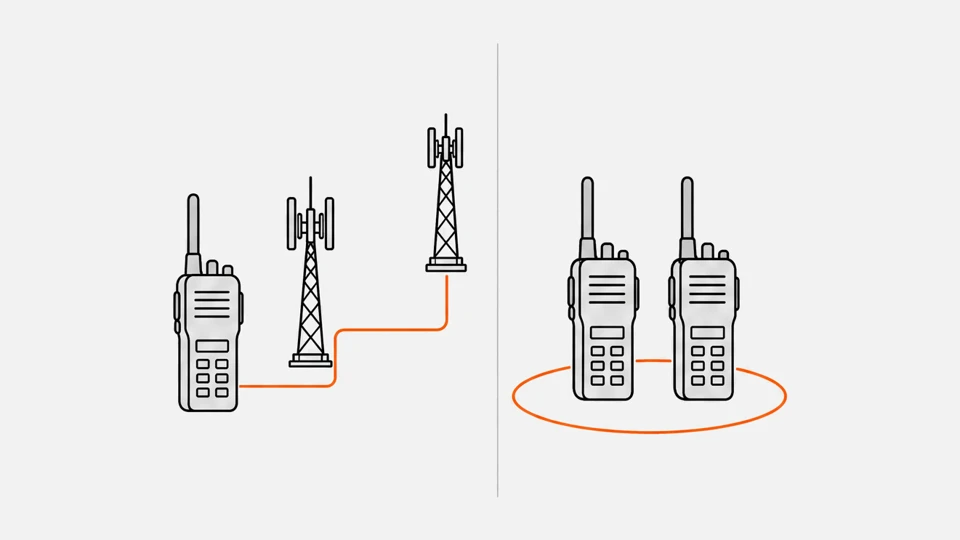
Yes. A repeater is a fixed station on a high site that receives each call and retransmits it, so a handheld only has to reach the repeater, not the other handheld. A 50 m mast gives a handheld at head height a horizon of about 34 km, so two handhelds could be up to about 68 km apart on flat ground, before terrain takes its share.1
PMR446 rules forbid this: the CEPT decision allows hand portables with integral antennas only and bars use as a repeater or part of a network.2 GMRS allows repeater stations at up to 50 W.9 Professional systems on business channels, with or without repeaters, need a license from the national regulator.16 A DMR repeater carries two calls at once in one 12.5 kHz channel by splitting it into two timeslots.17 Digital does not add distance by itself: CEPT describes its benefit for PMR446 as quality out to the range limit rather than greater absolute range.2 Licensed hams run their own repeaters as well: see ham radio. See DMR and PMR446.
How far does a PoC (4G LTE) walkie-talkie reach?
As far as mobile data reaches. A PoC radio sends voice over the operator's network, so the distance between two radios does not matter, but coverage at each end does (what is a PoC radio?).
Coverage is never total. In the UK, 4G reaches about 96% of the land area from at least one operator, according to Ofcom's Connected Nations 2025 as reported by ISPreview.18 Iridium, which sells satellite PTT, notes that phones with PTT apps cover long distances near cell towers but are not reliable in remote areas.19
Choose direct radio or a repeater where there is no signal and you want no monthly fee. Choose PoC when people work across towns or countries and signal exists. PoC vs PMR446 compares the two, and 4G LTE walkie-talkies covers the bands a PoC radio needs.
Is there an unlimited-range walkie-talkie?
No handheld radio has unlimited range. In ads, "unlimited range" usually means a network: 4G where an operator covers, satellite where none does. Iridium PTT runs on 66 cross-linked low-earth-orbit satellites without towers or repeaters, and its Extreme PTT device starts a talk group in under two seconds.19 It needs a satellite PTT handset and an Iridium service. At these frequencies, a 1,000-mile link between handhelds needs a network like this.
How can you get more range?
- Get higher. Antenna height matters most: use a rooftop, a rise or a ridge.10
- Get a clear line. Stay outdoors and away from walls. At the edge of range a step of 17 cm (a quarter wavelength) can swing a signal from readable to lost.10
- Match the band to the place. VHF for open country, UHF for buildings.14
- Add a repeater on a licensed system.
- Use a network where coverage exists.
Do not try to boost a PMR446 radio: the rules fix the power at 0.5 W ERP and the antenna as part of the radio.2
Questions
How far can walkie-talkies reach?
License-free models reach a few hundred meters in town and a few kilometers in open country. Two people on flat ground are capped near 10 km by the horizon; a mountaintop to a valley can span tens of kilometers.13
What two-way radio has the longest range?
Among radios that transmit directly, one working through a repeater on a high site. Among all radios, a network one: 4G PoC where there is mobile coverage, satellite PTT elsewhere.19
Do 50-mile and 100-mile walkie-talkies exist?
The largest claims we checked are 35 miles (Motorola) and 36 miles (Midland).64 A 50-mile (80 km) link over flat ground needs both antennas about 95 m (313 ft) up, and 100 miles about 381 m (1,250 ft).1
Does more power mean more range?
Only a little. Ten times the power gives about 3.2 times the free-space distance, and nothing beyond the horizon.7
Sources
- Rec. ITU-R P.834: Effects of tropospheric refraction on radiowave propagation · ITU-R. Effective Earth radius factor 4/3. Horizon distances are our calculation from it, with an Earth radius of 6,371 km.
- PMR446 radios, licensing and range (in Latvian) · Elektroniskie sakari, Latvia
- GXT1000VP4 two-way GMRS handheld radio · Midland
- Long range two-way radios · Onedirect UK
- Talkabout T470 series · Motorola Solutions
- PMR446 coverage experimentation · Avalon Amateur Radio Club
Show all 19 sources
- PMR446 · Wikipedia
- UHF vs VHF · Motorola Solutions
- CP110 non-display radio · Motorola Solutions
- Professional PMR radios and permits (in Latvian) · Elektroniskie sakari, Latvia
- DMR Association white paper: Benefits and features of DMR · DMR Association
- Ofcom: gigabit broadband covers 87% of UK as 5G hits 97% · ISPreview, reporting Ofcom's Connected Nations 2025
- What is Satellite PTT? · Iridium