What does TETRA stand for?
TETRA stands for Terrestrial Trunked Radio, a digital trunked mobile radio standard that ETSI developed for professional users. The first ETSI standards, adopted in January 1996, still spelled it Trans-European Trunked Radio. Public safety agencies, transport operators, utilities, governments, armed forces and industry run TETRA today.12
"Trunked" means the network hands out channels on demand from a shared pool instead of giving each group its own frequency. ETSI says TETRA scales from single-site local coverage to multi-site wide-area and nationwide networks.1 It is one of several types of two-way radio; makers of TETRA radios include Motorola Solutions and Hytera.
How does TETRA work?
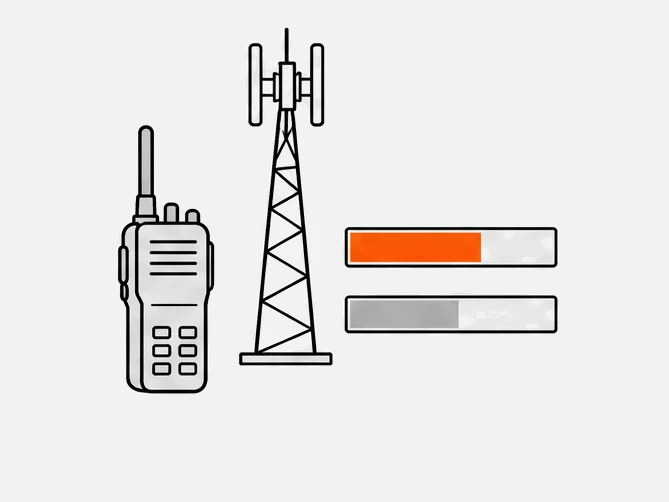
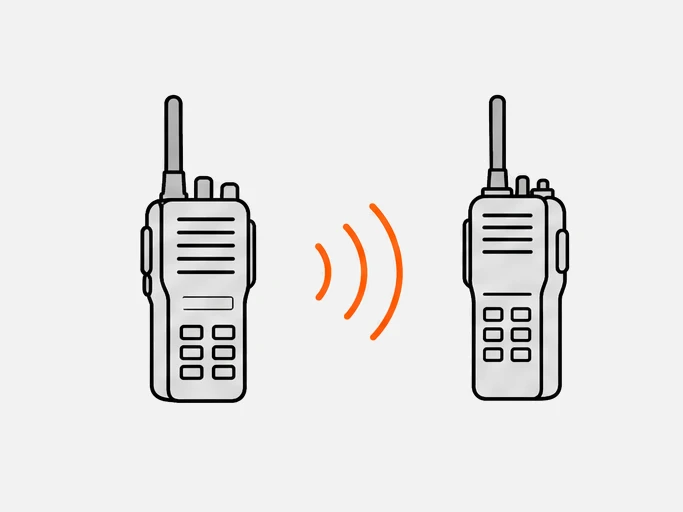
A TETRA carrier is 25 kHz wide and split in time into four channels, so four calls share one carrier. Radios normally work through the network's base stations and switching (trunked mode). They can also talk radio to radio without any base station (direct mode), for example where there is no coverage.34
| Parameter | TETRA |
|---|---|
| Carrier width | 25 kHz for phase modulation3 |
| Channels per carrier | 4, by time division (TDMA)3 |
| Modulation | π/4-DQPSK at 36 kbit/s per carrier3 |
| Frame structure | A multiframe of 18 TDMA frames lasts 1.02 s3 |
| Bands defined by ETSI | 380–400 MHz, 410–430 MHz, 450–470 MHz, 870–876/915–921 MHz5 |
| Emergency services in Europe | 380–385/390–395 MHz, designated for narrowband PPDR since 19966 |
| Modes | Trunked (TMO), controlled by the network's switching and management infrastructure; direct (DMO), without any base station4 |
National regulators assign the exact frequencies.3 TETRA Release 2 added TEDS, a data mode on wider channels of 25, 50, 100 or 150 kHz with user bit rates from 30 to 400 kbit/s.6
Who uses TETRA?
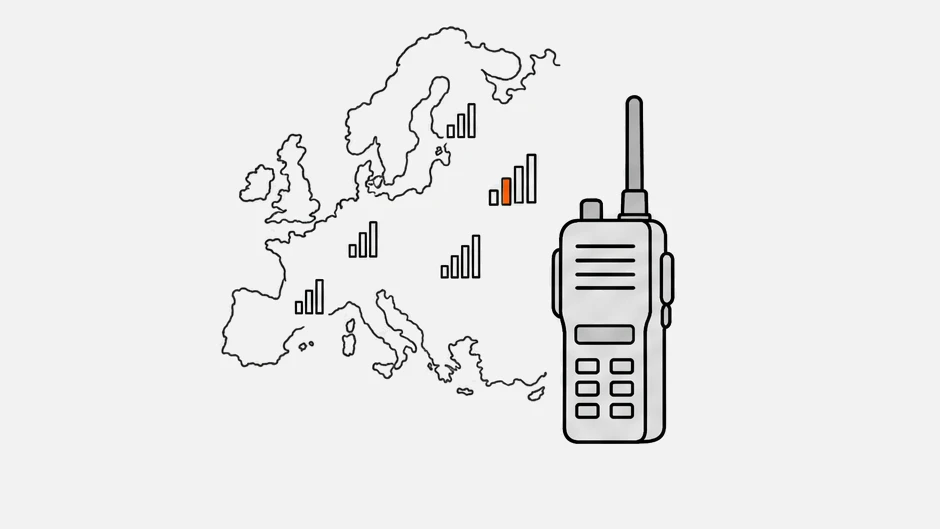
TETRA serves public safety agencies first, along with transport operators, utilities, government and military users, oil and gas companies, and commercial and industrial fleets. In a July 2023 statement, ETSI and TCCA counted more than 120 countries using dedicated TETRA networks, from single sites to nationwide systems.17
National emergency networks are the best-known examples. Sweden's Rakel, Norway's Nødnett and Finland's Virve are TETRA networks linked across their borders.8 In Britain, the emergency services' Airwave network runs on TETRA.9 The wider picture, including P25 in North America, is on public safety radio.
How is TETRA different from DMR and PoC?
TETRA puts four channels on a 25 kHz carrier and is built for large trunked networks. DMR puts two on 12.5 kHz and is common in business fleets. A PoC radio uses no radio channel of its own: it sends voice over 4G/LTE data, so it reaches wherever the mobile network does.310
| TETRA | DMR | PoC / LTE | |
|---|---|---|---|
| Standard | ETSI EN 300 3923 | ETSI TS 102 36110 | Set by the PTT platform; MCPTT for mission-critical use21 |
| Radio channel | 25 kHz carrier, 4 TDMA channels3 | 12.5 kHz, 2 time slots10 | The mobile operator's LTE bands |
| Network | Trunked base stations; direct mode without them4 | Direct, repeater or trunked (Tier III)10 | Mobile network and a PTT server |
| Access | A network operator or a licensed private network | Individual license for Tier II and III10 | A SIM and a PTT service |
| Data | Short data; TEDS up to 400 kbit/s6 | Short data | Mobile broadband |
CEPT groups TETRA with other digital 25 kHz systems, and DMR, TETRAPOL and P25 with 12.5 kHz systems.6 The full PoC comparison with a direct radio network is in PoC vs DMR.
What is TETRAPOL?
TETRAPOL is a digital radio system for public safety that Matra began developing in 1988 and Airbus now sells. Unlike TETRA, it gives each channel its own frequency, 12.5 or 10 kHz wide depending on the project. Airbus lists nationwide TETRAPOL networks in Switzerland, the Czech Republic, Spain, Slovakia, Mexico and France.111213
| Parameter | TETRAPOL |
|---|---|
| Access | One voice or data channel per carrier (FDMA)11 |
| Channel spacing | 12.5 or 10 kHz, set per project; a 6.25 kHz extension is possible12 |
| Modulation | GMSK, 8 kbit/s gross12 |
| Frequency range | 70–520 MHz12 |
| Specification | Publicly available specifications of the TETRAPOL Forum1214 |
The French Gendarmerie has used its TETRAPOL network, RUBIS, since 1992.15 The ISITEP final report calls TETRAPOL the other prevalent public safety technology in Europe and notes that it does not interoperate with TETRA over the air.14
How do TETRA and TETRAPOL networks work together across borders?
Networks connect through the Inter-System Interface (ISI), an ETSI standard that links two TETRA networks so radios can migrate between them and join individual and group calls across. The EU project ISITEP (2013–2016) built on it with IP gateways between national TETRA and TETRAPOL networks and tested them across European borders.161718
ISI is a family of ETSI standards: individual calls, group calls, short data and mobility management each have their own part, and the TETRA security standard covers key management across ISI.1619 Norway's DSB puts it simply: ISI enables communication between different networks and lets radio terminals migrate across them.8
ISITEP, "Inter System Interoperability for Tetra-TetraPol Networks", ran from 1 September 2013 to 31 December 2016 under the EU's security research program. Leonardo of Italy coordinated 18 partners from Belgium, Norway, Sweden, the Netherlands, Spain, Finland, France, Denmark, Italy and Greece. It cost €15.99 million, of which the EU paid €10.29 million.18 Its goals were ETSI ISI among national TETRA networks and ISI over IP gateways among TETRAPOL networks and between TETRAPOL and TETRA.18
| ISITEP demonstration (2016) | Networks |
|---|---|
| Multi-agency exercise, Meråker (Norway) and Jämtland (Sweden), 16 November | Norwegian and Swedish TETRA networks over ISI14 |
| Hot pursuit, Belgium–Netherlands–Germany | Lab networks14 |
| Airplane disaster at the Geneva border | TETRAPOL to TETRAPOL, France–Switzerland, a manufacturer demo14 |
| VIP protection at a European summit, Brussels | The ASTRID, Acropol and C2000 networks14 |
| Portugal–Spain | TETRAPOL to TETRAPOL, lab demo14 |
The report calls the Norway–Sweden cooperation agreement of November 2016 the first real implementation of the ISITEP framework, and says Finland and Norway agreed to put the ISITEP ISI into operational use in 2017.14 In September 2019 the three-way link between Finland's Virve, Norway's Nødnett and Sweden's Rakel went live, a joint effort of DSB, Erillisverkot and MSB.8
How is TETRA moving to mission-critical LTE?
Operators are moving to 3GPP mission-critical services over 4G and 5G, starting with MCPTT, completed in Release 13 in March 2016. TETRA stays in use during the change. Interworking functions, introduced in 3GPP Release 15, link mission-critical users with TETRA, P25 and GSM-R, mainly for voice, messaging and location.2021
3GPP itself says the migration is not instantaneous and that many user groups will rely on narrowband networks for years.20 Its TETRA interworking specification does not define the interface inside the TETRA system, which is left to vendors; ISI is one of the alternatives it names.20 ETSI studied the scenarios in TR 103 565 in 2017.22
| Country | What is happening |
|---|---|
| Finland | Virve 2 on Elisa's 4G and 5G network is ready for use (June 2025);23 TETRA support contracts run until 203024 |
| Sweden | MSB signed a 7-year contract with Airbus in October 2025 for a step-by-step move from Rakel to 5G broadband25 |
| United Kingdom | The Airwave shut-down target was moved to December 2029;26 its successor ESN uses EE/BT coverage9 |
How commercial networks give responders priority is covered under commercial networks for public safety.
Is TETRA encrypted?
TETRA has air-interface encryption with the TEA algorithms, and end-to-end encryption as a separate service. In July 2023 researchers at Midnight Blue published TETRA:BURST, five vulnerabilities, two of them critical. ETSI and TCCA answered that they knew of no exploitation on operational networks and pointed to the newer TEA5–TEA7 algorithms.19277
Midnight Blue describes four TEA ciphers with 80-bit keys: TEA1 and TEA4 for commercial and export use, TEA2 and TEA3 for emergency services inside and outside Europe. It reported that TEA1 reduces the effective key so far that it can be brute-forced.27 ETSI does not regard that export-related limit as a backdoor, found no weakness in TEA2 and TEA3, and recommends patches, the move to TEA5–TEA7 and end-to-end encryption.7 In October 2022 ETSI said it had completed new air-interface encryption algorithms designed to withstand brute-force attack beyond 2040.28
How this relates to PoC radio
A PoC radio and a TETRA radio solve the same problem, a group talking at the press of a button, on different networks. TETRA runs on a dedicated network with its own frequencies and direct mode; a PoC radio rides on a mobile operator's LTE network and a push-to-talk service.
The two meet in three places. Mission-critical push-to-talk on LTE is where TETRA networks are heading.20 Push-to-talk platforms bridge app users to TETRA: TASSTA, for example, lists Sepura TETRA equipment among the radios its gateway connects. And some makers sell both, such as Motorola Solutions with DIMETRA (TETRA) next to its LTE radios.
For a team that does not run a national emergency network, the comparison that matters is usually PoC against a licensed radio network, covered in PoC vs DMR and 4G LTE walkie-talkies.
Questions
What frequency does TETRA use?
ETSI defines TETRA bands at 380–400, 410–430 and 450–470 MHz and at 870–876/915–921 MHz.5 In Europe, 380–385/390–395 MHz is designated for narrowband public safety radio.6 National regulators assign the exact frequencies.3
Can a TETRA radio work without the network?
Yes. In Direct Mode Operation, radios talk to each other without any base station; ETSI defines it as simplex operation outside the control of the trunked network.4 A PoC radio has no such mode: it needs mobile data or Wi-Fi.
Is TETRA better than DMR?
They are built for different jobs. TETRA fits four channels in 25 kHz and suits large trunked networks with many users, such as nationwide emergency networks. DMR fits two in 12.5 kHz and runs direct, through repeaters or trunked, often for a single company.310
Can TETRA radios talk to PoC or LTE users?
Through gateways. 3GPP interworking functions link mission-critical LTE users with TETRA, mostly for voice, messaging and location.20 Some push-to-talk platforms also bridge app users to TETRA radios.
Sources
- Cross-border communication · DSB, Norway
- Emergency Services Network: summary business case, 27 July 2026 · UK Home Office
Show all 28 sources
- Eignung der Standards ETSI/TETRA und TETRAPOL (2000, in German) · RWTH Aachen University
- TETRAPOL PAS 0001-2 v3.0.0: Radio Air Interface · TETRAPOL Forum, hosted by Airbus
- TETRAPOL · Airbus
- ISITEP final publishable summary report · CORDIS, European Commission
- ISITEP: Inter System Interoperability for Tetra-TetraPol Networks, project 312484 · CORDIS, European Commission
- Mission critical services · 3GPP
- Built through teamwork: the Virve 2 service is ready for action · Erillisverkot
- TETRA:BURST · Midnight Blue