How does shortwave travel so far?
Shortwave bends back to Earth in the ionosphere, layers of charged gas 50 to 400 km and more above the ground. One hop off the highest layer, F2, covers up to about 4,000 km. The ground and the sea send the signal back up, so it can hop around the globe.5
The layers are peaks of ionization, not hard shells. They change with the Sun, which is why shortwave behaves differently by day and by night.5
| Layer | Height | What it does |
|---|---|---|
| D | 50–80 km | Exists by day and absorbs signals, the lower frequencies most. It fades away soon after sunset |
| E | 100–125 km | Bends signals back; one hop reaches about 2,000 km. It almost disappears at night |
| F (F1 and F2 by day) | about 250–400 km and more | The main layer for long distance; one hop off F2 reaches about 4,000 km |
Source: Ian Poole, G3YWX, in the ARRL's QST.5
Between the end of the ground wave and the first signal that comes back from the sky lies the skip zone, where nothing is heard. On shortwave it can be a thousand miles wide or more. Raise the frequency far enough and the signal no longer bends back: it goes through the layers into space.5
Why does shortwave change between day and night?
By day the D layer soaks up the lower frequencies, so frequencies below about 10 MHz travel best at night and those above 10 MHz by day. How high you can go depends on the Sun: over its 11-year cycle the upper bands open and close.56
- Maximum usable frequency (MUF). The highest frequency that still bends back between two places. The best working frequency is about 85% of it, and transmitter power does not change it.7
- The solar cycle. Near the low point of the cycle, bands above about 20 MHz may not work at all. Near the peak, even 50 MHz can. NASA and NOAA announced on October 15, 2024 that the Sun had reached the maximum phase of Solar Cycle 25.589 In NOAA's data the smoothed sunspot number peaked at 160.9 in October 2024 and had dropped to 94.4 by March 2026; the month of the peak is only fixed in hindsight.108
- Solar flux (F10.7). Radio noise from the Sun at 10.7 cm, a simple measure of solar activity. It runs from below 50 to above 300 units over a cycle and tracks the ultraviolet that charges the ionosphere.11
- K and Kp index. Disturbance of the Earth's magnetic field, 0 to 9. Kp 5 or more is a geomagnetic storm.12
When the Sun misbehaves, NOAA rates the effect on shortwave on two scales:1314
| Event | What happens to shortwave |
|---|---|
| Solar flare, R1 to R5 | X-rays strengthen the D layer on the sunlit side. R1 (about 2,000 per cycle) brings weak degradation; R3 (about 175 per cycle) blacks out wide areas for about an hour; R5 blacks out the whole sunlit side for hours |
| Geomagnetic storm, G2 to G5 | Signals fade at high latitudes first. At G4 (Kp 8) shortwave is sporadic; at G5 (Kp 9) it may be impossible in many areas for one to two days |
Shortwave bands and frequencies
International broadcasters work in ten bands between 5.9 and 26.1 MHz, set by the ITU, the UN agency for radio. Listeners call them by wavelength: the 49-meter band is 5.9–6.2 MHz, the 31-meter band 9.4–9.9 MHz. Below 5.1 MHz there are bands for national broadcasting, most of them only in the tropics.23
| Band | Frequencies, kHz | Note |
|---|---|---|
| 120 m | 2300–2495 | Tropical Zone only |
| 90 m | 3200–3400 | Tropical Zone only |
| 75 m | 3900–4000 | National; not in the Americas, 3950–4000 also in Europe and Africa |
| 60 m | 4750–4995, 5005–5060 | Tropical Zone only |
| 49 m | 5900–6200 | International |
| 41 m | 7200–7450 | 7300–7400 worldwide; 7200–7300 and 7400–7450 not in the Americas |
| 31 m | 9400–9900 | International |
| 25 m | 11600–12100 | International |
| 22 m | 13570–13870 | International |
| 19 m | 15100–15800 | International |
| 16 m | 17480–17900 | International |
| 15 m | 18900–19020 | International |
| 13 m | 21450–21850 | International |
| 11 m | 25670–26100 | International |
Source: ITU, bands allocated to broadcasting; band names by convention.23
Broadcasters change frequencies twice a year. Season A runs from the last Sunday in March, season B from the last Sunday in October. The summer schedule A26 ends on October 25, 2026, when B26 begins.15 Ham bands sit between the broadcast bands; they are on the ham radio page.
What can you hear on shortwave?
International broadcasters, time signals, aircraft over the oceans, ships, weather charts, hams and numbers stations. Broadcasting has shrunk: by HFCC counts, international shortwave fell from 107,210 hours a week in 2010 to 61,538 in winter 2025/26, a drop of 43%.15
| What | Who and where | Examples |
|---|---|---|
| International broadcasters | China Radio International kept or raised its hours; the BBC went from 4,110 to 671 hours a week and now targets mainly Afghanistan, West and East Africa, the Middle East and South Asia | CRI, BBC, Radio Romania International, NHK Radio Japan, all in the 2026 schedules151819 |
| Time signals | NIST in the US and NRC in Canada send the exact time around the clock | WWV, Colorado: 2.5, 5, 10, 15, 20 MHz (25 MHz experimental). WWVH, Hawaii: 2.5, 5, 10, 15 MHz. CHU, Ottawa: 3330, 7850, 14670 kHz262728 |
| Aircraft | Over the ocean, out of VHF range, pilots talk to controllers on shortwave | Shanwick Radio in Ireland uses over 20 shortwave channels for the eastern North Atlantic; Shannon VOLMET reads weather for pilots, for example on 3413 kHz2918 |
| Ships | Digital selective calling (DSC) for distress | The US Coast Guard watches 4207.5, 6312, 8414.5, 12577 and 16804.5 kHz; its voice watch on shortwave ended in February 2022, except Kodiak and Guam on 4125 kHz30 |
| Weather charts | Radiofax maps for ships, decoded with a computer | NOAA Boston (NMF): 4235, 6340.5, 9110, 12750 kHz. Deutscher Wetterdienst, Pinneberg: 3855, 7880, 13882.5 kHz3132 |
| Hams | Voice in single sideband (SSB) and Morse code | See What is ham radio? and Morse code |
| Numbers stations | Voices reading groups of numbers | See below |
Some big names have left. Deutsche Welle dropped shortwave in German, Russian, Persian and Indonesian on November 1, 2011, Radio Canada International on June 24, 2012, and Radio Australia on January 31, 2017; the BBC Russian service went off shortwave in 2011.2324425 In March 2025 the US Agency for Global Media shut down its broadcasters; Radio Martí's shortwave went silent, and in January 2026 a former VOA correspondent counted only minutes a day of VOA on shortwave.2122
What is on the air at this minute, by language and area, is in What's on shortwave now.
Why broadcasters stay: in the HFCC's words, shortwave is the only platform that does not need the consent of the country it covers, and a listener cannot be identified.15
What are numbers stations?
Shortwave stations that read out groups of numbers, mostly in a synthetic voice, believed to carry encrypted messages to intelligence officers abroad. No government admits running one. US court records come closest: they describe Cuban intelligence sending encrypted radio messages to its agents, received on shortwave.333738
- UVB-76, "The Buzzer". On 4625 kHz around the clock, a short buzz about 25 times a minute, now and then a live voice in Russian reading a message. The earliest kept recording is from 1982. The name is a misreading of the call sign UZB76; since the end of 2020 it has been NZhTI. No official has confirmed what it is for.3536
- The Lincolnshire Poacher. A British station, mid-1970s to July 2008: bars of the English folk tune, then a woman's voice reading groups of five numbers. Widely attributed to MI6, never confirmed.34
- Cuba's Atención. The first numbers station publicly accused of sending to spies, at the 2001 Wasp Network trial. In 2009 the US Justice Department charged that a former State Department official had received coded messages from Cuba on a shortwave radio.3337
Numbers stations are still on air. The Summer 2026 schedule by EiBi lists the Buzzer and stations it labels E11 (Polish) and E06 and E07 (Russian); those labels are hobbyists' attributions.18
What radio do you need for shortwave?
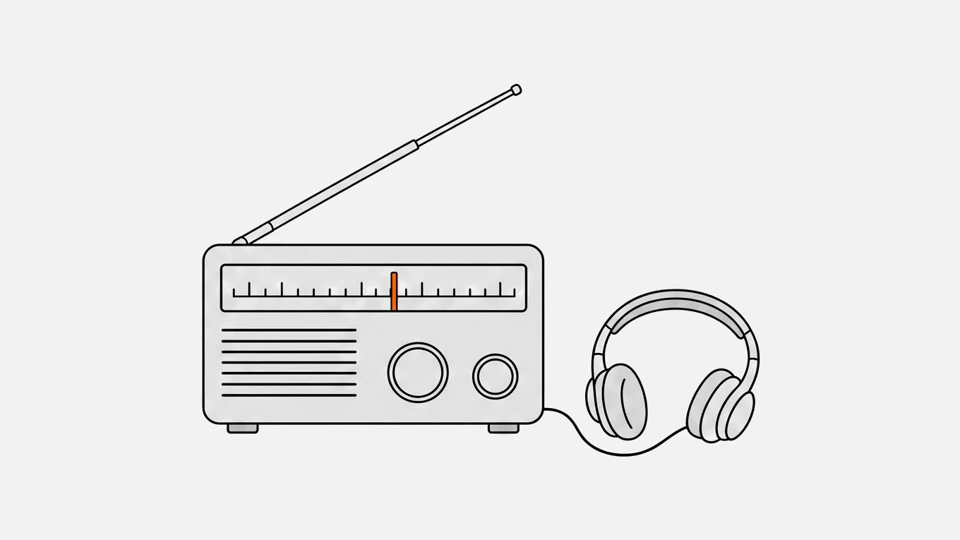
Any receiver that covers 3–30 MHz. A portable world-band radio with a telescopic antenna hears the big broadcasters. To hear hams, aircraft or ships you need SSB: a plain AM radio cannot make single-sideband voice readable.394047
| Kind | Good for |
|---|---|
| Portable world-band radio | International broadcasters on the built-in telescopic antenna3947 |
| DSP portable | The same with sharper filters; some have 40 or more filter widths, plus SSB and synchronous detection for clearer AM39 |
| Communications receiver | A larger tabletop set with more controls39 |
| Software-defined radio (SDR) | A receiver whose filtering and decoding are done in software, usually on a computer; see What is SDR?39 |
| Web receiver | No radio at all: you tune a receiver somewhere else in your browser. WebSDR started at the University of Twente in 2007 and lists over 100 receivers; KiwiSDR lists public receivers of its own545556 |
A few broadcasters, Radio Romania International and CRI among them, also send digital shortwave (DRM), which needs a DRM-capable receiver.3918
What antenna works for shortwave?
Start with the telescopic antenna, then add a length of wire outside. Listeners often use a random wire, any length, strung outdoors away from electrical noise. Below about 14 MHz, where noise is the limit, small loop antennas are common; a loop has a sharp null in one direction.414742
- Noise is the real enemy. The ARRL lists power lines, solar installations, LED lighting and household electronics among the sources of radio interference it deals with.43
- Lightning. An outdoor wire needs a way to disconnect the radio and ground the antenna before storms.4441
DXing, reception reports and QSL cards
DXing is hunting distant stations: DX is old telegraph shorthand for distance. Listeners send stations a reception report with time, frequency and a SINPO score, and many stations confirm it with a QSL card or an e-mail.454746
SINPO rates Signal, Interference, Noise, Propagation and Overall from 1 to 5, a code from 1951. Radio Romania International still prints reports such as "SINPO 45544" in 2026.4619 Utility stations answer too: Canada's NRC asks for reports on CHU, and AirNav Ireland has a QSL page for Shanwick and Shannon.2859
Check what you heard against a schedule, and keep EiBi's warning in mind: "The ONLY 100% ID is that which you hear on the radio yourself."17
Shortwave listening clubs and references
Before the internet, clubs were how listeners swapped logs and schedules, and a few still run. The printed handbook WRTH ends with its 2026 edition, while free schedules such as EiBi are updated every season.50515316
| Club or reference | What it is |
|---|---|
| NASWA | The North American Shortwave Association, sharing shortwave news since 1961; a monthly bulletin, The Journal50 |
| ANARC | The Association of North American Radio Clubs, founded in 1964 to link the clubs. It announced its disbanding at ANARCON 1990 but kept going in looser form; its site lists awards up to 20034849 |
| EDXC | The European DX Council, founded on June 4, 1967 by DX club leaders from six countries; it still holds conferences, the 2025 one in Sweden51 |
| WRTH | The World Radio TV Handbook, first published in 1947; the 2026 edition is the 80th and the last in print5253 |
| EiBi | Free schedules by Eike Bierwirth, sorted by time and frequency, renewed each season; anyone may use them, including in other software1617 |
Do you need a license to listen to shortwave?
Licenses are about transmitting; a shortwave receiver only listens. The UK's 1989 receiver regulations, for example, exempted equipment that cannot transmit, except TV sets and sets used to hear unlicensed pirate stations. Rules differ by country, so check your own.57
To talk back you need a ham license and a transceiver. Shortwave listening and ham radio share the same range but use different bands. The differences are on What is ham radio?, and how to get licensed in 14 countries is on How to get a ham radio license.
Is shortwave still useful in an emergency?
Yes, because it needs nothing between the transmitter and your radio. When local networks are down or blocked, broadcasters switch shortwave back on: the HFCC calls it often the only source of news in disaster areas.15
| When | What happened |
|---|---|
| March 2022 | The BBC added 15735 and 5875 kHz, four hours a day of English news that could be heard in Kyiv and parts of Russia; Austria's Ö1 put its news on 6155, 13730 and 5940 kHz25 |
| April 2025 | About two weeks of special broadcasts for the Democratic Voice of Burma went to Myanmar on 9430 and 17500 kHz58 |
| March 2026 | NHK raised its Japanese service to the Middle East from six to 24 hours a day, as internet and phone links in the region became unstable20 |
For two-way emergency radio, see What is ARES?.
Can a PoC radio receive shortwave?
No. A PoC radio talks over the mobile network through a push-to-talk app and has no shortwave receiver. The two work the opposite way: shortwave needs no network but only listens, while PoC talks both ways wherever there is mobile coverage. See What is a PoC radio? and types of two-way radio.
Questions
What frequency range is shortwave?
3 to 30 MHz, the ITU's HF band, wavelengths of 100 to 10 meters. Broadcasters often start counting at 1.6 MHz, listeners at 1.7 MHz.1447
Is shortwave radio still used?
Yes. International broadcasting still ran 61,538 hours a week on shortwave in winter 2025/26, and time stations, oceanic air traffic, ships and hams use it daily.152629
Why does shortwave work better at night?
The D layer, which absorbs the lower frequencies by day, fades after sunset, so bands below about 10 MHz open up and reach farther.56
Sources
- Recommendation ITU-R V.431-8: nomenclature of the frequency and wavelength bands (2015) · ITU (web archive copy)
- Shortwave radio · Wikipedia
- Shortwave radio, chapter 1 (Senate committee report) · Parliament of Australia
- Radio waves and the ionosphere, QST, November 1999 · ARRL, Ian Poole G3YWX
- Skywave · Wikipedia
- Maximum usable frequency · Wikipedia
- Joint solar maximum announcement · NOAA Space Weather Prediction Center
- Observed solar cycle indices (data) · NOAA Space Weather Prediction Center
Show all 59 sources
- F10.7 cm radio emissions · NOAA Space Weather Prediction Center
- Planetary K-index · NOAA Space Weather Prediction Center
- HF radio communications · NOAA Space Weather Prediction Center
- NOAA space weather scales · NOAA Space Weather Prediction Center
- EiBi shortwave schedules · Eike Bierwirth
- EiBi README: conditions of use and codes · Eike Bierwirth
- EiBi schedule A26 (Summer 2026), CSV · Eike Bierwirth
- Listeners' Letterbox: loads of reception reports (June 6, 2026) · Radio Romania International (web archive copy)
- NHK World-Japan begins round-the-clock shortwave broadcasts for Iran coverage (March 2026) · The SWLing Post, quoting NHK
- The hollow resurrection of US international broadcasting (January 2026) · Asia Times, Steve Herman
- Deutsche Welle · Wikipedia
- RCI ends shortwave broadcast (June 26, 2012) · CBC News
- Radio station WWV · NIST
- Radio station WWVH · NIST
- NRC shortwave station broadcasts (CHU) · National Research Council Canada (web archive copy)
- North Atlantic communications · AirNav Ireland
- HF distress and USCG contact frequencies · US Coast Guard Navigation Center
- Worldwide marine radiofacsimile broadcast schedules (March 7, 2025) · NOAA National Weather Service
- Radio broadcasts for shipping · Deutscher Wetterdienst
- Numbers station · Wikipedia
- UVB-76 · Wikipedia
- The Buzzer · Priyom.org
- Former State Department official and wife arrested for serving as illegal agents of Cuba (June 5, 2009) · US Department of Justice (web archive copy)
- United States v. Campa, 529 F.3d 980 (11th Cir. 2008) · US Court of Appeals (Georgetown Law copy)
- Shortwave radio receiver · Wikipedia
- Single-sideband modulation · Wikipedia
- Random wire antenna · Wikipedia
- Loop antenna · Wikipedia
- Lightning protection · ARRL
- DXing · Wikipedia
- SINPO code · Wikipedia
- Shortwave listening · Wikipedia
- NASWA Journal, October 1990 (scan) · North American Shortwave Association, via World Radio History
- ANARC home page (archive copy) · Association of North American Radio Clubs
- NASWA · North American Shortwave Association
- World Radio TV Handbook · Wikipedia
- WRTH · WRTH
- WebSDR background · PA3FWM
- WebSDR.org · PA3FWM, University of Twente
- KiwiSDR · KiwiSDR NZ
- The Wireless Telegraphy Apparatus (Receivers) (Exemption) Regulations 1989 · legislation.gov.uk
- HFCC news (April 24, 2025) · HFCC
- QSL reception report · AirNav Ireland