What are dPMR and NXDN?
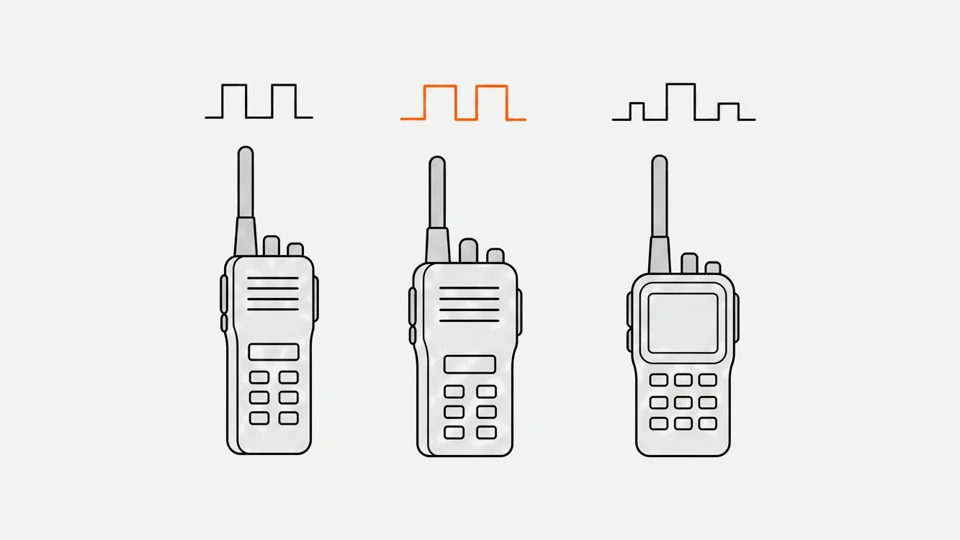
dPMR (digital Private Mobile Radio) is a European standard from ETSI. NXDN is an open protocol from a technical alliance of Icom and JVC Kenwood. Both are digital FDMA systems that give each voice call its own 6.25 kHz channel, half the width of the common 12.5 kHz business channel.14
ETSI describes dPMR as FDMA with 4FSK modulation at 6.25 kHz spacing, aimed at consumer, professional and public-safety markets.1 The NXDN Forum describes NXDN as a very narrowband protocol for 6.25 and 12.5 kHz channels.4 Both sit alongside DMR and TETRA among the types of two-way radio.
How does dPMR work?
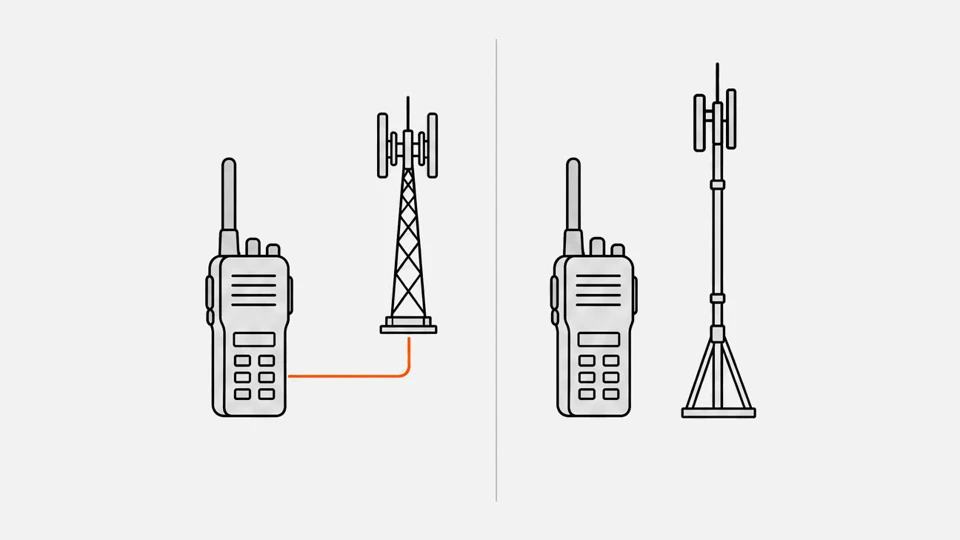
dPMR sends 2,400 symbols per second at two bits per symbol, 4,800 bit/s on one 6.25 kHz carrier. ETSI splits it into two documents: TS 102 490 for the license-free tier and TS 102 658 for licensed systems with three modes, from direct radio to trunked networks.123
| Parameter | dPMR |
|---|---|
| Access | FDMA, one call per 6.25 kHz carrier12 |
| Modulation | 4FSK, 2,400 symbols/s, 2 bits per symbol2 |
| Voice frame | 80 ms frames; four make a 320 ms superframe2 |
| Tier 1 (TS 102 490) | Peer to peer only, hand portables with an integral antenna, up to 500 mW e.r.p., 180 s transmit time-out3 |
| Tier 2, Mode 1 (TS 102 658) | Direct mode, no base stations2 |
| Tier 2, Mode 2 | One or more base stations for repeating or gateways2 |
| Tier 2, Mode 3 | Managed access with base stations, trunked12 |
| Spectrum rule | Designed to meet EN 301 166-22 |
The 4,800 bit/s figure follows from ETSI's symbol rate: 2,400 symbols a second, two bits each. A dPMR Memorandum of Understanding group formed in 2007 to promote the standard, and ETSI publishes test suites for Tier 1 and for Tier 2 Mode 1.1 DHS lists dPMR systems from many makers, single-site and multi-site, between 66 and 960 MHz.18
How does NXDN work?
NXDN uses 4-level FSK on 6.25 or 12.5 kHz channels. At 6.25 kHz the air interface runs at 4,800 bps with a 3,600 bps voice codec. At 12.5 kHz it doubles to 9,600 bps and 7,200 bps. Both conventional and trunked operation are defined.5
| Parameter | NXDN |
|---|---|
| Access | FDMA5 |
| Modulation | 4-level FSK5 |
| Channel spacing | 6.25 kHz and 12.5 kHz5 |
| Transmission rate | 4,800 bps at 6.25 kHz; 9,600 bps at 12.5 kHz5 |
| Voice codec rate | 3,600 bps and 7,200 bps5 |
| Trunking | Type-C and Type-D at 6.25 kHz; Type-C at 12.5 kHz5 |
| Security | 15-bit scrambling with 32,000 keys; AES and DES encryption5 |
| Trunked network size | Up to 60,000 IDs per system7 |
Voice is coded with the AMBE+2 vocoder from DVSI, which the Forum says is also used in dPMR, DMR and P25.8
Type-C trunking uses a dedicated control channel. Type-D is distributed: no control channel, and every channel can carry traffic.7 Icom and Kenwood began the work in 2003, announced NXDN at IWCE 2005 and shipped the first products in 2006. The Forum was founded in 2008, and the standards suite was opened up in 2012.6
The ITU-R accepted the NXDN air interface in Report M.2014-3, published in February 2017.9
What are Icom IDAS and Kenwood NEXEDGE?
IDAS is Icom's brand for NXDN radios and NEXEDGE is Kenwood's. Both are NXDN, each with the maker's own system features and radios. Icom also sells dPMR versions of its radios, and Kenwood lists NXDN, DMR and analog radios in the same product families.9101113
Icom's IC-F5122D and IC-F6122D show how the split works. The model has an NXDN version with IDAS digital mode and a dPMR version with Mode 1 and Mode 2 operation, each on its own product page and both with analog functions such as 2-tone and 5-tone signaling.1112 Icom lists IDAS trunking as NXDN Type-C and Type-D and dPMR Mode 3.10
Kenwood says NEXEDGE has been on the market since 2008, and its Gen2 generation, from 2015, can link up to 1,000 sites or 24 networks.9 The NXDN Forum's member list also includes other radio makers, among them Hytera, Lisheng and Alinco.16
NXDN vs DMR vs dPMR: what is the difference?
In FDMA, each call has its own carrier. In TDMA, as in DMR, two calls share one 12.5 kHz carrier in alternating time slots. The spectrum per call comes out the same, 6.25 kHz, but the radios and repeaters are built differently.1514
| dPMR | NXDN | DMR | |
|---|---|---|---|
| Standard body | ETSI1 | NXDN Forum; ITU-R Report M.2014-39 | ETSI14 |
| Access | FDMA1 | FDMA5 | TDMA, two slots14 |
| Channel width | 6.25 kHz1 | 6.25 or 12.5 kHz5 | 12.5 kHz14 |
| Calls per 12.5 kHz | Two carriers of 6.25 kHz | Two carriers of 6.25 kHz9 | Two time slots14 |
| Trunking | Mode 31 | Type-C, Type-D5 | Tier III14 |
| License-free version | dPMR4463 | None | DMR Tier I14 |
Two NXDN channels at 6.25 kHz fit inside one 12.5 kHz channel and can carry voice and voice, voice and data, or data and data.9 Icom and Kenwood both stress mixed analog and digital operation, which lets a fleet migrate one radio at a time.910
The practical difference in the US is spectrum. DHS counted over 3,000 channels there dedicated as 6.25 kHz channels in 2016, interleaved channels that no 12.5 kHz technology, DMR's two-slot TDMA included, can use. It credits part of NXDN's success to them and notes that some makers offer P25 and NXDN in dual-mode radios.18
Can dPMR, NXDN and DMR radios talk to each other?
No. They are separate air interfaces, and a radio set to one cannot join a call on another. ETSI says even the three DMR tiers work independently, with no interoperability across tiers. What does work is analog fallback: dual-mode radios receive analog and digital on the same channel.1014
Radios that speak several protocols switch between them. Kenwood's NX-1000 series is listed as NXDN, DMR and analog, and its NX-3000 mobiles as switchable between the three.13 That is one radio with several modes, not one protocol talking to another.
To check a specific pair, use the digital radio compatibility tool: dPMR and NXDN and NXDN and DMR are two ready-made comparisons.
Who uses dPMR and NXDN?
The NXDN Forum calls NXDN a business and industry solution that has spread to nearly every segment, public safety included. It counted well over half a million NXDN terminals by the end of 2011. ETSI names consumer, professional and public-safety markets for dPMR.164
NXDN grew out of the FCC's refarming rules for VHF and UHF land mobile radio, which, in the NXDN Forum's account, asked for 6.25 kHz or equivalent capability by January 1, 2005.6 The rule that took effect was looser: since January 1, 2013, US Part 90 stations in 150–174 and 406–512 MHz must use channels of 12.5 kHz or less.17 Kenwood reports NEXEDGE in more than 160 countries.13 dPMR follows the European route: licensed systems under national frequency plans and the license-free tier on 446 MHz.1
What is the difference between DMR446 and dPMR446 in Europe?
Both are license-free digital modes on 446.0–446.2 MHz in Europe. DMR446 (DMR Tier I) uses 12.5 kHz channels and two-slot TDMA; dPMR446 uses 6.25 kHz FDMA channels. Rules are the same for both: handheld only, integral antenna, 0.5 W ERP, 180 seconds maximum transmit time, no repeaters.31415
Dividing the 200 kHz band by the channel width gives 16 DMR446 channels and 32 dPMR446 channels. The CEPT decision asks for digital equipment to use 6.25 kHz or the equivalent per voice channel.15 In digital mode a dPMR446 radio does not decode DMR446 or analog PMR446 calls; it meets an analog radio only if it also has analog PMR446 channels. The band itself is explained on PMR446.
What are the pros and cons of dPMR and NXDN?
The main gain is capacity: 6.25 kHz per call, with NXDN also able to step up to 12.5 kHz at twice the data rate. The trade-offs are fewer trunking options for NXDN at 12.5 kHz and, for dPMR, Mode 3 telephone interconnect that Icom lists as a future feature.5710
| Point | Number |
|---|---|
| Spectrum per call | 6.25 kHz for both15 |
| NXDN data rate | 4,800 bps at 6.25 kHz, 9,600 bps at 12.5 kHz5 |
| NXDN codec rate | 3,600 bps and 7,200 bps5 |
| NXDN trunking at 12.5 kHz | Type-C only5 |
| NXDN system size | Up to 60,000 IDs7 |
| NXDN security | 32,000 scrambling keys; AES and DES5 |
| dPMR trunking | Mode 3; Icom lists telephone interconnect as available in the future10 |
| dPMR446 channels | 32 (arithmetic from 200 kHz / 6.25 kHz) |
A fleet already on analog can move to either standard radio by radio, since both makers sell radios that also work in analog.1012
How this relates to PoC radio
A dPMR or NXDN radio and a PoC radio both give a team push-to-talk, on different networks. The first pair uses its own licensed or license-free channels and works without a mobile network. A PoC radio sends voice as data over 4G/LTE, so range follows mobile coverage.
They meet at gateways. Icom's VE-PG4 RoIP gateway links IDAS systems with IP phones, LTE, wireless LAN and analog radios, which lets a team put smartphones on the same talk group as its NXDN radios.10 The wider comparison with a direct radio network is in PoC vs DMR, and the same logic holds for NXDN and dPMR.
| dPMR / NXDN | DMR | PoC / LTE | |
|---|---|---|---|
| Standard | ETSI TS 102 490 and 102 658 / NXDN Forum25 | ETSI TS 102 36114 | Set by the PTT platform |
| Radio channel | 6.25 kHz FDMA (NXDN also 12.5 kHz)15 | 12.5 kHz, two time slots14 | The mobile operator's LTE bands |
| Network | Direct, repeater or trunked27 | Direct, repeater or trunked14 | Mobile network and a PTT server |
| Range | Radio to radio; repeaters extend it | Radio to radio; repeaters extend it | Wherever there is mobile data or Wi-Fi |
| Access or license | Licensed on business channels; dPMR446 license-free3 | Licensed on business channels; DMR446 license-free15 | A SIM and a PTT service |
| Data | Short data; NXDN also GPS and status messages7 | Short data | Mobile broadband |
Questions
Is NXDN better than DMR?
Neither is better in general. NXDN gives each call its own 6.25 kHz carrier (FDMA) and DMR gives two time slots to one 12.5 kHz carrier, so spectrum per call is the same. DMR is an ETSI standard with a license-free tier on 446 MHz. NXDN has Icom and Kenwood behind it and ITU-R recognition.5914
Can an NXDN radio talk to a dPMR radio?
No, they use different air interfaces. A radio that supports both has to be switched to one mode per channel. See the dPMR and NXDN comparison.13
Is dPMR license-free?
Only the Tier 1 version, dPMR446, on 446.0–446.2 MHz, with up to 500 mW and no repeaters. Tier 2 systems with repeaters or trunking are licensed under national rules.13
Does NXDN work on 12.5 kHz channels?
Yes. NXDN is defined for both 6.25 and 12.5 kHz. At 12.5 kHz the air interface runs at 9,600 bps and trunking is Type-C.5
Who makes NXDN radios?
Icom (IDAS) and JVC Kenwood (NEXEDGE) created it. The NXDN Forum's member list also names Hytera, Lisheng and Alinco.916
Can NXDN radios reach PoC users?
Through a gateway. Icom's VE-PG4 RoIP gateway connects IDAS systems with IP phones, LTE, wireless LAN and analog radios.10
Sources
- NXDN: a brief overview · NXDN Forum (archived copy; the live site now asks for a login)
- Technical specifications of NXDN · NXDN Forum (archived copy; the live site now asks for a login)
- The history of NXDN · NXDN Forum (archived copy; the live site now asks for a login)
- NXDN Trunking · NXDN Forum (archived copy; the live site now asks for a login)
- Vocoder · NXDN Forum (archived copy; the live site now asks for a login)
- IDAS solutions · Icom America
Show all 18 sources
- IC-F5122D / IC-F6122D dPMR version · Icom America
- IC-F5122D / IC-F6122D NXDN version · Icom America
- NEXEDGE NXDN, DMR and dPMR digital radios · Kenwood Communications Europe
- Who are our members? · NXDN Forum (archived copy; the live site now asks for a login)
- 47 CFR 90.209: Bandwidth limitations · Cornell LII, electronic Code of Federal Regulations
- Public safety interoperability implications of non-P25 radio technologies (July 2016) · DHS Office of Emergency Communications