Why does a radio need an approval mark?
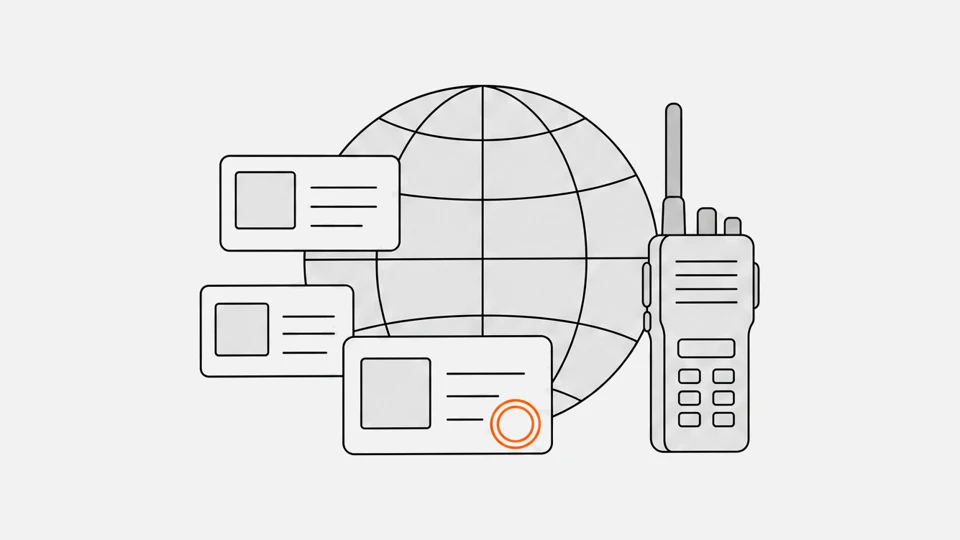
A radio sends energy into shared air, so every market asks for proof that a model stays in its bands, at its power, without disturbing others. The proof is a mark, a number or a registration. Each country has its own rules, its own regulator and its own label.1610
This page is the map. It tells you which mark belongs to which market, what the mark proves, where to look it up and what happens when you carry a radio across a border. Operating licenses are a separate topic: see two-way radio licensing and radio regulations by country.
Which approval mark does each country use?
Eight markets, eight systems. The table shows the mark, the regulator, what it proves, where you check it and what it means for a radio from abroad. Read the row for the market where the radio will be sold, because a mark only works in the market it names.136101114182328
| Country | Regulator | Mark or ID | What it proves | Where to look it up | Foreign radio |
|---|---|---|---|---|---|
| EU | European Commission; national market surveillance | CE mark | The maker declares the radio meets the Radio Equipment Directive 2014/53/EU1 | The EU declaration of conformity from the maker or seller1 | Sold only with CE; a US-only radio lacks it |
| United Kingdom | Trading Standards for product safety; Ofcom for spectrum | UKCA, or CE accepted | The radio meets the Radio Equipment Regulations 2017; CE has been recognized since 1 October 202434 | The declaration of conformity; the mark on the radio | CE-marked radios are accepted in Great Britain |
| United States | FCC | FCC ID | The FCC or a recognized body granted equipment authorization6 | FCC ID search by grantee code and product code7 | Needs its own grant to be marketed or imported |
| Canada | ISED | IC: XXXXX-YYYYYYYYYYY | The model has an ISED certification and a listing11 | Radio Equipment List (REL) search11 | An FCC ID alone is not a Canadian approval |
| Australia | ACMA | RCM | The supplier is registered on the national database, holds a declaration of conformity and any required test evidence14 | The supplier's registration and declaration | License-free handhelds are UHF CB radios on 476–477 MHz; ACMA warns overseas radios are probably on other frequencies34 |
| Japan | MIC (Soumu) | Giteki mark | The radio has a technical conformity certification or a self-confirmation18 | The mark on the radio | The 90-day visitor rule covers Wi-Fi and Bluetooth-type devices1920 |
| Brazil | Anatel | Anatel seal with a homologation number | The product is homologated, after certification by a designated body23 | The homologation number on the seal | No sale or use without homologation23 |
| India | WPC (DoT); TEC | ETA, plus MTCTE where listed | WPC approved the type for import, sale and use; TEC certifies listed classes2831 | The ETA or MTCTE certificate from the seller | ETA is required for import, sale and use28 |
What do CE, UKCA and the Northern Ireland marks mean?
CE is the maker's statement that the radio meets the Radio Equipment Directive. UKCA is the British equivalent. Great Britain accepts both, and Northern Ireland follows the EU directive, so a radio sold there carries CE, or CE plus UKNI, and never UKCA.134
Behind CE stands the EU declaration of conformity.2 Detail is in Radio Equipment Directive. UKCA may sit on a label or on an accompanying document until 31 December 2027, and the UK security law is in UK PSTI Act and UKCA.3 A CE-marked radio can therefore be sold in the EU, Northern Ireland and Great Britain. A UKCA-only radio cannot go to the EU.
What is an FCC ID?
An FCC ID is the identifier of an FCC equipment authorization. The first three or five characters are the grantee code the FCC assigns to the company, and the rest is the product code the company chooses. Every radio transmitter sold or imported in the US needs a grant, and the grant is public.67
You look it up in the FCC ID search, and the grant shows frequency range, power and test reports. The full walkthrough, labels, import rules and the Covered List are in FCC ID and certification. The FCC ID answers one question: may this model be marketed in the United States.
What is the IC number in Canada?
The IC number is the certification number of Innovation, Science and Economic Development Canada (ISED). The label reads "IC: XXXXX-YYYYYYYYYYY". "IC:" is not part of the number. XXXXX is the company number ISED assigns, and the product number has up to eleven digits and capital letters.11
The label also shows the hardware version identification number (HVIN). The marketing name, HVIN and certification number must match the entry in the Radio Equipment List (REL), which is the place to look it up: search by certification number, then HVIN, then marketing name.11 A radio inside a host product is marked "Contains IC: XXXXX-YYYYYYYYYYY".11
License-exempt devices also carry a bilingual compliance notice in English and French.11 The legal base is the Radiocommunication Act, which bars anyone from manufacturing, importing, distributing, leasing, offering for sale or selling radio apparatus that needs a technical acceptance certificate unless it is certified.10
| Item | Rule |
|---|---|
| Category I radios | Must be listed on the REL before sale11 |
| FRS and GMRS | RSS-210 Annex E; no encryption or voice inversion; frequency circuitry closed to the user13 |
| Import of uncertified radios | An offense; equipment bought abroad "may not comply"12 |
| Top administrative penalty | Up to $10,000,000 for a company10 |
| RSS-Gen Issue 6 | Published 30 July 2026; Issue 5 and 6 applications are accepted for one year11 |
In practice, a US radio with an FCC ID only is not an approved radio in Canada. It needs an IC number and an REL entry, even when FRS and GMRS are license-exempt in both countries.
What is the RCM in Australia?
The RCM, the regulatory compliance mark, shows that the supplier met the Australian labeling rules. The supplier must be registered on the national database and hold a declaration of conformity. Depending on the radio class, the supplier also keeps test evidence from an accredited body.14
The rules are the Radiocommunications Equipment (General) Rules 2021. They bar supplying a device that lacks the required standard or label, and the duties fall on manufacturers and importers.14 There are two general compliance levels:
| Level | Devices | Evidence in practice |
|---|---|---|
| Level 1 | Short Range Equipment and Intelligent Transport Systems standards | Description and signed declaration of conformity |
| Level 2 | Every other device, including UHF CB (AS/NZS 4365) | Level 1 plus written test evidence |
A UHF CB radio sits under a class license and still needs the standard and the RCM. License-free handhelds in Australia are UHF CB radios on 476–477 MHz, and ACMA warns that a radio bought overseas is probably on other frequencies.34 Licensing is in two-way radio licensing.
What are the Smart Device Rules from 4 March 2026?
The Cyber Security (Security Standards for Smart Devices) Rules 2025 apply to products manufactured on or after 4 March 2026. They cover consumer-grade connectable products: personal, domestic or household devices an Australian consumer acquires. They exclude desktop computers, laptops, tablets, smartphones, therapeutic goods and road vehicles. Radios are not excluded.1516
The three requirements are the same shape as the UK's:
- Passwords: unique per product or set by the user, never counter-based or taken from a serial number.
- Vulnerability reporting: a published contact point, free, in English, with no personal data.
- Support period: a published end date for security updates, shown on the maker's own sales page.15
A statement of compliance travels with the product, and the maker keeps it for five years.15 Makers and suppliers answer for non-compliant products when they know, or could reasonably be expected to know, that an Australian consumer will acquire them. The regulator is the Technology Assessment and Regulation Office in Home Affairs.1516
The Rules apply to products that connect to the internet over IP, or that connect to two or more products at once by a non-IP protocol and to an internet-connectable product.17 In practice, a consumer LTE or Wi-Fi radio fits that wording. An analog radio with no IP link and no Bluetooth does not, and a Bluetooth radio fits when it can link to two devices at once and to an internet-connectable one. A radio sold only to companies likely falls outside the household class.
What is the Giteki mark in Japan?
The Giteki mark (技適マーク) is the technical conformity mark of Japan's Radio Act. Radio equipment with it may be used without an individual station license in the cases the Act lists. It comes from a conformity certification, a design certification or a self-confirmation.18
Article 4 of the Radio Act exempts stations of 1 W or less from licensing when they use only radio equipment with a conformity mark. Operating a station without the license or registration it needs is punishable by up to one year in prison or a fine of up to 1 million yen.18 Registered digital simple radios, up to 5 W, need registration with the regional bureau.
Can a visitor use a foreign radio in Japan?
Only some devices. Under Article 4-2(1), a person entering Japan may use their own radio equipment that meets technical rules corresponding to Japan's, and it is treated as marked for up to 90 days. The 2018 handout names Wi-Fi and Bluetooth terminals; later ones add a few short-range types.1920
A 180-day route lets a person use unmarked equipment for experiments after notifying the Minister.20 Voice walkie-talkies, whether FRS, PMR446, GMRS or CB, appear in neither list. In practice, the 90-day rule covers a visitor's phone and headset, and a visitor's foreign walkie-talkie stays outside it.
What is JC-STAR?
JC-STAR is Japan's IoT security labeling scheme from IPA and METI. Operation began on 25 March 2025. Level 1 is the baseline for all IoT products, level 2 adds product-type requirements, and levels 3 and 4 need third-party evaluation. Levels 1 and 2 are vendor self-declarations. The ministry's committee report calls the scheme voluntary.2122
Separately, since April 2020 the Terminal Equipment Ordinance sets mandatory rules for IoT devices that connect directly to telecom lines: access control with a preset ID and password, a unique password or a prompt to change it, firmware updates and settings that survive a power loss. A committee report of 8 December 2025 proposes tightening them.22 In practice, a radio that connects directly to a carrier network goes through terminal certification on top of Giteki.
What is Anatel homologation in Brazil?
Homologation is Anatel's approval of a telecom product. It follows certification by a designated body and gives the product a personal, non-transferable code. The product carries the Anatel seal with that number. The service page states that using or selling telecom products in Brazil without homologation is not permitted.23
The request runs through the CERTIFICA system with a gov.br Silver or Gold account, with an estimated 16 to 30 days.23 The legal basis is Resolução 715 of 23 October 2019.24 A radio can be license-free and still need the Anatel code: license-free "rádio de uso geral" equipment is exempt from authorization but must be certified.
What does Ato 77/2021 require?
Ato 77 of 5 January 2021 approved Anatel's cybersecurity requirements for telecom equipment. It entered into force 180 days after publication. It covers products with an internet-connected terminal function, and the applicant declares which requirements the product meets when it files for certification and homologation. Anatel may check the declaration later.24
The annex draws on ETSI EN 303 645 and ETSI TS 133 117 and requires that credentials not be hard-coded.24 In practice, an LTE PoC radio is an internet-connected terminal and fits that scope, while an analog radio with no internet function does not.
What did Anatel do against non-homologated products in 2025?
Anatel sealed 3,300 irregular products in eight marketplace distribution centers on 26 and 27 May 2025, and seized 1,587 non-homologated items after Black Friday, on 2 and 3 December 2025.2526 The Ministry of Communications says marketplaces now share liability with sellers for offering them.27
What is WPC ETA and MTCTE in India?
ETA, Equipment Type Approval, is the WPC approval needed to import, sell and use wireless devices in de-licensed bands. A finished product can get it by self-declaration, for Rs 10,000, valid for life unless WPC revokes it. MTCTE is a separate TEC certification for listed telecom products.2831
Self-declaration ETA excludes radar, jammers, drones and satellite equipment.28 Import adds a second step. Under Notification 71 of 1953 a license is needed to import any wireless transmitter, receiver or transceiver. For radio devices in notified license-exempt bands in the "free" category of the import policy, a system-generated import undertaking replaces a separate license. Restricted items need scrutiny-based ETA and a separate import license.2930
MTCTE Phase 4 lists VHF/UHF radio system equipment, including VHF/UHF handheld portable stations, mobile stations and base stations, with mandatory certification from 1 August 2024. Trunked mobile radio stations, handheld included, and SIM, eSIM and USIM share that date. HF radio started on 1 April 2024.31 The IoT code of practice, TEC 31318:2025, has 13 guideline topics in the style of ETSI EN 303 645, and the binding part is MTCTE.32 Confirm a model's class on the MTCTE portal before import. The 446 MHz license-exempt band is in two-way radio licensing.
What is the difference between CE and FCC?
CE is a maker's declaration under the Radio Equipment Directive. An FCC ID is a grant that the FCC or a recognized body issues after reviewing test data. Each is valid only in its own market: a US FCC radio has no CE statement, and a CE radio has no FCC grant.16
| CE (EU) | FCC ID (US) | |
|---|---|---|
| Who decides | The maker, through the conformity route; a notified body for some radios1 | The FCC or a recognized certification body6 |
| Document | EU declaration of conformity and technical file1 | Grant of equipment authorization, public7 |
| Rules tested | Radio Equipment Directive, with EU standards1 | 47 CFR: Part 95 for FRS and GMRS, Part 90 for business radios, Parts 22, 24, 27 for cellular, Part 15 for Wi-Fi and Bluetooth6 |
| Lookup | Declaration from the maker or seller | FCC ID search7 |
| Cyber rules | Article 3(3)(d), (e), (f) since 1 August 2025; Cyber Resilience Act later | Cyber Trust Mark, voluntary |
The two systems test against different rules. EU radios are checked for the bands, power and channel plan of the EU, for example PMR446 at 0.5 W, and US radios for the US plan, for example FRS under Part 95. A radio built for one plan can transmit in places the other market does not allow. That is why a US FRS radio is not automatically legal in the EU, and a CE-marked PMR446 radio is not automatically legal in the US. Each needs the mark of the market where it is sold.16
The FCC has said a radio able to transmit outside its authorized bands is not legal to use, and it has warned about imported VHF and UHF radios that do (see FCC ID and certification). For the EU side, see PMR446.
How do the cyber rules compare across markets?
Cyber rules sit next to approval marks. The table puts the main ones side by side with their status and scope. The EU, the UK and Australia set mandatory duties for connected products, and the US label is voluntary. Japan, Brazil and India tie their rules to terminal certification or to the approval itself.
| Market | Rule | Status | Applies to |
|---|---|---|---|
| EU | Cyber Resilience Act | Mandatory: reporting from 11 September 2026, main duties from 11 December 202733 | Products with a data connection, consumer or business |
| UK | PSTI Act | Mandatory since 29 April 20245 | Connectable products for UK consumers |
| Australia | Smart Device Rules | Mandatory for products made from 4 March 202615 | Connectable consumer-grade products; smartphones excluded |
| US | Cyber Trust Mark | Voluntary; the program is still being set up9 | Wireless consumer IoT products |
| Japan | JC-STAR | Voluntary since 25 March 2025; terminal rules mandatory since April 20202122 | IoT products |
| Brazil | Ato 77 | Declaration at homologation, in force since 202124 | Internet-connected terminals |
| India | MTCTE | Mandatory certification for listed classes31 | Listed telecom products |
The UK and Australian rules share their three requirements: no universal default password, a published vulnerability contact and a published support period. Japan's JC-STAR level 1 label counts as deemed compliance with PSTI since 4 December 2025.5 The EU act is wider and adds a conformity assessment and CE marking under the act. Detail: Cyber Resilience Act, UK PSTI Act.
What does it mean for makers who export radios?
One radio design usually needs one certification file per market. Plan the product line around the table above, because each region has its own mark, its own regulator and its own local contact. The list gives one line for each group of regions:
- EU and UK: CE covers the EU, Northern Ireland and Great Britain. Add UKCA only if you want it on the label.
- US and Canada: two separate approvals. An FCC grant does not give an IC number, and the reverse. In practice, a dual-mode design that adds an LTE modem to an FRS or GMRS radio runs into the Annex E restriction in Canada, so each certification route gets its own model.13
- Australia, Japan, Brazil, India: a registered local supplier or importer, a local mark and a local record. Plan lead times: Anatel estimates 16 to 30 days for the request itself.23
- Connected models: add the cyber file for each market: statement of compliance for the UK and Australia, the RED cyber points and later the Cyber Resilience Act for the EU.
What does it mean for importers and shops?
An importer carries its own duty in most of these markets. Ask the supplier for the declaration of conformity, the grant or the registration before you list a model. The duties differ by country, and the list gives them one by one.
- Canada: an uncertified radio may not be imported, distributed, offered or sold, and penalties reach $10,000,000 for a company.10
- Australia: shops may not supply a device without the label.14
- Brazil: marketplaces share liability with sellers, and warehouse stock can be sealed.2527
- United States: the FCC marketing and import rules apply to the seller.68
What does it mean for travelers with radios?
Carrying a radio across a border brings it under that country's rules, and the mark on the label shows which country approved it. Four examples follow: a US FRS radio in Canada, a PMR446 or FRS radio in Australia, a walkie-talkie in Japan and any radio in Brazil.
- US FRS radio to Canada: needs an IC number; the FCC ID alone is not an approval.1112
- PMR446 or FRS radio to Australia: license-free handhelds there are UHF CB radios on 476–477 MHz, so a PMR446 or FRS radio is on other frequencies.34
- Walkie-talkie to Japan: in practice the 90-day visitor rule covers Wi-Fi and Bluetooth-type devices, not voice walkie-talkies.1920
- Any radio to Brazil: the service page states that use without homologation is not permitted.23
For band rules see PMR446 and FRS and GMRS. A phone-based PoC radio is checked by its LTE bands, in the LTE band checker.
What does it mean for companies with fleets in several countries?
Buy region-specific models. A fleet should carry the mark of each country where it works: CE for Europe, an FCC ID for the US, an IC number for Canada, the Giteki mark in Japan, the Anatel seal in Brazil and an ETA in India.
For connected radios, ask each vendor for the statement of compliance and the published support end date, as the UK and Australian rules require. Cross-border moves of US-only units into Canada are an import issue.12
Questions
What is the difference between CE and FCC?
CE is the maker's declaration of conformity with the EU Radio Equipment Directive. An FCC ID is a grant from the FCC for the US market. Each is valid only in its own market, and a radio needs the mark of the country where it is sold.16
Is a CE-marked radio legal in the UK?
Yes for sale in Great Britain. The government guide says the UK continues to recognize CE marking, and radio equipment is covered by SI 2024/696. The radio must still meet GB requirements.34
Can I use a US radio in Canada?
Only if the model also has an IC number and an REL listing. ISED says equipment acquired outside Canada may not comply, and importing uncertified radios is an offense.1112
What does an RCM mean on a radio?
The supplier is registered on the national database and holds a declaration of conformity and, for some classes, test evidence. License-free handhelds in Australia are UHF CB radios on 476–477 MHz.1434
Does a walkie-talkie need a Giteki mark?
A radio used license-free in Japan needs it. The visitor rule of 90 days names Wi-Fi and Bluetooth-type devices, not voice walkie-talkies.181920
Can I buy a radio abroad and use it in Brazil?
The Anatel service page states that use or sale of telecom products without homologation is not permitted. Look for the Anatel seal with a homologation number.23
Sources
- Radio Equipment Directive (RED) and RED Guide · European Commission
- 47 CFR 2.907: Certification · eCFR, FCC
- FCC ID search · FCC
- 47 CFR 2.1204: Importation of devices · eCFR, FCC
- U.S. Cyber Trust Mark · FCC
- Radiocommunication Act, section 4 · Justice Laws, Government of Canada
Show all 34 sources
- Importing wireless equipment into Canada · ISED Canada
- Radiocommunications Equipment (General) Rules 2021 · Federal Register of Legislation, Australia
- Cyber Security (Security Standards for Smart Devices) Rules 2025 · Federal Register of Legislation, Australia
- Security standards for smart devices · Department of Home Affairs, Australia
- Cyber Security Act 2024, section 13 · Federal Register of Legislation, Australia
- Radio Act, English translation · Japanese Law Translation, Government of Japan
- Handout on using radio equipment in Japan, 7 December 2018 · Ministry of Internal Affairs and Communications
- Handout on special exceptions for visitors and experiments · Ministry of Internal Affairs and Communications
- Report on terminal equipment security, 8 December 2025 · Ministry of Internal Affairs and Communications
- Homologate telecommunications products · gov.br, Anatel
- Anatel regulation formalizes joint liability of digital platforms · Ministry of Communications, Brazil
- Equipment Type Approval (ETA) · Department of Telecommunications, India
- Import license · Department of Telecommunications, India
- Compendium of orders related to import license, 6 July 2022 · Department of Telecommunications, India
- MTCTE amendment notification F.No. 5-2/2024-TC/TEC, 1 July 2024 · Telecommunication Engineering Centre, India
- Code of Practice for Securing Consumer IoT, TEC 31318:2025 · Telecommunication Engineering Centre, India