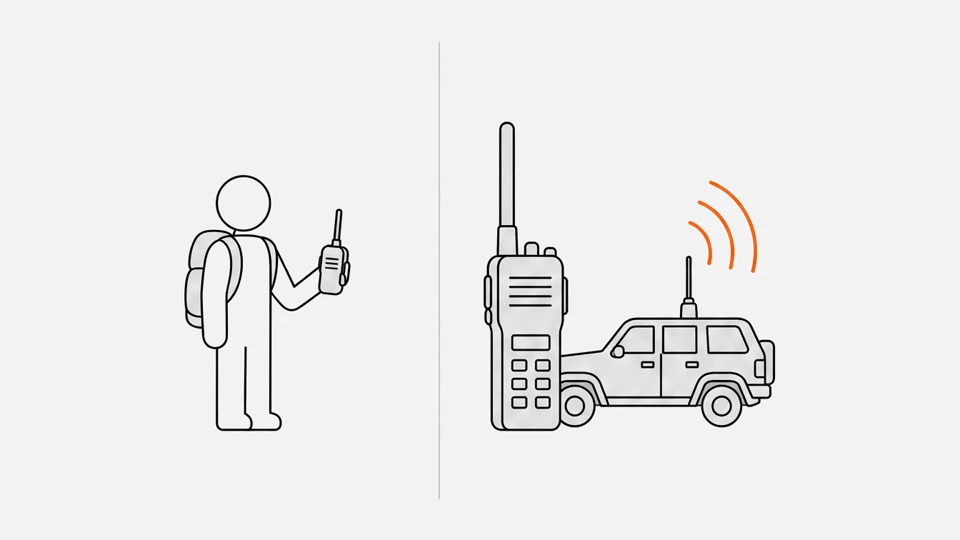
What is a GMRS radio?
A GMRS radio is a two-way radio for the General Mobile Radio Service, set out in 47 CFR Part 95 Subpart E. It works on 30 channels near 462 and 467 MHz and needs an FCC license. The FCC names short-distance voice with hand-helds, mobile radios and repeaters as the most common use.12
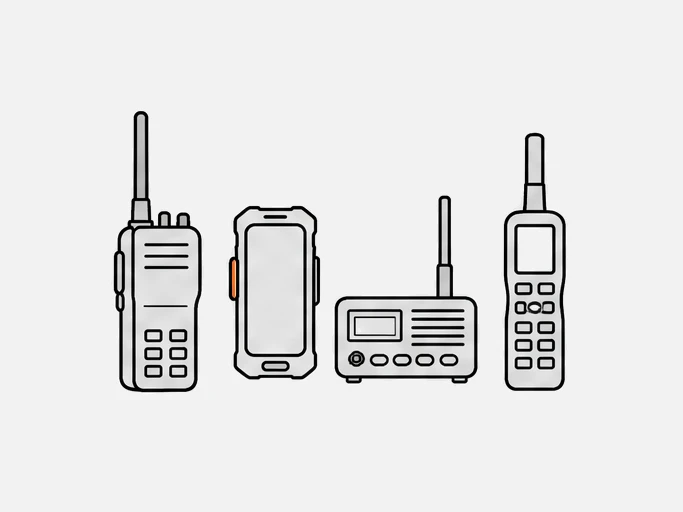
A license covers the licensee and family. The FCC says that if you receive a license, "any family member, regardless of age, can operate GMRS stations and units within the licensed system."1 Radios come as hand-helds, vehicle-mounted mobiles and base stations, plus repeaters.2 GMRS is one of the types of two-way radio.
What is FRS?
FRS, the Family Radio Service, is the license-free side of the same channels. It has 22 channels of 12.5 kHz each, all shared with GMRS.3 The FCC says FRS is licensed by rule, so no individual license is needed if you follow the rules.4
| FRS rule | What it says |
|---|---|
| License | None; the radio must be FCC-certified5 |
| Power | 0.5 W ERP on channels 8–14; 2 W on 1–7 and 15–226 |
| Antenna | A built-in, non-removable part of the radio7 |
| Data | Location, a location request or a brief text message; one burst of 1 s at most every 30 s8 |
| Talk to GMRS | Allowed; FRS units may communicate with GMRS stations8 |
How do FRS and GMRS share 22 channels?
FRS channels 1–7 and 15–22 are also GMRS channels, and FRS 8–14 are GMRS hand-held channels. GMRS adds eight more channels at 467.550–467.725 MHz that FRS does not use. In all, the FCC counts 30 GMRS channels: 16 main and 14 interstitial.12 The table gives each shared channel with its power limit.
| Ch | MHz | Group | FRS limit (ERP) | GMRS limit |
|---|---|---|---|---|
| 1 | 462.5625 | 462 interstitial | 2 W6 | 5 W ERP9 |
| 2 | 462.5875 | 462 interstitial | 2 W | 5 W ERP |
| 3 | 462.6125 | 462 interstitial | 2 W | 5 W ERP |
| 4 | 462.6375 | 462 interstitial | 2 W | 5 W ERP |
| 5 | 462.6625 | 462 interstitial | 2 W | 5 W ERP |
| 6 | 462.6875 | 462 interstitial | 2 W | 5 W ERP |
| 7 | 462.7125 | 462 interstitial | 2 W | 5 W ERP |
| 8 | 467.5625 | 467 interstitial | 0.5 W6 | 0.5 W ERP, hand-held only9 |
| 9 | 467.5875 | 467 interstitial | 0.5 W | 0.5 W ERP, hand-held only |
| 10 | 467.6125 | 467 interstitial | 0.5 W | 0.5 W ERP, hand-held only |
| 11 | 467.6375 | 467 interstitial | 0.5 W | 0.5 W ERP, hand-held only |
| 12 | 467.6625 | 467 interstitial | 0.5 W | 0.5 W ERP, hand-held only |
| 13 | 467.6875 | 467 interstitial | 0.5 W | 0.5 W ERP, hand-held only |
| 14 | 467.7125 | 467 interstitial | 0.5 W | 0.5 W ERP, hand-held only |
| 15 | 462.5500 | 462 main | 2 W | 50 W output, mobile, base, repeater9 |
| 16 | 462.5750 | 462 main | 2 W | 50 W output |
| 17 | 462.6000 | 462 main | 2 W | 50 W output |
| 18 | 462.6250 | 462 main | 2 W | 50 W output |
| 19 | 462.6500 | 462 main | 2 W | 50 W output |
| 20 | 462.6750 | 462 main | 2 W | 50 W output |
| 21 | 462.7000 | 462 main | 2 W | 50 W output |
| 22 | 462.7250 | 462 main | 2 W | 50 W output |
FRS limits are effective radiated power (ERP), while GMRS main-channel limits are transmitter output power, so 50 W is not a limit that applies to every shared channel. Fixed stations on the main channels are held to 15 W.69 Any channel can be looked up in the frequency charts.
What changed in the 2017 FCC rules?
In 2017 the FCC reorganized the Personal Radio Services in the Report and Order FCC 17-57, adopted May 18, 2017 and in force from September 28, 2017. It doubled the GMRS license term, raised FRS power to 2 W on most channels, allowed short data and ended dual-service FRS/GMRS hand-helds.1011
| Change | Detail |
|---|---|
| GMRS license term | Five years became ten10 |
| FRS power | 0.5 W became 2 W on channels 1–7; the 462 MHz main channels were added to FRS10 |
| GMRS data | Location and short text allowed110 |
| Combination radios | No new equipment grants for FRS/GMRS hand-helds from December 27, 2017; no manufacture, import or sale from September 30, 201911 |
Before 2017 most "FRS" radios on the shelf were combination radios with 22 channels and 2 W on the GMRS channels, and most owners had no GMRS license. The FCC reclassified combination radios that meet its technical rules as FRS only.10 The FCC adds that existing radios were reclassified as either FRS or GMRS.4
Do I need a GMRS license?
Yes, for any GMRS station. The FCC says a license is required to operate a GMRS system. Anyone aged 18 or older who is not a representative of a foreign government may apply, and one license costs $35, lasts ten years and covers the licensee's immediate family.11213
| License item | Value |
|---|---|
| Fee | $35 for a new license, modification and renewal12 |
| Term | Ten years13 |
| Who is covered | The licensee and immediate family members113 |
| Exam | None in the rules; the FCC lists age and eligibility only113 |
| Call sign | Give it at the end of a communication and at least every 15 minutes14 |
| Emergencies | Any GMRS channel may be used for emergency or traveler assistance15 |
The FCC says new licenses go only to individuals, not companies; a few older non-individual systems may still renew.1 Check your own case in the license checker. The 462.675 MHz "travel" channel is a habit; any GMRS channel may be used for emergencies.15
How do GMRS repeaters work?
A GMRS repeater receives on an input channel and retransmits on an output channel, which extends coverage. The eight inputs are 467.550 to 467.725 MHz and the eight outputs are 462.550 to 462.725 MHz, 25 kHz apart.2 These are the 8 repeater pairs.
FRS radios cannot use a repeater: they may transmit only on the 22 FRS channels, and the 467 MHz main channels are not among them.37
| Pair | Repeater output (radio hears), MHz | Repeater input (radio sends), MHz |
|---|---|---|
| 15R | 462.550 | 467.550 |
| 16R | 462.575 | 467.575 |
| 17R | 462.600 | 467.600 |
| 18R | 462.625 | 467.625 |
| 19R | 462.650 | 467.650 |
| 20R | 462.675 | 467.675 |
| 21R | 462.700 | 467.700 |
| 22R | 462.725 | 467.725 |
The rule text lists the inputs and outputs but not the pairs or the "R" numbers. The usual pairing keeps the same last digits and adds 5 MHz, so 462.675 MHz output goes with 467.675 MHz input. That is a common practice, not a rule.2 A licensee may open a repeater to anyone or limit it.13
The FCC also limits linking. GMRS stations cannot be connected to the telephone network or any other network to carry communications, except for remote control of a repeater. Linking repeaters over the internet to extend range violates sections 95.1733(a)(8) and 95.1749.1
How far does GMRS reach?
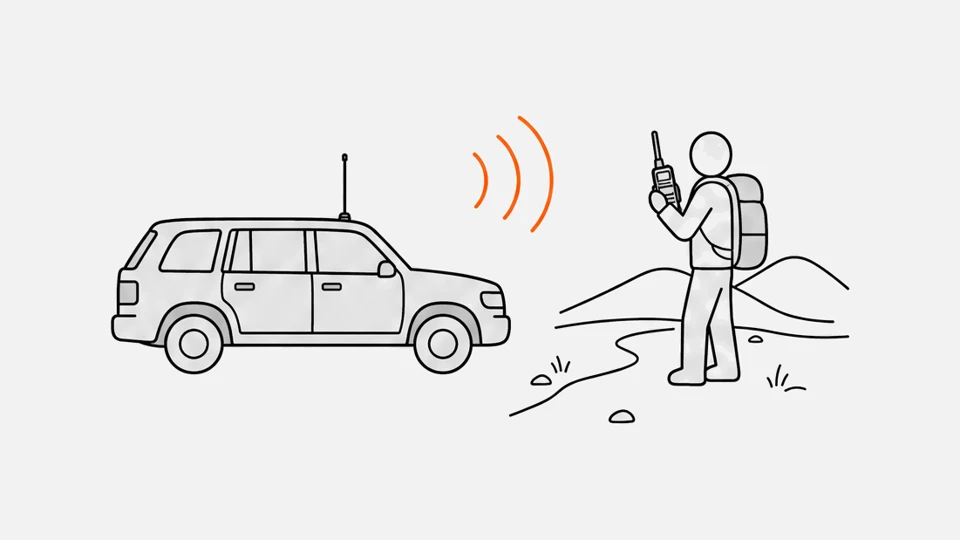
The FCC says a GMRS user can expect one to twenty-five miles depending on station class, terrain and repeater use.1 On FRS, the FCC says the usual range on channels 8–14 is less than half a mile, and longer on channels 1–7 and 15–22 depending on conditions.4
Cobra, which makes 2 W hand-held radios, lists these as typical:
| Setting | Typical range |
|---|---|
| Between buildings or houses | 675 ft to 0.5 mile |
| Urban | 0.5–1 mile |
| Suburban | 1–2+ miles |
| Flat open ground | 1.5–3+ miles |
| Woodland | 0.5–1.5 miles |
These are the maker's typical figures for the 2 W class.16 A mobile radio with a roof antenna, up to 50 W, or a repeater on a hill does better. Model your own site in the range calculator.
What are handheld and mobile GMRS radios?
A handheld GMRS radio is a portable unit. It is the only station type allowed on the 467 MHz interstitial channels (FRS 8–14).29 A mobile GMRS radio is installed in a vehicle and may transmit at up to 50 W transmitter output on the 462 MHz main channels.9 Both can use a repeater.2
A hand-held that only does FRS must have a non-removable antenna.7 A GMRS hand-held is certified under the GMRS rules, and the 2017 rules ended combination hand-helds.11
Is GMRS the same in Canada?
No. In Canada, FRS and GMRS handhelds are license-exempt. Innovation, Science and Economic Development Canada (ISED) lists the same 22 simplex channels, 0.5 W ERP on channels 8–14 and 2 W on the others, in RSS-210.17 No GMRS license is needed.
The eight 467 MHz channels once held for GMRS repeater inputs "will no longer be made available for GMRS" in Canada, so US-style GMRS repeaters are not available license-exempt.18 ISED created GMRS-M, five 462 MHz frequencies for dog trackers and intercoms, in place of MURS.18
What is MURS?
MURS, the Multi-Use Radio Service, is a separate US service on five VHF channels at 151–154 MHz. It needs no individual license, is limited to 2 W transmitter power and, unlike FRS, may use an external antenna up to 60 feet above ground. Being VHF, it does not talk to FRS or GMRS radios.19
| MURS channel | MHz | Bandwidth |
|---|---|---|
| 1–3 | 151.820, 151.880, 151.940 | 11.25 kHz |
| 4–5 | 154.570, 154.600 | 20 kHz |
MURS stations may not be used as repeaters, and the antenna may be no higher than 60 feet above ground, or 20 feet above the building it is on.19 Channels 4 and 5 are often called "Blue Dot" and "Green Dot", a retail custom that is not in the FCC rules. Canada did not adopt MURS.18
How are FRS and GMRS different from PMR446?
PMR446 is the European license-free service at 446.0–446.2 MHz. It allows 500 mW ERP with a built-in antenna, no repeaters and 16 analog channels. FRS sits at 462 and 467 MHz, so the two cannot talk to each other, and neither radio is legal to use in the other's home market.2021 See PMR446.
| FRS | GMRS | PMR446 | |
|---|---|---|---|
| Where | US, Canada | US | Europe |
| Frequencies | 462 and 467 MHz | 462 and 467 MHz | 446.0–446.2 MHz |
| Channels | 223 | 301 | 16 analog20 |
| Power | 0.5 W or 2 W ERP6 | Up to 50 W on main channels9 | 0.5 W ERP20 |
| Repeaters | No | Yes, 8 pairs2 | No20 |
| License | None4 | $35, ten years1213 | None |
FRS 2 W is four times the PMR446 limit of 0.5 W.620
How this relates to PoC radio
FRS and GMRS radios and PoC radios fill the same need, a group talking at the press of a button, with different limits. FRS and GMRS work directly between radios or through one repeater, in analog FM. PoC sends voice over the mobile network, so range is wherever there is signal.
| FRS / GMRS | PMR446 | PoC / LTE | |
|---|---|---|---|
| Standard | FCC 47 CFR Part 952 | ETSI EN 303 40520 | Set by the PTT platform |
| Radio channel | 22 or 30 channels near 462 and 467 MHz | 16 channels at 446 MHz | The mobile operator's LTE bands |
| Network | None, or a GMRS repeater | None | Mobile network and a PTT server |
| Range | Under 0.5 mile to 25 miles14 | Short; 0.5 W with a built-in antenna20 | Wherever there is signal |
| Access or license | None for FRS; $35 for GMRS412 | None | A SIM and a PTT service |
| Data | Location and short text8 | Short messages on digital radios20 | Mobile broadband |
The FCC's rule against linking GMRS repeaters over the internet marks the difference. A PoC service does that across a whole country; a GMRS repeater system may not.1 Hybrid radios put both in one case, with PoC where there is signal and direct radio where there is none. See PoC vs PMR446 for the European comparison and what is a two-way radio for the basics.
To choose between the two services, or against MURS and ham radio, see FRS vs GMRS.
Questions
What is the difference between FRS and GMRS?
FRS needs no license and is limited to 2 W ERP, or 0.5 W on channels 8–14. GMRS needs a $35 FCC license and allows up to 50 W on the main channels and repeaters.6912
Does GMRS need an exam?
Not under the rules. The FCC asks for age 18 or older and eligibility, and the fee is $35 for ten years.11213
Can FRS radios talk to GMRS radios?
Yes. The rules allow FRS units to communicate with GMRS stations, because they share all 22 FRS channels.38
How much power can a GMRS radio use?
Up to 5 W ERP on the 462 MHz interstitial channels, 0.5 W on the 467 MHz interstitial channels, and up to 50 W transmitter output for mobile, repeater and base stations on the main channels.9
Sources
- 47 CFR 95.563: FRS channels · eCFR, FCC
- 47 CFR 95.335: Equipment authorization required · eCFR, FCC
- 47 CFR 95.567: FRS transmit power · eCFR, FCC
- 47 CFR 95.587: FRS transmitter requirements · eCFR, FCC
- 47 CFR 95.531: FRS communications · eCFR, FCC
- 47 CFR 95.1767: GMRS transmit power limits · eCFR, FCC
- Personal Radio Service Reform, FCC 17-57, 82 FR 41096 (29 August 2017) · Federal Register, FCC
Show all 21 sources
- 47 CFR 95.1705: Who may operate a GMRS station · eCFR, FCC
- 47 CFR 95.1751: GMRS station identification · eCFR, FCC
- Cobra support article 47001184443: typical FRS/GMRS radio range · Cobra Electronics
- 47 CFR 97.301: Authorized frequency bands · eCFR, FCC