What is the difference between FRS and GMRS?
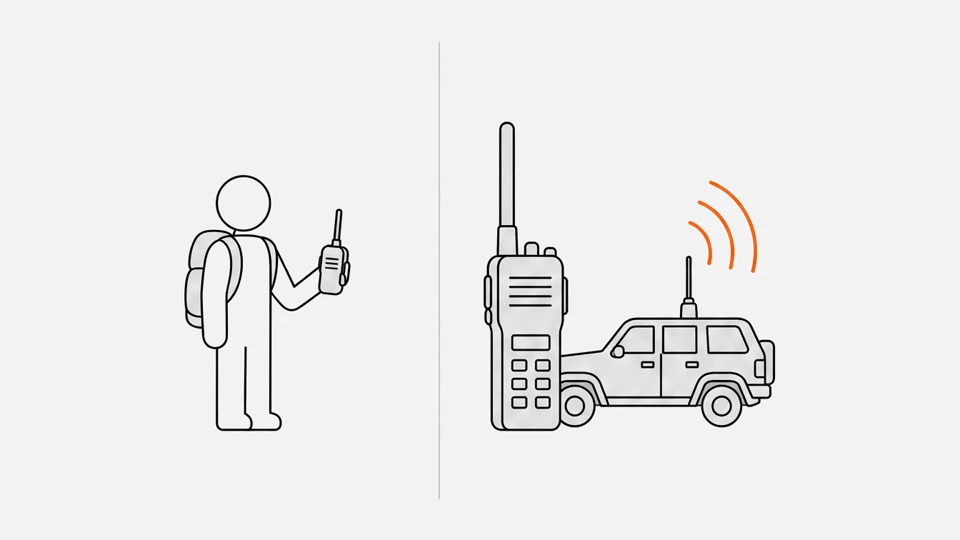
FRS needs no license and is limited to 2 W ERP (0.5 W on channels 8–14), with a built-in antenna and no repeaters. GMRS needs an FCC license, $35 for ten years, that covers your immediate family. It allows up to 50 W on the main channels and repeaters on eight channel pairs.12345
Both are US personal radio services in 47 CFR Part 95 and share frequencies near 462 and 467 MHz. What is GMRS radio explains each service in depth. This page decides between them, then covers GMRS against ham and MURS against GMRS.
Choose FRS if…
- You want a radio that works today, with no license or fee
- Your group stays on one site, trail or campground
- Some users are not family, such as staff or friends
- You want no paperwork and nothing to renew
Choose GMRS if…
- You want a vehicle radio or a base station with an outside antenna
- You want repeaters to reach across a valley, a town or a county
- The users are you and your immediate family
- You will pay $35 once for ten years of extra power and reach
How do FRS and GMRS compare point by point?
FRS wins on cost and simplicity: no license, no fee, nothing to renew. GMRS wins on power and reach: up to 50 W on eight main channels, repeaters on eight pairs, and vehicle and base stations. Both carry voice and short location or text data on the same 22 hand-held frequencies.673
| Criterion | FRS | GMRS |
|---|---|---|
| License | None; authorized by rule8 | Individual FCC license, age 18 or older4 |
| Cost | Radio only | $35 for ten years54 |
| Who may transmit | Anyone | The licensee and immediate family4 |
| Channels | 226 | 30: 16 main and 14 interstitial7 |
| Hand-held power | 2 W ERP; 0.5 W on 8–141 | 5 W ERP on the 462 interstitial channels; 0.5 W on the 467 interstitial channels3 |
| Mobile and base power | Hand-held radios only9 | Up to 50 W output on the main channels3 |
| Repeaters | Not usable2 | Yes, 8 channel pairs7 |
| Business use | Allowed: "business activities"9 | Personal or business traffic, but licenses go to individuals and their families104 |
| Call sign | None | At the end of a transmission and at least every 15 minutes11 |
| FCC range statement | Under half a mile on channels 8–1412 | One to twenty-five miles, by station class, terrain and repeater use13 |
Technical details
| Parameter | FRS | GMRS |
|---|---|---|
| Rules | 47 CFR Part 95 Subpart B | 47 CFR Part 95 Subpart E |
| Frequencies, MHz | 462.5625–462.7125 (1–7), 467.5625–467.7125 (8–14), 462.5500–462.7250 (15–22)6 | 462.5500–462.7250 main, 462.5625–462.7125 interstitial, 467.5500–467.7250 main (repeater input), 467.5625–467.7125 interstitial7 |
| Power measure | ERP on every channel1 | ERP on interstitial channels; transmitter output on main channels, 15 W for fixed stations; no hand-held figure named for the main channels3 |
| Antenna | Non-removable, gain at most a half-wave dipole2 | Not built in by rule; gain antennas are used on GMRS14 |
| Frequencies a radio may use | Only the 22 FRS channels2 | All 30 channels, with limits by station type7 |
| Data | Location, location request or a brief text; bursts of 1 s or less152 | Location or a brief text from hand-helds10 |
What does GMRS stand for?
GMRS stands for General Mobile Radio Service, FRS for Family Radio Service and MURS for Multi-Use Radio Service. All three are US personal radio services. GMRS and FRS share channels near 462 and 467 MHz; MURS uses five separate VHF channels near 151 and 154 MHz.16917
Since September 30, 2019, FRS hand-helds that can also operate in another radio service, such as GMRS, may not be sold, so a new radio is one service or the other.18
Can FRS and GMRS radios talk to each other?
Yes. All 22 FRS channels are also GMRS channels, and the rules let FRS units talk to GMRS stations. Set both radios to the same channel number and the same privacy code. Match the tone in hertz, because brands number their codes differently.1510
- Same frequencies. Look up any channel in the frequency charts.
- Same tone. The CTCSS and DCS code list translates between brands. A privacy code keeps other users' calls out of your speaker; it does not make the call private.
- Repeaters are one way. An FRS radio cannot transmit on the 467 MHz repeater-input channels, so it cannot use a GMRS repeater.27
- The license stays with GMRS. The GMRS user needs a license even when the other person has an FRS radio.4
How far do FRS and GMRS radios reach?
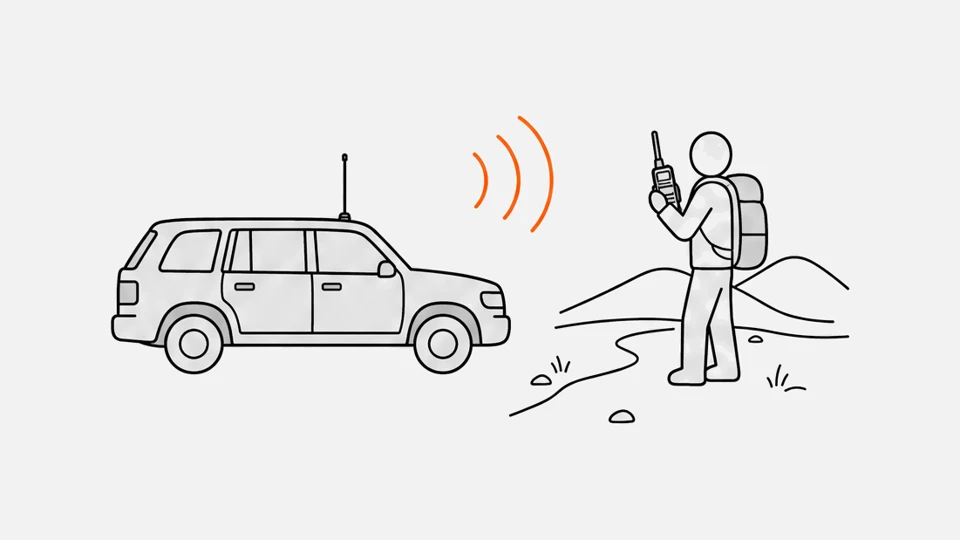
A 2 W hand-held reaches about 0.5 to 1 mile in a city and 1.5 to 3 miles on flat open ground, by Cobra's figures. GMRS gains reach from power, a vehicle antenna and repeaters, which the FCC states as one to twenty-five miles. FRS on channels 8–14 stays under half a mile.141312
| Setting (2 W hand-held to hand-held) | Typical range |
|---|---|
| Between buildings or houses | 675 ft to 0.5 mile |
| Urban | 0.5 to 1 mile |
| Suburban | 1 to 2+ miles |
| Woodland, moderate to thick | 0.5 to 1.5+ miles |
| Flat terrain, no obstructions | 1.5 to 3+ miles |
| Both radios at high altitude | 5 to 10+ miles |
These are the maker's approximate averages for the 2 W class; the table leaves out repeaters.14
Power helps less than people expect. A 5 W hand-held is 2.5 times a 2 W one (4 dB), and a 50 W vehicle radio is 25 times (14 dB). In free space, range grows with the square root of the power, so 1.6 times and 5 times. Buildings and trees lower that gain. Height counts for more: Cobra's 2 W figure rises from 1.5 to 3+ miles on flat ground to 5 to 10+ miles with both radios at high altitude.14 Model your own site in the range calculator.
Do you need a GMRS license?
Yes, for any GMRS station. The fee is $35 and the license lasts ten years. Anyone 18 or older may apply, and Part 95 sets no exam. The license covers the licensee's immediate family, including in-laws. FRS needs no license at all.45
- Who counts as family. Spouse, children, grandchildren, stepchildren, parents, grandparents, stepparents, siblings, aunts, uncles, nieces, nephews and in-laws. Employees and friends are not on the list.4
- Emergencies. A licensee may let anyone use the station to send an emergency message.4
- Companies. Only an individual can get a new license. A few pre-1987 licenses held by companies may still renew.4
- Your case. The license checker shows the rule for each service in your country.
What is the difference between GMRS and ham radio?
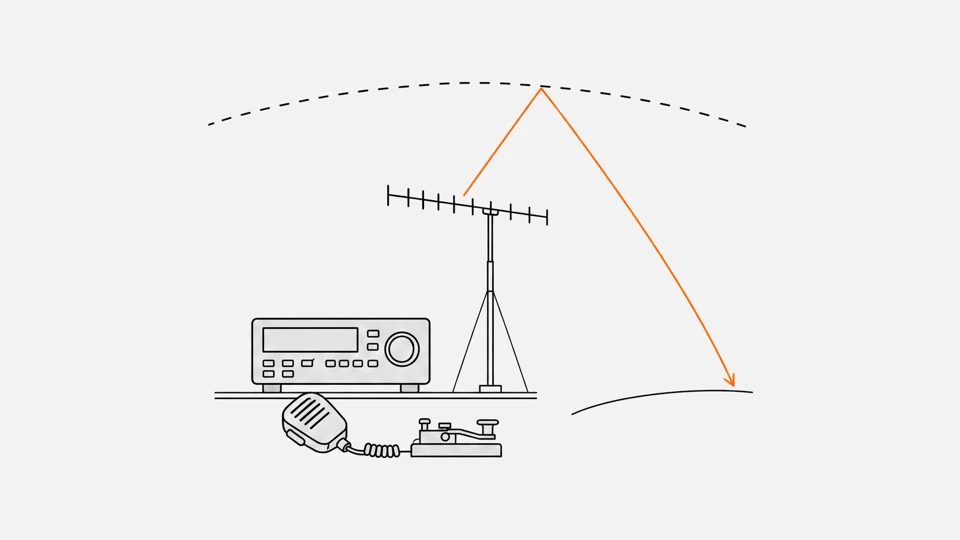
GMRS is a $35 license with no exam, 30 channels near 462 and 467 MHz and up to 50 W. Ham radio needs an exam, 35 questions at Technician level, and opens 2 m, 70 cm and more bands under a 1.5 kW ceiling. GMRS stations may not message ham stations, except in emergencies.419202122
| Criterion | GMRS | Ham radio (US) |
|---|---|---|
| Exam | None in Part 954 | Technician: 35 questions, 26 right to pass19 |
| Cost | $35 FCC fee5 | $35 FCC fee, plus a $15 session fee at ARRL exam sessions23 |
| License term | Ten years4 | Ten years24 |
| Frequencies | 30 channels, 462 and 467 MHz7 | 2 m 144–148 MHz, 70 cm 420–450 MHz, 6 m and the bands above them20 |
| Power ceiling | 50 W output on main channels3 | 1.5 kW PEP21 |
| Business use | Personal or business traffic10 | No communications on behalf of an employer25 |
| Who may transmit | The licensee and immediate family4 | A control operator with a license grant26 |
| Call sign | At least every 15 minutes11 | At least every 10 minutes27 |
Details are in what is ham radio and how to get a ham radio license.
How does MURS compare with GMRS?
MURS has five VHF channels near 151 and 154 MHz, needs no license, is limited to 2 W and cannot use repeaters. GMRS has 30 UHF channels, a $35 license, up to 50 W and repeaters. The two services cannot talk to each other, because the bands differ.2829307
| Criterion | MURS | GMRS |
|---|---|---|
| Band | VHF: 151.820, 151.880, 151.940, 154.570, 154.600 MHz28 | UHF: 462 and 467 MHz7 |
| License | None | $35, ten years5 |
| Power | 2 W transmitter output29 | Up to 50 W on main channels3 |
| Antenna | Up to 60 ft above ground or 20 ft above the structure31 | Outdoor gain antennas help; the maker notes GMRS only14 |
| Repeaters | Not allowed30 | Yes7 |
| Use | Personal or business17 | Personal or business, licensee and family10 |
| In Canada | Not adopted32 | License-exempt, shared with FRS33 |
MURS channels are 11.25 kHz wide on the three 151 MHz channels and 20 kHz on the two 154 MHz channels.34 How the band changes range is in UHF vs VHF.
Do FRS and GMRS work the same in Canada?
No. In Canada, FRS and GMRS hand-helds are one license-exempt class under ISED's RSS-210: the same 22 simplex channels, 0.5 W ERP on channels 8–14 and 2 W on the others. There is no GMRS license, the 467 MHz repeater-input channels are not available, and MURS was not adopted.3332
Where does PoC fit beyond radio range?
FRS and GMRS stop where the radio path stops: a mile or two for hand-helds, farther with a vehicle antenna or a repeater. The FCC bars linking GMRS repeaters over the internet to extend range. A PoC radio carries the call over mobile data, so one group can span towns for a monthly fee.13
PoC needs mobile coverage and a service plan. FRS and GMRS need neither, only the one-time GMRS license. See what is a PoC radio, LMR vs PoC and, for the European license-free service, PoC vs PMR446.
Which radio fits your team or trip?
Pick FRS for one site or trail, or when users are not family. Pick GMRS for vehicles, a base station, repeaters and a family that will pay $35. Pick MURS for a license-free VHF site with an outside antenna. Pick ham for the widest bands. Pick PoC when people are spread beyond radio range.
The radio type tool narrows the choice. The basics are in types of two-way radio.
Questions
Can I use a GMRS radio without a license?
Not on GMRS. A valid individual license is required to operate a GMRS station, and it costs $35 for ten years.45 An FRS-only radio needs none.
Can my employees use my GMRS license?
No. The license covers the licensee and immediate family, and new licenses go only to individuals. For staff, FRS radios need no license and allow business use.49
Can FRS radios use a GMRS repeater?
No. An FRS radio may transmit only on the 22 FRS channels, and the 467 MHz repeater-input channels are not among them.27
Sources
- 47 CFR 95.567: FRS transmit power · eCFR, FCC
- 47 CFR 95.587: FRS additional requirements · eCFR, FCC
- 47 CFR 95.1767: GMRS transmitting power limits · eCFR, FCC
- 47 CFR 95.563: FRS channels · eCFR, FCC
- 47 CFR 95.1763: GMRS channels · eCFR, FCC
- 47 CFR 95.503: Definitions, FRS · eCFR, FCC
- 47 CFR 95.1731: Permissible GMRS uses · eCFR, FCC
Show all 34 sources
- 47 CFR 95.1751: GMRS station identification · eCFR, FCC
- Cobra support article 47001184443: typical FRS/GMRS radio range · Cobra Electronics
- 47 CFR 95.531: Permissible FRS uses · eCFR, FCC
- 47 CFR 95.1703: Definitions, GMRS · eCFR, FCC
- 47 CFR 95.2703: Definitions, MURS · eCFR, FCC
- 47 CFR 97.503: Element standards · eCFR, FCC
- 47 CFR 97.301: Authorized frequency bands · eCFR, FCC
- 47 CFR 97.313: Transmitter power standards · eCFR, FCC
- 47 CFR 95.1733: Prohibited GMRS uses · eCFR, FCC
- FCC Application Fee · ARRL
- 47 CFR 97.25: License term · eCFR, FCC
- 47 CFR 97.113: Prohibited transmissions · eCFR, FCC
- 47 CFR 97.7: Control operator required · eCFR, FCC
- 47 CFR 97.119: Station identification · eCFR, FCC
- 47 CFR 95.2763: MURS channels · eCFR, FCC
- 47 CFR 95.2767: MURS transmitting power limit · eCFR, FCC
- 47 CFR 95.2733: Prohibited MURS uses · eCFR, FCC
- 47 CFR 95.2741: MURS antenna height limit · eCFR, FCC
- 47 CFR 95.2773: MURS authorized bandwidths · eCFR, FCC