What is the difference between LMR and PoC?
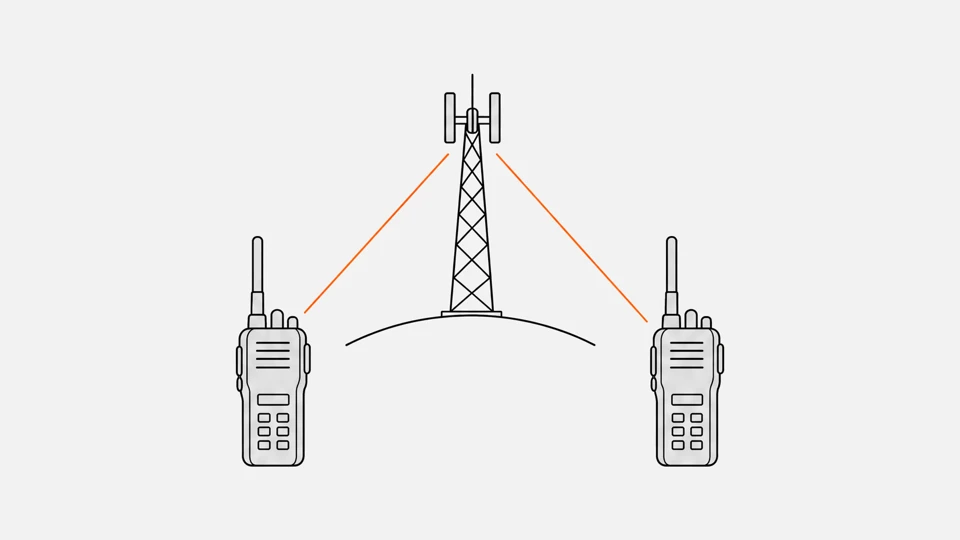
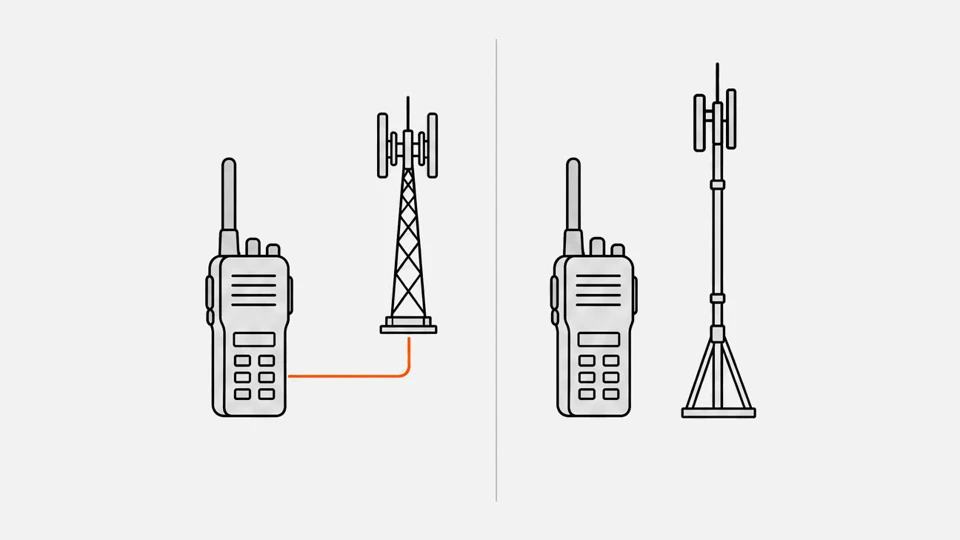
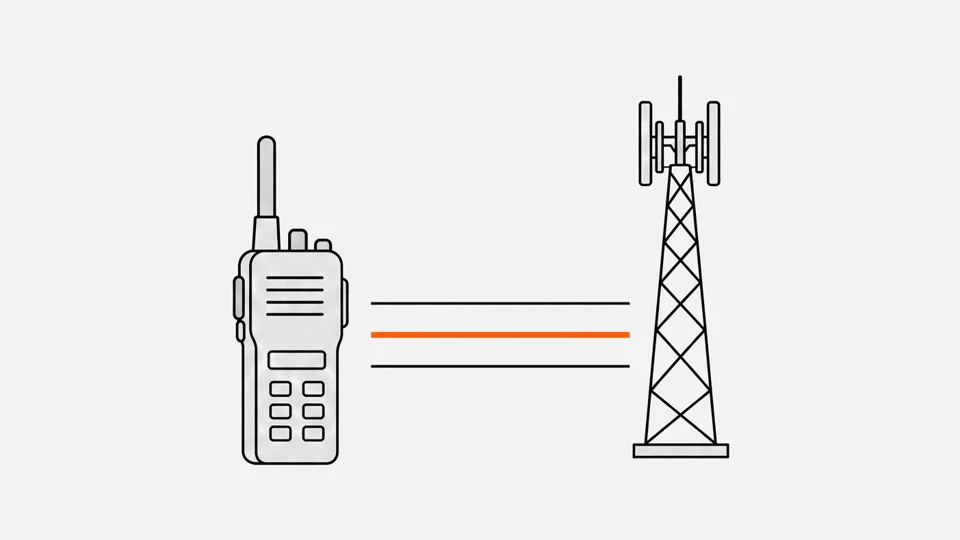
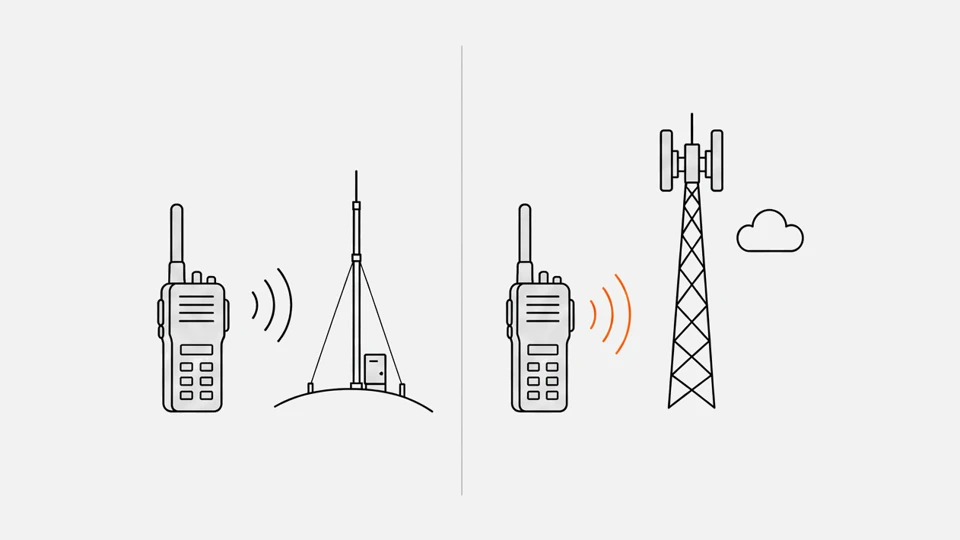
LMR, land mobile radio, is a private radio network: base stations, repeaters and radios on channels you license, in the US under FCC Part 90.1 PoC, push-to-talk over cellular, sends voice as data over a mobile operator's network to a push-to-talk server, for a fee per user.2 With LMR you build the coverage; with PoC you use the operator's.
LMR is the umbrella for analog FM, DMR, P25, TETRA and NXDN, run as conventional channels or as trunked systems that hand out channels on demand.13 This page compares that whole class with PoC. For DMR handhelds alone, see PoC vs DMR; for the basics, land mobile radio and what is a PoC radio.
Choose LMR if…
- Calls must work with no mobile network at all
- Your people work in one defined area, such as a site, a campus or a county
- You want your own licensed channels, not a shared public network
- You can hold a license and fund sites, repeaters and radios up front
Choose PoC if…
- Your people work across cities, regions or countries
- Mobile coverage is dependable where they work
- You want photos, location and messages alongside voice
- You prefer a monthly fee per user to building and running a radio network
How do LMR and PoC compare point by point?
LMR wins where the radio must work through a network failure, your people stay in one area and you can hold a license. PoC wins on reach, data and low entry cost. The first table sets the two side by side; the second adds standards, capacity and measured figures.
| Criterion | LMR | PoC |
|---|---|---|
| Who provides the network | You, or a contractor: sites, repeaters, licensed channels1 | The mobile operator; you buy a SIM and a push-to-talk service2 |
| Coverage | Your sites; external antennas and higher power than a phone4 | Wherever the operator has data coverage, or Wi-Fi2 |
| Network failure | Radios still talk radio to radio4 | No call without mobile data or Wi-Fi |
| Congestion | Limited by your own channels; a busy trunked system can run out of free channels5 | Shares the operator's capacity; priority only on services such as FirstNet6 |
| Call start | P25 trunked: about 1.0 s end to end in a NIST lab test5 | Under 1 s on 4G, per Zello7 |
| License | Needed: an FCC Part 90 license in the US, Ofcom Business Radio in the UK89 | None for the radio; SIM and service only10 |
| Cost shape | Equipment, sites and license up front | $8 to $27.50 per user per month on published plans1112 |
| Data | Low speed: location, key updates, short messages4 | Mobile broadband: photos, location, video4 |
Technical details
| Parameter | LMR | PoC |
|---|---|---|
| Standards | TIA-603 analog FM, ETSI TS 102 361 (DMR), TIA-102 (P25), ETSI EN 300 392 (TETRA)31314 | Platform-defined; 3GPP MCPTT (TS 22.179) for mission-critical use15 |
| Calls per radio channel | DMR: 2 in 12.5 kHz. P25 Phase 2: 2. TETRA: 4 in 25 kHz13314 | No radio channel; Zello allows up to 7,000 active users in one channel2 |
| Network priority | Your own licensed channels | LTE bearer classes: QCI 65 mission-critical, QCI 66 other push-to-talk voice16 |
| Joining the other side | P25 ISSI and CSSI interfaces17 | 3GPP interworking function with TETRA and P25 (Release 15)18 |
Who provides the coverage, LMR or PoC?
With LMR you decide where sites go, so coverage follows your map: a yard, a campus or a county. With PoC the operator decides, and your radio must support its LTE bands. Check them in the LTE band checker; for LMR channels, see the license checker.
Real fleets split along that line. One Texas hospital district carried 95 percent of voice on LMR and 5 percent on LTE, mostly from ambulances out of LMR coverage or underground.4 Fairfax County moved non-public-safety users to LTE push-to-talk for better indoor coverage.4 Most new US LMR applications need frequency coordination, so wait for the authorization before you buy equipment.19
Which is more reliable in a disaster or under congestion?
A private LMR network is built for the failure case: radios keep talking to each other if the infrastructure fails. A public network can lose towers or fill up. On 18 October 2018, eight days after Hurricane Michael, 162 of 345 cell sites in Bay County, Florida, were still out of service, 47.0 percent.20
The same FCC report counts 2.7 percent of cell sites out across the whole disaster area, so outages are severe where the storm hit and small elsewhere.20 CISA lists vulnerability to tower loss and congestion among LTE's weaknesses.4
Priority narrows the gap. FirstNet says public safety devices gain access to the network first and cannot have network resources taken away, with no action by the user.6 That applies to entitled services, not to a PoC app on an ordinary plan, which 3GPP places in a lower class, QCI 66.16
Is LMR faster than PoC?
Direct-mode LMR is fastest, but trunked LMR is not instant. In a NIST lab test, P25 trunked Phase 1 took about 1.0 s from button press to heard speech; P25 direct took 0.3 s. A prototype mission-critical PoC showed 104 ms access delay in a shielded room. Zello states under 1 s on 4G.5217
| Measure | Value | Source |
|---|---|---|
| P25 direct, end-to-end access time | 300 ms | NIST IR 8275, Table 45 |
| Analog conventional repeater, end to end | 376 ms | NIST IR 8275, Table 45 |
| P25 trunked Phase 1, end to end | 1,011 ms | NIST IR 8275, Table 45 |
| P25 trunked Phase 1, access delay at 85% intelligibility | 640 ms | NIST IR 8275, Table 75 |
| MCPTT over LTE prototype, access delay at 85% | 104 ms | NIST IR 832821 |
| PoC on Wi-Fi / 4G / 2G (Zello) | under 0.5 s / under 1 s / 2 s or more | Zello help7 |
End-to-end access time adds mouth-to-ear latency to access delay. The figures come from separate NIST tests, one of them on a prototype MCPTT system.21 The 3GPP mission-critical target is under 300 ms to the go-ahead for 95 percent of requests and under 1,000 ms end to end; 3GPP's group-communication specification bases its own 300 ms setup requirement on ETSI's legacy TETRA requirement.1522
Is PoC mission critical?
Only when it is built to the mission-critical standard and runs with network priority. 3GPP completed MCPTT in March 2016.23 FirstNet Rapid Response is 3GPP-based with Mission Critical QoS; the UK plans a voice release for ESN. A general PoC app sits in the non-mission-critical class.122416
| Network | Status |
|---|---|
| FirstNet, US (AT&T) | Rapid Response: 3GPP-based push-to-talk, highest priority on the network, talkgroups up to 3,000 active; brief dated June 202412 |
| ESN, UK | Three releases planned; Release 2, "ESN Voice initial capability", includes MCX certification. Airwave stays until it is safe to shut down (business case, July 2026)24 |
| Virve 2, Finland | Broadband service declared ready for use in June 202525 |
P25 and TETRA remain the mission-critical voice networks of emergency services in North America and Europe;314 public safety radio and MCPTT cover the standards in depth.
What does each cost?
LMR costs money up front and little per month. PoC costs per user per month. A new FCC site-based license application costs $105 and runs up to 10 years.826 Zello Work costs $8 (Core) or $15 (Plus) per user per month billed monthly, October 2026.11 Which is cheaper depends on fleet size, sites and term.
| Cost item | LMR | PoC |
|---|---|---|
| License or access | FCC $105 new, $35 renewal; Ofcom Simple UK Light £75 for five years; ComReg €22 per unit plus €228927 | No radio license; mobile data SIM extra |
| Equipment | Radios, repeaters, antennas, site space, consoles; quoted per project | PoC radios or phones you already own |
| Monthly | Your own maintenance and any site rent | Zello Work $8 or $15 (yearly billing $6.80 or $12.75); FirstNet Rapid Response $12 Standard or $27.50 Advanced1112 |
| Bridging the two | One-time per site: $2,500 RoIP gateway license, $7,500 ISSI, $7,500 CSSI; $5 per user per month interop fee, included in Advanced12 | Same |
For 20 users at monthly billing: $160 a month on Zello Work Core, $240 on Rapid Response Standard before the FirstNet wireless plan that Rapid Response requires.1112 Put your own radio and site quotes next to a plan in the cost calculator.
Can LMR and PoC radios talk to each other?
Yes, through a gateway, a standard interface or a hybrid radio. A radio-over-IP gateway carries a radio channel's audio and push-to-talk signal into an IP network, where a PoC service can join it. P25 networks link through ISSI and CSSI, and 3GPP's interworking function joins MCPTT to TETRA and P25 for voice, messaging and location.1718
Gateways have limits. CISA notes that each agency must use at least one channel in each band per shared talk path, and that a gateway can add latency.28 DHS notes that DMR, P25, NXDN, dPMR and TETRA have no direct digital interoperability except through gateways and maker-specific solutions.29 See radio over IP and the compatibility tool.
A hybrid radio holds both links in one case:
| Radio | LMR side | LTE side |
|---|---|---|
| Motorola APX NEXT XN | P25 Phase 1 FDMA and Phase 2 TDMA trunking; VHF, UHF, 700 and 800 MHz30 | LTE certified on FirstNet, Verizon and Bell Mobility (AN model); Wi-Fi30 |
| L3Harris XL Converge 200P | P25 on VHF, UHF and 700/800 MHz31 | Built-in LTE and Wi-Fi31 |
| Hytera PDC680 | DMR, including Hytera DMR trunking | LTE; Hytera says one ID and automatic switching32 |
Will PoC replace LMR?
Not wholesale. CISA calls it unlikely that LTE displaces LMR in the foreseeable future and expects the two to merge, with gateways and software already joining them.4 Teams keep LMR as the core for in-area and critical talk and move wide-area or non-critical staff to PoC. Four patterns from public reports:
| Pattern | Example |
|---|---|
| LMR core, LTE for the gaps | Texas hospital district: LMR 95%, LTE 5%4 |
| Non-critical users to PoC | Fairfax County: public-service users from analog LMR to LTE push-to-talk; lower recurring cost, better indoor coverage, but the LMR backup was lost4 |
| Smartphones joined to LMR | Michigan: mutual-aid partners at large events join the LMR network by app4 |
| Narrowband to broadband in steps | Finland's Virve 2 and the UK's ESN replace TETRA networks while the old one runs on2524 |
Which fits your team: LMR or PoC?
Pick LMR when calls must work with no network, people stay in one area and you can hold a license. Pick PoC when people cover cities or countries, mobile coverage is dependable and a per-user fee suits you. Many fleets use both. The table gives a starting point by user type; the radio type tool narrows it.
| User type | Lean | Why |
|---|---|---|
| Public safety | LMR core, plus priority broadband | P25 and TETRA carry mission-critical voice; MCPTT with priority adds wide-area data312 |
| Utilities | LMR for operations, PoC for wide-area crews | P25 serves utilities and transit; 3GPP names utilities as MCPTT users too315 |
| Transport | LMR on the line or yard, PoC for staff elsewhere | A New York commuter railroad runs a five-channel 700 MHz LMR system with 65 RF sites4 |
| Construction | PoC across sites; LMR for one large site | PoC follows people between sites without a license; one site can justify its own channels |
| Security | PoC for guards across sites; LMR on a campus | Coverage follows the operator across sites; LMR keeps calls local |
| Events | LMR for crew in the venue | CISA lists congestion among LTE's weaknesses; Michigan joins smartphones to LMR at large events4 |
Questions
Is PoC the same as MCPTT?
No. MCPTT is the 3GPP mission-critical standard, completed in March 2016. Most PoC apps are platform-defined, and 3GPP gives non-mission-critical push-to-talk voice its own lower class, QCI 66.2316
Does land mobile radio need a license?
Yes, on business and public safety channels. The US needs an FCC Part 90 license, with a $105 application fee, and the UK needs an Ofcom Business Radio license. Consumer services such as FRS and PMR446 sit outside these licenses.89
Can a smartphone join an LMR talkgroup?
Yes, through a gateway or an app. Michigan lets mutual-aid partners join the LMR network from a smartphone, and FirstNet prices an interoperability fee of $5 per user per month for linking Rapid Response to LMR.412
Sources
- 47 CFR 90.7: Definitions, Private Land Mobile Radio Services · eCFR, US government
- Overview of Zello Work · Zello Work Help Center
- P25 frequently asked questions, version 1.9 (2025) · P25 Technology Interest Group
- What is the current latency? · Zello Work Help Center
- Business Radio licence management · Ofcom, UK
- Mobile 3G/4G/5G devices: what to check before buying (in Latvian) · Elektroniskie sakari, Latvia
Show all 32 sources
- Zello Work pricing · Zello
- FirstNet Rapid Response product brief (v.061224, June 2024) · FirstNet, AT&T
- Project 25 ISSI and CSSI primer (January 2019) · CISA, FPIC
- 47 CFR 90.175: Frequency coordination requirements · eCFR, US government
- Mission critical services · 3GPP
- Emergency Services Network: summary business case, 27 July 2026 · UK Home Office
- Built through teamwork: the Virve 2 service is ready for action · Erillisverkot
- 47 CFR 90.149: License term · eCFR, US government
- Business Radio licensing · ComReg, Ireland
- SAFECOM Interoperability Continuum brochure · CISA, SAFECOM
- Public safety interoperability implications of non-P25 radio technologies (July 2016) · DHS Office of Emergency Communications
- APX NEXT XN data sheet · Motorola Solutions
- XL Converge 200P multiband portable radio · L3Harris
- PDC680 dual-mode rugged radio · Hytera