What is radio over IP (RoIP)?
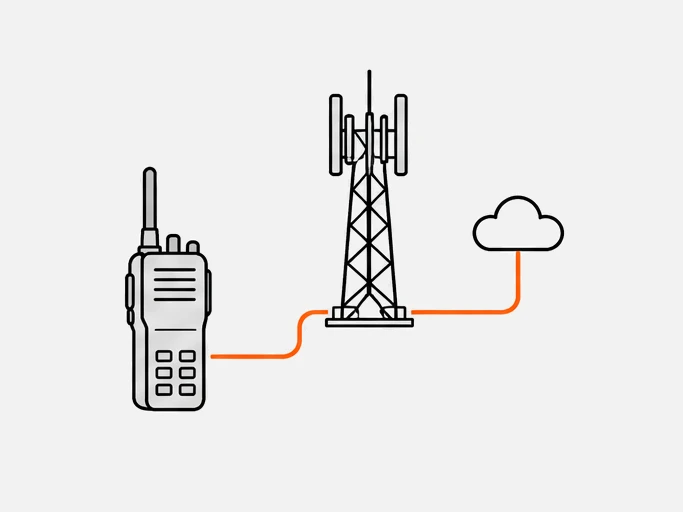
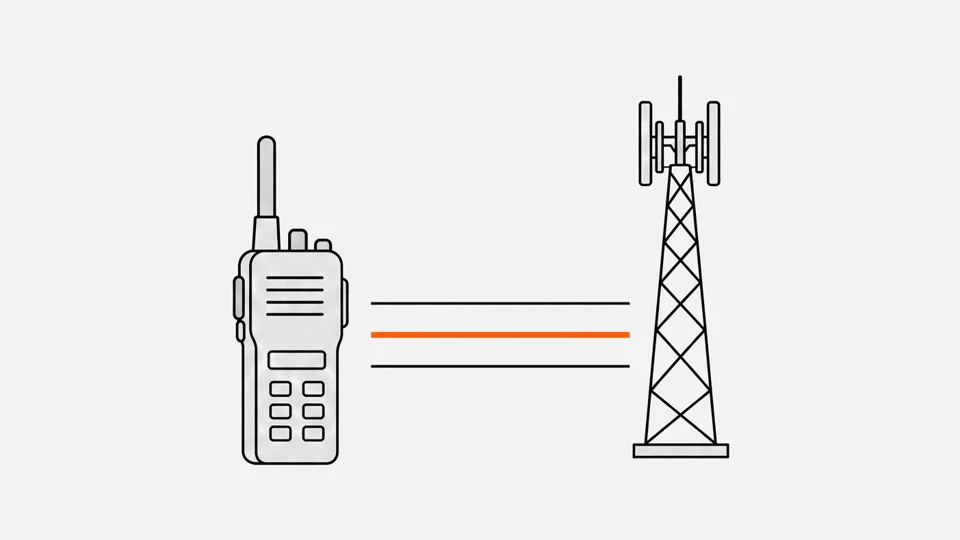
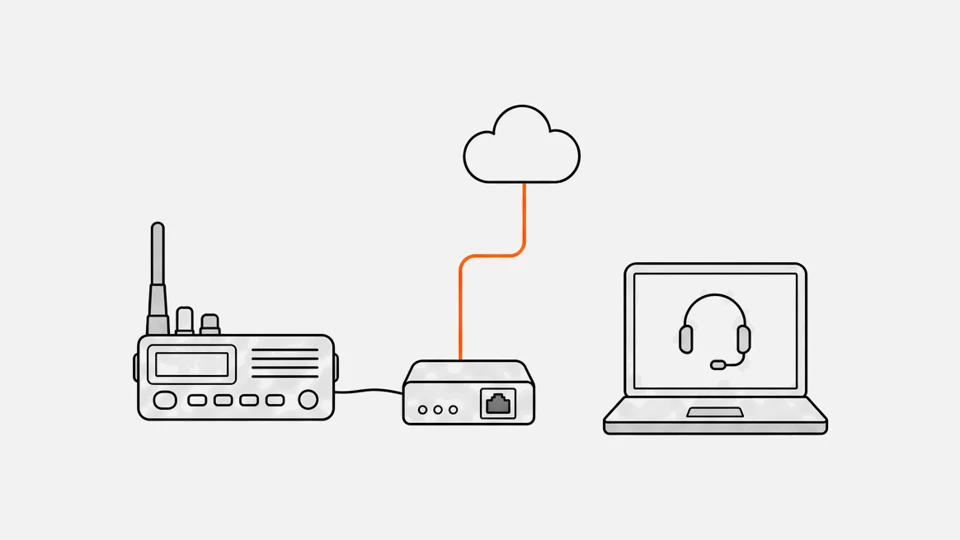
Radio over IP, or RoIP, carries a radio's voice and its push-to-talk control over an IP network instead of over a wire or a second radio link. A gateway sits between the radio and the network. It turns received audio into IP packets and keys the transmitter at the far end.1
JPS, a maker of these gateways, describes its unit as transporting full duplex audio, one serial port and four status bits across an IP network.1 The status bits carry the signals a radio needs: when to transmit (PTT) and when a signal is being received (COR, carrier operated relay, which works like carrier operated squelch).2
In an interoperability net, the rule is simple. When one device detects an active COR, its audio is sent with a PTT signal to every other device in the net to be retransmitted.2 Because almost every radio is half duplex, the whole net then runs half duplex too.2 The same gateway can also tie a radio channel to a PoC radio talkgroup, covered below.
How does a radio gateway connect to a radio?
A radio gateway connects through four things: receive audio from the radio, transmit audio to it, a PTT output that keys the transmitter, and a COR or squelch input that tells the gateway a signal is arriving. The IP side then carries audio and status as packets.2
The JPS NXU-2B, a single-channel unit, shows what that looks like in numbers:
| Connection | NXU-2B specification |
|---|---|
| Receive audio in | Balanced 600 ohm or 47 kilohm; nominal -10 dBm, adjustable from -20 to +10 dBm1 |
| Transmit audio out | Balanced 600 ohm; nominal -10 dBm, adjustable from -20 to +10 dBm1 |
| PTT | Relay, in addition to solid-state keying1 |
| COR / squelch | Programmable active high or low; can use VOX or voice modulation recognition (VMR) instead of a COR line2 |
| Other ports | RS-232 serial, dual GPIO, browser-based setup1 |
| Network | UDP for audio and status bits, TCP for the serial port; vocoders GSM 13 kbps, ADPCM 16, 24 and 32 kbps, G.711 64 kbps12 |
JPS says its interface cables connect to more than 300 types of radios and other devices.1 The manual also lists an adjustable receive delay, which exists to prevent lost syllables at the start or end of a transmission.2
Gateways come in four types, and sources name examples of each:
- Single-channel units. The NXU-2B above; the Zello hardware page lists it as a single-channel RoIP gateway.3
- Multi-channel and modular interoperability gateways. The same page lists the dual-channel JPS RSP-Z2, the modular ACU-Z1 and the Raven FlexGate Enterprise System.3
- Software bridges. TASSTA's T.Bridge connects TETRA, Hytera and Motorola DMR, Kenwood NEXEDGE and P25 equipment from a four-channel bridge that expands to eight or more.4
- PTT platform connectors. Motorola's WAVE PTX On Prem datasheet lists wireline interoperability with ASTRO 25, P25, DIMETRA and MOTOTRBO systems and wireless RoIP-based interoperability.5
What are the typical RoIP gateway setups?
Most radio over IP systems follow one of six patterns: a point-to-point link between two radios, a radio wired to a dispatch console, a radio channel joined to a PoC talkgroup, several radio systems in one interoperability net, linked repeater sites, and a satellite push-to-talk group joined to ground radios.13628
| Setup | What the IP link joins | Example named by the maker |
|---|---|---|
| Point-to-point link | Two radios, or a radio and a remote control point; a pair of gateways forms a transparent link | JPS NXU-2B in pairs1 |
| Radio to dispatch console | A base station or control station and a console | NXU-2B tying radios to console interfaces1 |
| Radio channel to a PoC talkgroup | One radio channel per gateway port and one talkgroup on the platform | Zello-listed JPS and Raven gateways, TASSTA T.Bridge, WAVE PTX345 |
| Interoperability net | Several radio systems; active COR on one keys PTT on all the others | JPS ACU-Z1, Raven FlexGate23 |
| Linked repeater sites | Repeaters of one system at several sites | MOTOTRBO IP Site Connect, up to 15 sites6 |
| Satellite to ground radio | Iridium PTT handsets and local radios | Icom VE-PG4 RoIP gateway with IDAS and analog radios28 |
Every port needs a radio. A four-port gateway joining four talkgroups to four channels needs four radios or a radio system with four channels, each on a licensed channel. The gateway does not add range; it carries each radio's coverage to the others.214
How do repeaters link over IP?
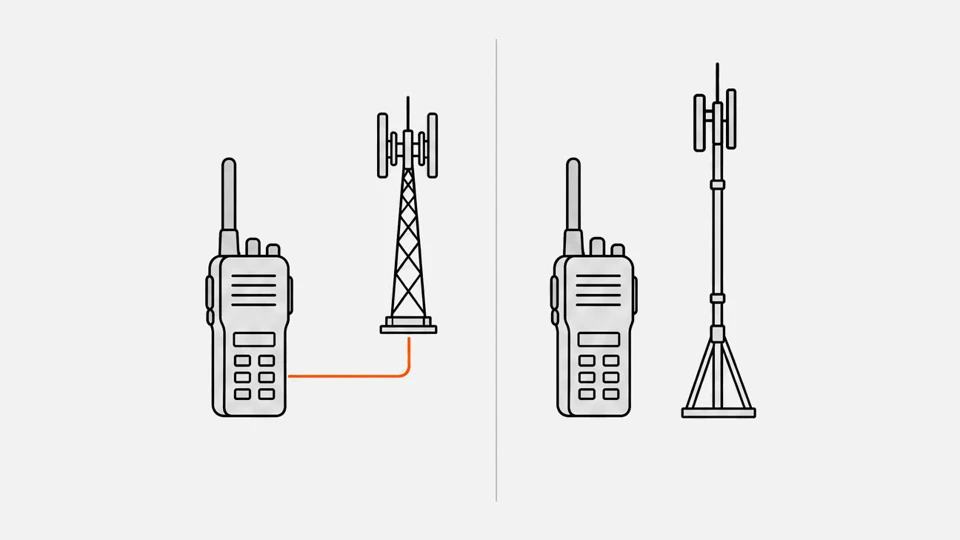
Repeaters link over IP by treating the internet or a private network as the link between sites. Motorola's IP Site Connect connects up to 15 MOTOTRBO sites over a standard IP network without a system controller, using one radio channel at each site, and radios roam between them.6
Amateur radio uses the same idea at a global scale. Three systems dominate, and RepeaterBook counted the linked repeaters on its listings on 12 October 2026:7
| System | How it works | Linked repeaters |
|---|---|---|
| EchoLink | Software that links licensed amateur stations over the internet with streaming audio, station to station or computer to station; every user is validated as a license holder; more than 350,000 validated users on the home page, undated89 | 3,1697 |
| AllStarLink | A network of repeaters, remote bases and hotspots on a dedicated computer wired to a radio or repeater, built on the open-source Asterisk phone system10 | 1,9577 |
| IRLP | Each node is a computer that bridges a radio and the internet; started by David Cameron, VE7LTD, in Canada in 199711 | 8827 |
DMR networks do it too. The ETSI standard covers the DMR air interface;12 the IP links between repeaters are sold under each maker's own names, such as Motorola's IP Site Connect and Hytera's Multi-Site Connect. BrandMeister's device list held 889 records of the first type and 747 of the second on 16 October 2026.13 The ham side is covered in ham radio DMR and the standard on DMR.
How does two way radio interoperability work in public safety?
Agencies on different radio systems connect through gateways that retransmit across frequencies and talk groups and can also reach phone and cellular systems. CISA's SAFECOM program calls a gateway an interim solution while agencies move toward shared systems. Within P25, standard interfaces such as ISSI link systems directly.1415
CISA lists two costs. A gateway uses spectrum, because each participating agency needs at least one channel in each band for every common talk path. It can also add latency between the push-to-talk press and traffic reception, which can be adjusted to reduce the effect on operations.14
Gateways of the ACU type, such as the JPS ACU-Z1, are modular boxes that join several radio interfaces in one unit.3 JPS says its NXU-2B is meant for radios, other four-wire devices and ACU interoperability gateways.1 A standard connection between systems of the same family works differently:
| P25 interface | What it connects |
|---|---|
| ISSI (Inter-RF Subsystem Interface, TIA-102.BACA) | Two radio frequency subsystems; group voice, unit-to-unit voice and mobility management; call control uses SIP and transmission control uses RTP15 |
| CSSI (Console Subsystem Interface) | A console from one maker and a radio system from another16 |
| FSI (Fixed Station Interface, TIA-102.BAHA) | A base station or repeater from another maker in a conventional subsystem16 |
For the LTE side, 3GPP's interworking function links mission-critical LTE users with TETRA, P25 and GSM-R for voice, messaging and location.17 That path is covered in MCPTT, public safety radio and TETRA.
Can two way radios connect to PoC apps?
Yes, through a gateway. Many push-to-talk platforms list gateways that tie a radio channel to a talk group, so a phone user and a handheld radio user hear each other. JPS describes its NXU-2B as tying radios via IP to console interfaces or to push-to-talk over cellular platforms.1
Zello's hardware page names JPS and Raven gateways as compatible with its apps, and also says it does not sell them and advises testing them in your own environment first.3 TASSTA's T.Bridge and Motorola's WAVE PTX connect to radio networks in the same way.45 For the platforms themselves, see software, TASSTA and Zello.
Which standards does radio over IP use?
The IP part uses ordinary internet protocols: RTP for audio, SIP for call setup, and G.711 or G.729 for the voice coding. The radio part is mostly maker-specific: many gateways use their own protocol over UDP. Standard interfaces exist in P25 and, through EUROCAE ED-137, in air traffic control.
| Standard | What it covers |
|---|---|
| RFC 3550 (July 2003), RTP | Transport for real-time audio; a 12-byte header; no mechanism for timely delivery or quality-of-service guarantees18 |
| RFC 3551, RTP audio profile | Payload types: PCMU (G.711 mu-law) 0, PCMA (G.711 A-law) 8, G.729 18; 8,000 Hz clock; 20 ms default packet19 |
| RFC 3261 (June 2002), SIP | Signaling to set up, modify and end sessions20 |
| ITU-T G.711, G.729 | G.711 pulse code modulation of voice frequencies (1988); G.729 speech coding at 8 kbit/s (version in force 06/12)21 |
| EUROCAE ED-137 | VoIP interoperability for air traffic management; its radio volume defines a SIP profile for the ground radio service22 |
| P25 ISSI and FSI | TIA-102.BACA and TIA-102.BAHA, above1516 |
| ETSI TS 102 361-1 | The DMR air interface protocol, V2.7.1 of May 202612 |
Implementers' documentation describes ED-137 carrying PTT and squelch state in an RTP header extension.23
How is RoIP different from PoC?
RoIP links radios and consoles to each other. A PoC radio is the endpoint itself, sending voice over mobile data to a push-to-talk server. IP Site Connect, the nearest radio-side relative, links repeaters of one maker over a private IP network.
| RoIP gateway | Linked repeaters (IP Site Connect) | PoC / LTE | |
|---|---|---|---|
| Standard | RTP, SIP or the maker's own protocol1820 | The maker's protocol over the DMR air interface126 | Set by the PTT platform; MCPTT for mission-critical use |
| Radio channel | The radio's own channel, one per gateway port | One channel per site6 | The operator's LTE bands |
| Network | Any IP network between gateways | Standard IP network, up to 15 sites6 | Mobile network and a PTT server |
| Range | Wherever the IP link reaches; the radio at each end covers its own area | Coverage of every linked site | Mobile coverage |
| Access or license | The radio's own license at each end | The repeater's license | A SIM and a PTT service |
| Data | Serial port and status bits1 | Short data, as in the DMR system | Mobile broadband |
How much bandwidth does a RoIP channel need?
One voice channel needs the codec rate plus 40 bytes of headers on every packet: 20 for IPv4, 8 for UDP and 12 for RTP. With G.711 at 64 kbit/s and 20 ms packets that is 80 kbit/s on the IP layer; with G.729 at 8 kbit/s it is 24 kbit/s.181924
The formula is (payload bytes + 40) x 8 x packets per second. These figures follow from the standards above, for audio flowing in one direction, and they leave out Ethernet or VPN framing.
| Codec | Codec rate | Packet interval | Payload | Packets per second | IP-layer rate |
|---|---|---|---|---|---|
| G.711 | 64 kbit/s | 10 ms | 80 bytes | 100 | 96 kbit/s |
| G.711 | 64 kbit/s | 20 ms | 160 bytes | 50 | 80 kbit/s |
| G.711 | 64 kbit/s | 40 ms | 320 bytes | 25 | 72 kbit/s |
| GSM | 13.2 kbit/s | 20 ms | 33 bytes | 50 | 29.2 kbit/s |
| G.729 | 8 kbit/s | 20 ms | 20 bytes | 50 | 24 kbit/s |
| G.729 | 8 kbit/s | 40 ms | 40 bytes | 25 | 16 kbit/s |
Longer packets lower the overhead and raise the delay. A continuous G.711 channel at 80 kbit/s moves 36 MB per hour. The RoIP bandwidth calculator does this arithmetic for your codec, packet size and channel count, also shows the monthly traffic, and the G.711 preset opens it with the codec above.
A gateway multiplies these figures by its channels. Four G.711 channels at 20 ms need 4 × 87.2 = 348.8 kbit/s on Ethernet, which adds 18 bytes of frame header and check to each packet; four G.729 channels need 124.8 kbit/s.29 The calculator preset for four G.711 channels shows the same result with monthly traffic.
Makers' own protocols differ from plain RTP. A dispatch vendor's planning page asks for at least 15 kbps per voice call on a MOTOTRBO wireline system and 30 kbps per repeater.25
What latency and jitter can radio over IP tolerate?
ITU-T G.114 says that when delay between mouth and ear stays below 150 ms, most applications feel essentially transparent, and that 400 ms one-way should not be exceeded in network planning. MCPTT, the mission-critical standard, sets its mouth-to-ear target at 300 ms for 95% of voice bursts.2627
Each part of a RoIP link adds to that budget:
- Packetization. A 20 ms packet cannot leave before 20 ms of audio exists, so the packet interval is a floor on delay.19
- Network. The path between gateways, which RTP does nothing to guarantee.18
- Jitter buffer. RTP defines interarrival jitter as a running estimate in which each new sample moves 1/16 of the way toward the latest difference in transit time. The receiving gateway buffers audio to smooth that variation, and the buffer adds delay.18
- Gateway settings. A radio gateway can add delay on purpose so the transmitter is keyed before the audio arrives; the NXU-2B allows up to 5 seconds in its receive path.2
CISA notes that a gateway may create latency between the push-to-talk press and traffic reception.14
How this relates to PoC radio
RoIP and PoC both put radio-style push-to-talk on an IP network, at different ends. A PoC radio is an LTE device that talks to a platform. RoIP is the bridge that lets a conventional radio, a repeater or a dispatch console take part in the same conversation.
That is why many push-to-talk platforms sell or list gateways: one gateway can join a company's DMR handhelds and its drivers' PoC radios into a single talk group.34 For the platforms and their radio links, see software. For the choice between running your own radio network and using a PoC service, see PoC vs DMR and 4G LTE walkie-talkies.
Questions
What does RoIP stand for?
Radio over IP. It carries a radio's audio and push-to-talk control over an IP network through a gateway. The JPS gateway datasheet describes full duplex audio, a serial port and four status bits carried across the network.1
How much bandwidth does one RoIP channel use?
With G.711 at 20 ms packets, about 80 kbit/s on the IP layer, and with G.729 about 24 kbit/s. That is the codec rate plus 40 bytes of IP, UDP and RTP headers on every packet.181924
Can a gateway connect a DMR radio to a P25 radio?
A gateway can pass audio and PTT between radios on different systems, which is how interoperability gateways work. CISA notes the costs: extra spectrum and possible latency.14
Sources
- JPS NXU-2B Radio over IP (RoIP) gateway datasheet (Rev. 8, 2020) · JPS Interoperability Solutions
- NXU-2B operations manual (May 2021) · JPS Interoperability Solutions
- Radio gateways · Zello
- T.Bridge · TASSTA
- WAVE PTX On Prem datasheet · Motorola Solutions
- MOTOTRBO IP Site Connect · Motorola Solutions
- RepeaterBook statistics by country, read 12 October 2026 · RepeaterBook
- EchoLink · EchoLink
- EchoLink validation · EchoLink
- AllStarLink · AllStarLink Inc.
Show all 29 sources
- Internet Radio Linking Project · Wikipedia, with the project's history at repeater-builder.com
- BrandMeister device list (API), counted 16 October 2026 · BrandMeister
- P25 frequently asked questions, version 1.9 (2025) · P25 Technology Interest Group
- ED-137/1C Change 1: Interoperability standards for VoIP ATM components, Volume 1 Radio · EUROCAE, via the SESAR ATM Master Plan portal
- ED-137 use cases · VOCAL Technologies
- SmartPTT: bandwidth requirements · SmartPTT
- Icom IC-SAT100 · Iridium