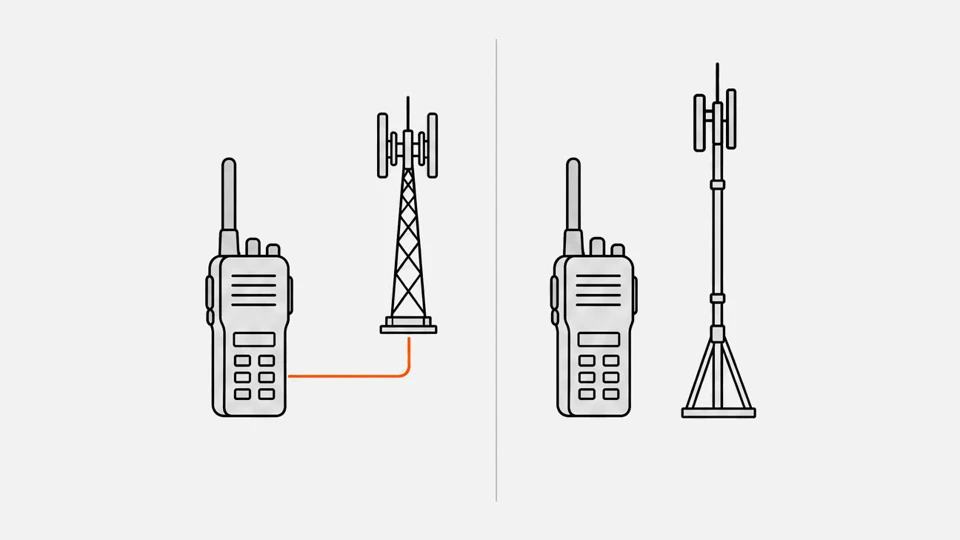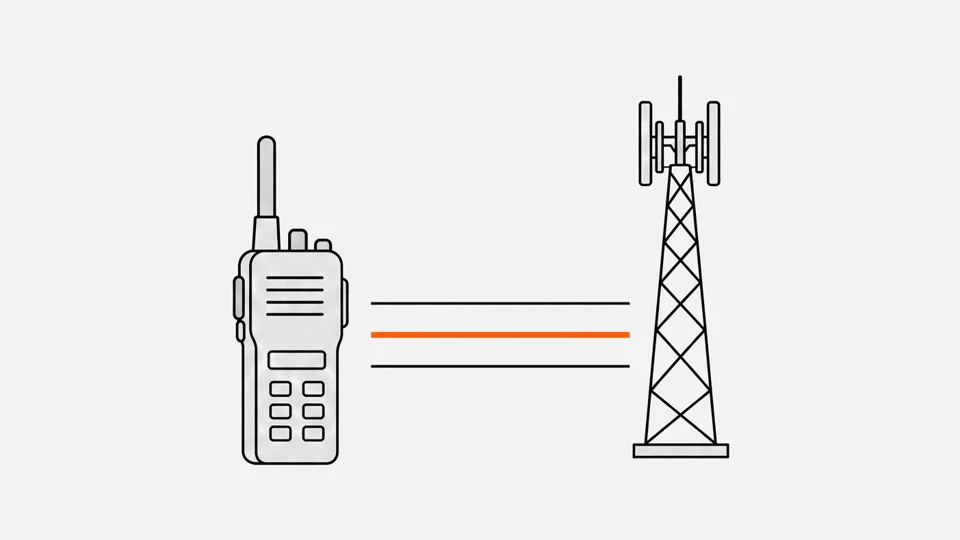
What is MCPTT?
MCPTT stands for mission-critical push-to-talk. It is a 3GPP service that carries group and private push-to-talk calls over LTE and 5G networks with fast call setup, priority handling and a direct mode for devices out of coverage. 3GPP completed it in March 2016 as part of Release 13.1
The service requirements are in 3GPP TS 22.179, which describes MCPTT as a push-to-talk service for mission-critical organizations and for other businesses with fast setup times, high availability, reliability and priority handling.2 Public safety is the main user. The text also names utilities and railways.2
Mission-critical data and video followed in Release 14, as MCData and MCVideo. Together with MCPTT they form the family called MCX.1 If you want the basics of push-to-talk first, start with what is push-to-talk.
How does MCPTT work?
Users call each other through an MCPTT application server in the operator's network. The server handles groups, floor control and priorities, and the LTE network carries the audio on bearers with a high priority. An MCPTT administrator defines users, groups and priority levels.2
| Parameter | MCPTT |
|---|---|
| Standards body | 3GPP, with ETSI publishing the specifications12 |
| First release | Release 13, completed March 20161 |
| Core specifications | TS 22.179 (requirements), TS 23.379 (functional architecture), TS 24.379 (call control), TS 24.380 (floor control)1 |
| Transport | LTE data bearers, with unicast or multicast delivery to the group2 |
| Later mission-critical services | MCData and MCVideo, Release 141 |
| Users | Public safety, utilities, railways and other organizations2 |
| Priority on the network | QCI 65 for voice and QCI 69 for signaling, plus an ARP level34 |
What are the MCPTT performance targets?
TS 22.179 sets three targets: MCPTT access time under 300 ms for 95% of requests, end-to-end access time under 1,000 ms, and mouth-to-ear latency under 300 ms for 95% of voice bursts. They apply under conditions, so they are design goals for a network, not a promise for any single call.2
| KPI (TS 22.179, V13.3.0) | Requirement | What it measures |
|---|---|---|
| KPI 1: MCPTT access time | Under 300 ms for 95% of requests; 99% for emergency and imminent-peril group calls2 | From pressing the talk key to the signal to start speaking, without confirmations from receivers and without group affiliation2 |
| KPI 2: End-to-end access time | Under 1,000 ms when the group call is not yet established2 | The same start, including call establishment and possibly an acknowledgement from the first receiver2 |
| KPI 3: Mouth-to-ear latency | Under 300 ms for 95% of voice bursts2 | From the speaker's utterance to playback at the receiver's speaker2 |
| Lost audio | 0 ms at the start and 0 ms at the end of a burst2 | At the receiving user2 |
The targets hold when the LTE network's traffic load stays below 70% of each node's capacity, and, on networks with QoS, when the load from users of equal or higher priority in the serving sector stays below 70%. They are measured with negligible backhaul delay.2 In Release 13 the access time and latency for off-network use were still marked for further study.2
A device still needs usable signal to meet any of this. To judge the signal at a given spot, enter the RSRP, RSRQ and SINR the device shows into the LTE signal checker.
What features does mission-critical push-to-talk have?
The core features are floor control, queuing, priority and pre-emption, emergency and imminent-peril calls, group affiliation, and an off-network mode. Floor control decides who may talk at any moment, so receivers normally hear one talker, and a queue orders the requests that wait for the floor.2
| Feature | What TS 22.179 requires |
|---|---|
| Floor control | Arbitrates who transmits; includes requesting permission, override, terminating permission and a transmit time limit2 |
| Queuing | Requests wait in a queue ordered by call type, urgency, group priority and user priority; users can cancel a queued request2 |
| Priority and pre-emption | Priority at network access, admission and scheduling and in the application; pre-emption ends ongoing calls to free resources for a higher-priority request2 |
| Emergency calls | Emergency group call, emergency private call, emergency alert and imminent-peril group call, which the text calls less critical than an emergency call2 |
| Group affiliation | A member indicates interest in a group; affiliations are expected to last several working hours, and an authorized user can change another user's affiliation2 |
| Off-network mode | Works "in the complete absence of any fixed infrastructure," for authorized users only, using ProSe direct communication2 |
| Other | Broadcast groups, dynamic regrouping, private calls, discreet and ambient listening, recording and audit, location2 |
Off-network mode is the counterpart of direct mode on a TETRA radio. It needs a device that supports ProSe, the proximity services 3GPP enhanced for public safety before Release 13.12
How does MCPTT get priority on LTE?
MCPTT traffic rides on dedicated QoS classes. QCI 65 carries MCPTT voice with a 75 ms packet delay budget, and QCI 69 carries mission-critical signaling with 60 ms. QCI 66 is for non-mission-critical push-to-talk voice with a lower priority and a 100 ms budget.3
| QCI | Used for | Priority | Delay budget | Loss rate |
|---|---|---|---|---|
| 65 | Mission-critical push-to-talk voice | 0.7 | 75 ms | 10^-23 |
| 66 | Non-mission-critical push-to-talk voice | 2 | 100 ms | 10^-23 |
| 69 | Mission-critical delay-sensitive signaling | 0.5 | 60 ms | 10^-63 |
| 70 | Mission-critical data | 5.5 | 200 ms | 10^-63 |
The Allocation and Retention Priority (ARP) adds the pre-emption rules. Its priority level runs from 1 to 15, with 1 highest, and two yes/no flags say whether a bearer may take resources from a lower-priority one and whether its own resources may be taken away. Levels 1 to 8 are for services authorized within the operator's domain.4 The table of classes also appears on public safety radio.
Which networks use MCPTT?
Public safety broadband networks in the US, South Korea, Finland, Sweden and the UK are built around mission-critical services. Sources confirm MCPTT by name for FirstNet and for South Korea's Safe-Net. For the others they describe the mission-critical service without naming MCPTT or give a plan.
| Network | What the sources confirm |
|---|---|
| FirstNet, United States | AT&T announced FirstNet Push-to-Talk in March 2020 as a controlled introduction, built to 3GPP mission-critical standards.5 A 2024 AT&T brief describes FirstNet Rapid Response as 3GPP-based, with talk groups of up to 3,000 users and links to land mobile radio.6 |
| Safe-Net, South Korea | Construction finished in March 2021 and service started in May 2021.7 Samsung says it runs in the 700 MHz band for more than 330 organizations and includes MCPTT with multicast support.8 |
| Virve 2, Finland | Erillisverkot said on 6 June 2025 that the broadband-based Virve 2 service is ready for use. TETRA support contracts run until 2030.910 |
| Sweden | In October 2025 MSB signed a 7-year contract with Airbus for 3GPP MCX equipment and a three-step migration from TETRA, toward the planned Swedish Emergency Network.11 |
| ESN, United Kingdom | The Home Office plans ESN Voice as Release 2 of three releases, with priority and pre-emption; EE/BT provide the mobile service.12 |
The FirstNet Authority has been open about the bar: in its voice roadmap it says responders will not call the push-to-talk service mission-critical capable until it is validated in real-world use.13
How is MCPTT different from carrier PoC apps?
A carrier PoC app is a push-to-talk service built by a vendor or operator for ordinary mobile data. MCPTT is a published 3GPP standard with performance targets, a priority mechanism and a direct mode. 3GPP treats non-mission-critical push-to-talk as a separate, lower-priority class, QCI 66.3
| MCPTT | TETRA | PoC apps on LTE | |
|---|---|---|---|
| Standard | 3GPP TS 22.179 and companions12 | ETSI EN 300 392, see TETRA | Set by each vendor; OMA approved PoC 1.0 on 9 June 200614 |
| Radio channel | The operator's LTE bands | 25 kHz carrier, four channels | The operator's LTE bands |
| Network | LTE or 5G core, MCPTT server, QCI 65 and 693 | Dedicated trunked network | Mobile network and a PTT server; 3GPP's class for non-mission-critical push-to-talk voice is QCI 663 |
| Range | Network coverage; direct mode between ProSe devices2 | Network coverage; direct mode | Network coverage, no direct mode |
| Access or license | A network operator's mission-critical service; an administrator sets users and priorities2 | A network operator or a licensed private network | A SIM or Wi-Fi and a PTT subscription |
| Data | MCData and MCVideo, Release 141 | Short data; TEDS | Mobile broadband |
In practice the line is blurred by product naming. AT&T sells Enhanced Push-to-Talk and Rapid Response side by side, and describes the second as the 3GPP-based, mission-critical option with a migration path from the first.6
Can MCPTT work with TETRA, P25 and land mobile radio?
Yes, through an interworking function (IWF). 3GPP introduced the IWF specifications in Release 15 and finalized them in Releases 16 and 17. They link mission-critical LTE users with TETRA, P25 and GSM-R, mainly for voice, messaging and location, because narrowband networks have little bandwidth to spare.15
TS 22.179 already lists the requirements for TETRA: interoperable group calls between MCPTT users and TETRA terminals and consoles, interoperable emergency calls, end-to-end encrypted group calls, override and regrouping across both.2 The technical specification for the interface is TS 23.283.16
On the American side, TIA and ATIS studied interworking between P25 and 3GPP mission-critical services, using a Release 15 IWF. TIA chose the P25 Inter-RF Subsystem Interface (ISSI) and the Digital Fixed Station Interface (DFSI) as the radio-side connections.17 The ISSI and the related Fixed Station Interface are covered under radio over IP, and the P25 side in what is a P25 radio. More on the TETRA side is in how TETRA is moving to mission-critical LTE.
3GPP says plainly that this migration "is not instantaneous" and that many user groups will keep using narrowband networks for years.15
What are the ETSI MCX Plugtests?
ETSI MCX Plugtests are interoperability events where vendors connect their MCPTT, MCData and MCVideo clients and servers and run test cases. The 10th event ran from 18 to 22 May 2026 with more than 240 participants, 112 test sessions and 356 executed tests, of which 92% passed.18
The test cases come from ETSI TS 103 564, which holds 466 of them.18 The 3GPP interworking function has also been demonstrated at these events, including TETRA-to-MCX connections.15 A plugtest result tests implementations against each other, not a whole network.
How this relates to PoC radio
A PoC radio and an MCPTT device do the same job, a group talking at the press of a button over LTE, under different rules. A PoC radio uses a push-to-talk platform and an ordinary data plan. An MCPTT device uses a mission-critical service with network priority, performance targets and, where supported, a direct mode.
The two overlap in the networks. Public safety agencies on FirstNet can run push-to-talk apps next to the MCPTT service.56 Many PoC platforms, such as TASSTA, bridge their users to TETRA, DMR and P25 radios. Radios for either service are LTE devices first, so the basics in 4G LTE walkie-talkies apply to both.
For a business whose calls are not life-critical, the practical comparison is a PoC radio against a licensed radio network, covered in PoC vs DMR. For emergency services, the wider picture is on public safety radio.
Questions
What does MCPTT stand for?
Mission-critical push-to-talk. It is the 3GPP push-to-talk service for LTE and 5G, completed in Release 13 in March 2016.1
Is MCPTT the same as PoC?
No. PoC is push-to-talk over cellular data, usually a vendor's service. MCPTT is a 3GPP standard with set performance targets, priority classes QCI 65 and 69, and a direct mode.23
What is the MCPTT access time?
The target is under 300 ms for 95% of requests, and for 99% of emergency and imminent-peril group calls. The end-to-end access time target is under 1,000 ms.2
Does MCPTT work without network coverage?
It has an off-network mode that runs without fixed infrastructure between authorized users with ProSe-capable devices.2 In 2020 the FirstNet Authority listed device-to-device communications (ProSe) among the MCPTT features it would push for.5
Will MCPTT replace TETRA?
Many operators plan the move, and interworking functions let both run together. 3GPP expects many user groups to stay on narrowband networks for years.15
Sources
- Mission critical services · 3GPP
- Samsung powers world's first 3GPP-compliant nationwide public safety network with MCPTT service in Korea, 30 April 2021 · Critical Communications Review, reprinting a Samsung release
Show all 18 sources
- Emergency Services Network: summary business case, 27 July 2026 · UK Home Office
- FirstNet Authority Roadmap: Voice Communications domain overview · FirstNet Authority
- P25 frequently asked questions, version 1.9 (2025), question 43 · P25 Technology Interest Group