What is a P25 radio?
A P25 radio is a two-way radio that follows Project 25, a suite of more than 80 standards documents for interoperable digital land mobile radio. Government and industry developed it together under governance of the Telecommunications Industry Association (TIA). It is the main digital standard for North American public safety.12
The project began with a meeting in September 1989, and APCO, the National Association of State Technology Directors (NASTD) and federal agencies formed the Steering Committee in 1990.3 TIA's TR-8 committee writes and maintains the TIA-102 series, which is most of the suite.1 CISA describes the standards as built for public safety by public safety, so that equipment from different makers can work together.2 P25 is one kind of land mobile radio.
What are P25 Phase 1 and Phase 2?
Phase 1 is FDMA: one voice or data transmission per RF channel, on conventional and trunked systems. Phase 2 is TDMA: two transmissions per RF channel, on trunked systems only. Both fit in a 12.5 kHz channel. Phase 1 is called "full rate" and Phase 2 "half rate".14
| Parameter | Phase 1 | Phase 2 |
|---|---|---|
| Access method | FDMA1 | TDMA, 2 slots1 |
| Channel width | 12.5 kHz4 | 12.5 kHz4 |
| Air link rate | 9.6 kb/s4 | 12 kb/s4 |
| Modulation | C4FM / CQPSK4 | H-CPM / H-DQPSK4 |
| Voice codec | IMBE, 7.2 kbps4 | AMBE+2, 3.6 kbps4 |
| System types | Conventional and trunked1 | Trunked only1 |
| Standard | TIA-102.BAAA-B (FDMA common air interface)5 | TIA-102.BBAB (TDMA physical layer)5 |
The AMBE+2 codec's full-rate version is compatible with the older IMBE codec of Phase 1.6 In Phase 2 the control channel can use both time slots, or share a channel with one voice or data slot.1 The radio compatibility tool shows how a Phase 1 and a Phase 2 radio get along.
Are P25 systems conventional or trunked?
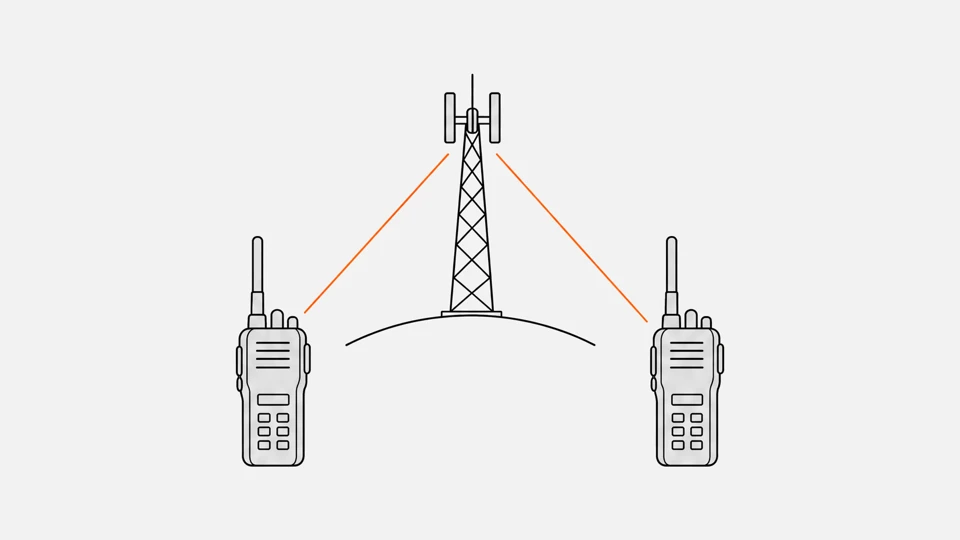
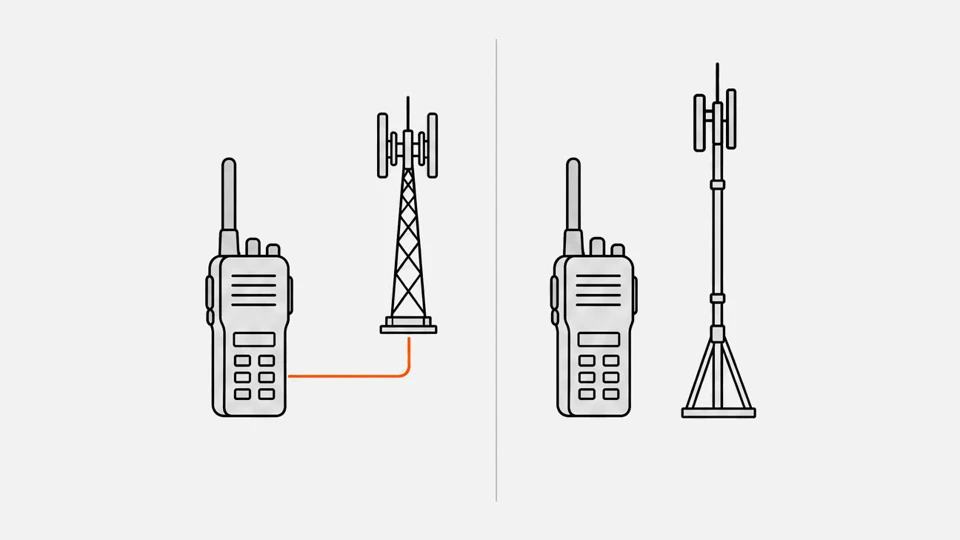
Both. A conventional P25 system uses fixed channels, with base stations and repeaters. A trunked one shares channels under a controller. Phase 2 exists only trunked. A repeater or base station from another maker can join a conventional system through the Fixed Station Interface (FSI).1
That answers most "P25 repeater" questions: a P25 repeater is a conventional fixed station, built to the FSI standard TIA-102.BAHA, so the repeater maker and the system maker can differ.15 Motorola Solutions, for example, lists a digital vehicular repeater (DVR-LX) alongside its P25 mobile radios.7
P25 equipment works in VHF, UHF, 700, 800 and 900 MHz. Multi-band radios let one handheld work, for example, on a 700/800 MHz trunked system and a VHF 136-174 MHz conventional one, and P25 radios typically include analog operation.1
What does "P25 compatible" mean?
On its own, the phrase is vague: the P25 standard has more than 80 documents, and "P25 compliant" does not say which interface, service or feature works. The P25 trade group suggests a precise form: compliant to the FDMA air interface, trunking service, group voice call feature.1
There are four levels of compliance: functions in the Statement of P25 User Needs, functions built to a published standard, functions that passed P25 standard tests, and functions tested under the DHS P25 Compliance Assessment Program (CAP).1 CAP is voluntary. Makers test at DHS-recognized labs and file a Supplier's Declaration of Compliance and a Summary Test Report, and the Approved (Grant-Eligible) Equipment list is used by several federal grant programs, including FEMA's.8
CAP does not "certify" a radio. The P25 trade group notes that DHS, NIST, TIA and its member companies avoid that word: a posting means that listed features were tested for compliance.1 Equipment is tested only to the tests in its report.8
For "P25 compatible radios" in practice, the system operator decides. Check the band, Phase 1 or Phase 2, and the system's software revision, and ask for the operator's list of approved models.1 Radios can differ in user interface even when features match; the standard does not define it.1
Which P25 radios are on the market?
The P25 trade group counts 15 infrastructure suppliers and 14 makers of subscriber radios. Motorola Solutions sells the APX series of portables and mobiles, L3Harris and Tait build systems and radios, and Icom sells P25 portables for conventional and trunked use.171591020
| Maker | P25 radios and systems named by the maker |
|---|---|
| Motorola Solutions | APX portables such as the APX N30, N50, 4000 and 6000XE; APX 4500, 6500 and 8500 mobiles; the DVR-LX digital vehicular repeater7 |
| L3Harris | Statewide P25 system in Alberta (AFRRCS)15 |
| Tait | TN9400 P25 Phase 2 network and 9800 series multiband radios, chosen for New Zealand's national network9 |
| Icom | IC-F9011 (136–174 MHz) and IC-F9021 (380–520 MHz, by version) portables: analog and P25 conventional, P25 trunking as an option, AES/DES as an option20 |
| Hytera | Its land mobile page lists DMR and TETRA lines and mentions P25 only as an industry standard10 |
See Motorola Solutions and Hytera for the brands. A "P25 handheld radio" or "P25 portable radio" is simply a portable built for the standard. Whether it works on a given network depends on the points in the previous section, not on the brand on the case.1
Is P25 encrypted?
P25 supports AES-256 encryption, the standard algorithm, defined in TIA-102.AAAD-B, first published in July 2002. DES-OFB was the earlier standard algorithm; NIST withdrew DES in 2005. Makers also sell legacy non-standard options such as Motorola ADP, a 40-bit RC4 variant.1112
| Algorithm | Key | Status |
|---|---|---|
| AES-256 | 256-bit | P25 standard; supported by CAP-approved equipment1112 |
| DES-OFB | 56-bit | Earlier P25 standard; considered weak1112 |
| ADP / Encryption Lite (ARC4) | 40-bit | Not a P25 standard algorithm; not recommended for sensitive traffic12 |
DHS decided in 2017 that CAP-approved equipment may have AES-256 enabled, or no encryption, but that a product with non-standard encryption and without AES-256 would not be approved. The reason: every radio in a secure group needs the same algorithm and key.11 Beyond voice encryption, P25 offers link layer authentication, over-the-air rekeying (OTAR), and key management; link layer encryption is still in development.1
What are ISSI and CSSI?
The Inter-RF Subsystem Interface (ISSI) connects P25 radio cores from different makers into a wide-area network. The Console Subsystem Interface (CSSI) connects a dispatch console from another maker to a radio core. Both are standards-based IP connections that form a "system of systems".13
A multi-vendor overlay in Dallas/Fort Worth links subsystems from several makers over ISSI, and similar systems run or are planned in Connecticut, Florida, Oklahoma, the Denver region and southern Texas.1 How these IP links carry voice is covered in radio over IP. In Texas, one hospital district's system ties together more than 17 counties and 100,000 users, with talkgroups mapped in advance between makers.14
Who uses P25 radio, and where?
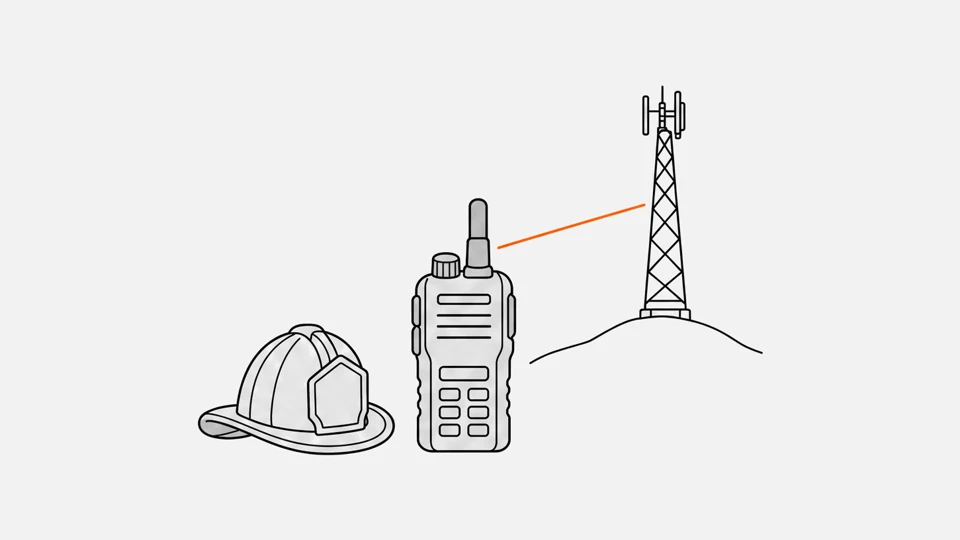
Law enforcement, fire, EMS and federal, state, local and tribal agencies use P25, along with military, utilities and transit. PTIG members count over 3,368 P25 systems on air worldwide, 2,387 conventional and 981 trunked. Outside the US, networks run in Canada, New Zealand and Australia.11516
| Place | System | Detail |
|---|---|---|
| Canada, Alberta | AFRRCS | 340 sites, 43,000+ radios, 150+ agencies including the RCMP; L3Harris selected in 201115 |
| New Zealand | National land mobile radio network | 450+ sites on Tait TN9400 Phase 2; Police, Fire and Emergency NZ, St John and Wellington Free Ambulance; contract Nov 20229 |
| Australia, Victoria | Statewide government radio network | P25 Phase 2 with about 92,000 handsets, per an independent evaluation hosted by PTIG16 |
Counts and site numbers for these networks come from the makers and a trade-group case study, so treat them as vendor figures.91516
How does P25 compare with DMR and TETRA?
P25 is a US public safety standard from TIA. DMR and TETRA are ETSI standards: DMR with two slots in 12.5 kHz, mainly for business, and TETRA with four slots in 25 kHz, mainly for public safety outside the US. DHS says P25 and these systems generally interoperate only through gateways.171
| P25 | DMR | TETRA | |
|---|---|---|---|
| Standard body | TIA (TIA-102)1 | ETSI, 200517 | ETSI, 199517 |
| Channel | 12.5 kHz; FDMA or 2-slot TDMA1 | 12.5 kHz, 2-slot TDMA17 | 25 kHz, 4-slot TDMA17 |
| Analog fallback | Typical1 | Yes, many setups17 | No17 |
| Strong in | North American public safety | Business and industry17 | Public safety in Europe and 120+ countries17 |
| AES encryption | Standard11 | AES and DES allowed by the DMR Association (as of 2016)17 | Not in the standard; TEA algorithms17 |
How do P25 and LTE or MCPTT work together?
They are built to coexist. The P25 trade group says broadband does not make P25 obsolete and that the two technologies complement each other. TIA and ATIS resumed work on LMR-LTE interworking in late 2017, studying a 3GPP Release 15 interworking function between P25 and mission-critical push-to-talk.1
3GPP's interworking function lets broadband mission-critical users talk with P25, TETRA and GSM-R users, mainly for voice, messaging and location. FirstNet has announced an implementation for P25.18 The study names the P25 ISSI and the Digital Fixed Station Interface (DFSI) as the P25 side.1 In October 2025 Tait lent a P25 network to NIST's Public Safety Communications Research lab to study P25 and LTE/5G interoperability.19
How this relates to PoC radio
A P25 radio and a PoC radio both give group talk at the press of a button. P25 does it on licensed radio channels, with its own sites, repeaters and encryption. A PoC radio sends voice over 4G/LTE data and needs a SIM and a push-to-talk service; it works anywhere the mobile network does.
| P25 | DMR | PoC / LTE | |
|---|---|---|---|
| Standard | TIA-102, over 80 documents1 | ETSI, 200517 | Set by the PTT platform; MCPTT for mission-critical use18 |
| Radio channel | 12.5 kHz; Phase 1 FDMA, Phase 2 two-slot TDMA1 | 12.5 kHz, two TDMA slots17 | The mobile operator's LTE bands |
| Network | Conventional repeaters or trunked systems, linked over ISSI113 | Direct, repeater or trunked | Mobile network and a PTT server |
| Range | Radio to radio; repeaters and multi-site trunking extend it1 | Radio to radio; repeaters extend it | Wherever the mobile network has data coverage |
| Access or license | Licensed channels; the system operator approves each radio model1 | Licensed business channels17 | A SIM and a PTT service |
| Data | Data services, over-the-air rekeying, AES-256 encryption111 | Short data17 | Mobile broadband |
They meet in three places. P25 agencies add LTE push-to-talk apps so staff on phones can join talkgroups, as in Michigan, where mutual-aid partners join from an app instead of carrying a radio.14 Interworking functions link mission-critical LTE users with P25.18 And makers test the two together: Tait's P25 network at NIST's lab is there to compare P25 with LTE/5G push-to-talk.19
For a business without an emergency network, the comparison that matters is usually PoC against a licensed radio system: see PoC vs DMR, public safety radio and 4G LTE walkie-talkies.
Questions
What is the difference between P25 and analog radio?
P25 is digital. It carries a coded voice signal (IMBE or AMBE+2) in a 12.5 kHz channel and supports AES-256 encryption, talker ID and emergency alerts.14 Analog FM is one conversation per channel, and P25 radios usually include analog as a fallback.1
Can a P25 radio talk to a DMR radio?
Not directly in digital mode. DHS says there is generally no direct interoperability with DMR, NXDN or dPMR except through gateways and maker-specific solutions; analog FM can give a base level.17
Are all P25 radios the same?
No. Features, bands (VHF, UHF, 700/800 MHz) and the Phase supported differ, and a system operator decides which radio models may join its system.1
Does P25 Phase 2 replace Phase 1?
It adds to it. Phase 1 runs conventional and trunked, while Phase 2 runs only trunked, with two calls per 12.5 kHz channel. Many multi-mode radios support both.1
What frequency does a P25 radio use?
P25 equipment works in VHF, UHF, 700, 800 and 900 MHz; a single radio covers one band or several.1 In the US, public safety voice radios in 150–174 and 450–470 MHz must also work in analog FM on the nationwide interoperability channels.21
Are the P25 standards free to read?
They are free to US government agencies and sold to others through TIA's store.1
Sources
- P25 frequently asked questions, version 1.9 (2025) · P25 Technology Interest Group
- SAFECOM: Project 25 · CISA
- Project 25 organizational overview and committees · APCO International
- Advanced protocol analysis: APCO-25 · Wavecom
- P25 TIA standards accepted, April 2025 · P25 Steering Committee
- USB-3000 P25 vocoder device · Digital Voice Systems, Inc.
- APX P25 portable radios and APX P25 mobile radios · Motorola Solutions
- P25 Compliance Assessment Program · DHS Science and Technology Directorate
- Tait wins nationwide public safety network, 10 November 2022 · Tait Communications
- Land mobile radio · Hytera
Show all 21 sources
- P25 CAP encryption requirements, P25-CAB-ENC_REQ (March 2017) · DHS Office for Interoperability and Compatibility
- Project 25 encryption white paper · L3Harris
- Project 25 ISSI and CSSI primer (January 2019) · CISA, FPIC
- Australian public safety networks: a strategic evaluation · P25 Technology Interest Group, case study by an independent author
- Public safety interoperability implications of non-P25 radio technologies (July 2016) · DHS Office of Emergency Communications
- Tait P25 network implemented in public safety communications lab, 21 October 2025 · Tait Communications
- 47 CFR 90.203: Certification required · Cornell LII, electronic Code of Federal Regulations