What is land mobile radio (LMR)?
LMR stands for land mobile radio. FCC rules define the land mobile radio service as a mobile service between base stations and land mobile stations, or between land mobile stations. The ITU Radio Regulations, No. 1.26, use the same words for the land mobile service.12
In practice, "LMR" names the whole family of professional two-way radio: handhelds, vehicle radios, base stations and repeaters, on networks that the user or a service provider operates. The FCC rule that governs it in the US is titled Private Land Mobile Radio Services.3 The term covers every kind of two-way radio that talks over its own radio channels rather than a mobile phone network.
CISA, the US cybersecurity agency, says radio has been the main way public safety staff reach dispatchers and each other for almost a century. Today's LMR gives group and individual voice, end-to-end encryption and low-speed data such as location.4
What are the parts of a land mobile radio system?
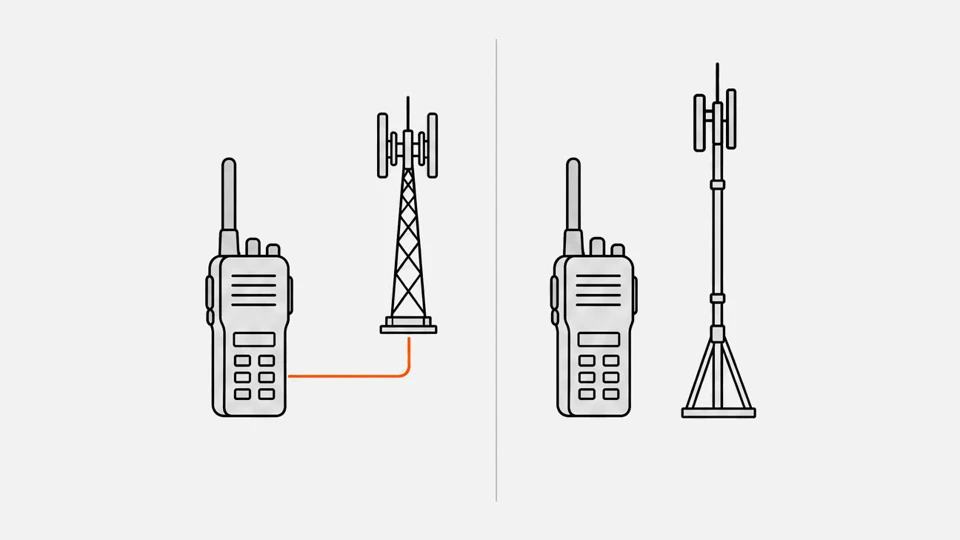
The FCC defines a land mobile radio system as a regularly interacting group of base, mobile, control and fixed relay stations serving one area. In practice that means handheld and vehicle radios, base stations, repeaters and dispatch consoles, which larger networks link over IP.116
| Part | What it does |
|---|---|
| Portable and mobile radios | Mobile stations, used "while in motion or during halts", including hand-carried transmitters1 |
| Base station | A station at a fixed site that talks to mobile stations1 |
| Repeater (mobile relay station) | A base station that automatically retransmits, on a mobile frequency, what mobiles send on their own transmit frequency1 |
| Control station | A fixed station that controls another station, such as a remote repeater, at a set location1 |
| Dispatch console | Where dispatchers talk to groups and patch them together; P25 links a console from another maker through the CSSI16 |
| Network core | On larger systems, assigns channels and joins sites; the P25 ISSI links radio cores from different makers16 |
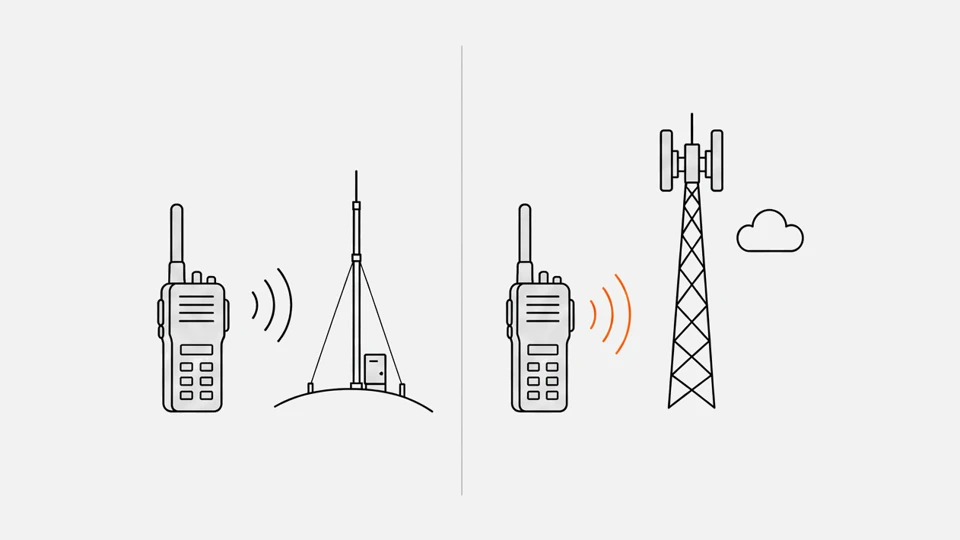
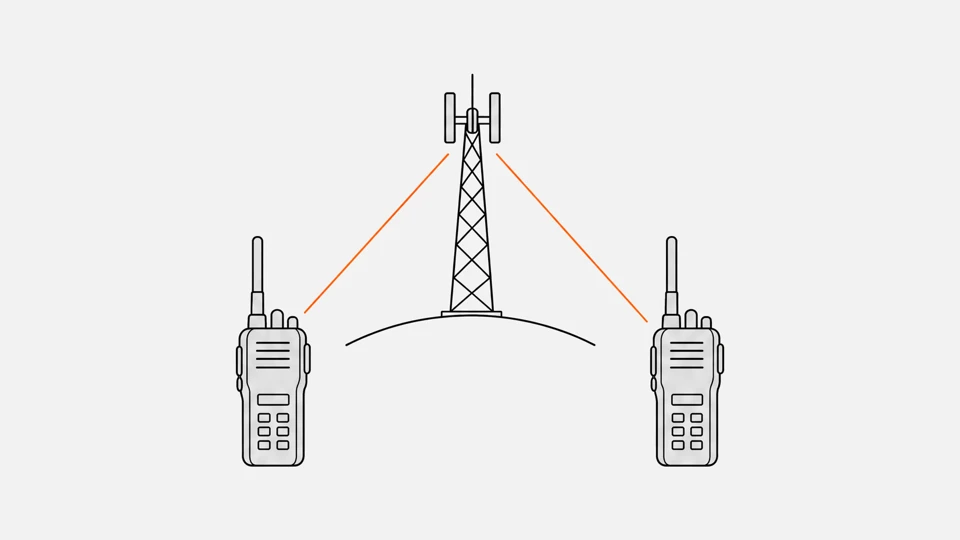
A repeater on a tower or hilltop is why a handheld reaches much farther through a system than radio to radio. The range calculator shows how antenna height changes that distance, and radio over IP covers how sites and consoles connect.
What is the difference between conventional and trunked LMR?
A conventional system assigns channels to base and mobile stations without pooling them: users pick a channel and talk, directly or through a repeater. A trunked system searches two or more paths and automatically assigns an open one when someone presses the button. Both definitions come from the FCC's Part 90.1
| Conventional | Trunked | |
|---|---|---|
| Channel use | One channel per group, chosen by the user1 | Pool of channels, assigned automatically1 |
| Typical size | A site, a campus, a fleet | A county, a state or a nation |
| P25 | Phase 1 only6 | Phase 1 and Phase 26 |
| DMR | Direct mode and repeaters (Tier II)7 | Tier III trunking7 |
ETSI describes TETRA trunking the same way, as channels handed out on demand.5 Systems are often mixed. P25 radios usually include analog operation, and interoperability gateways and consoles patch conventional analog channels into P25 trunking.6
Which technologies count as LMR?
Analog FM, DMR, P25, TETRA, NXDN and dPMR are all LMR. They differ in who standardized them, how they split a channel and where they are strong. Analog FM is the baseline that most of them can still fall back on, and the only mode allowed on US public safety calling channels.68
| Technology | Standard body | How the channel is used | Typical use |
|---|---|---|---|
| Analog FM | TIA-6036 | One conversation per channel | Everywhere; the common fallback on US public safety channels8 |
| DMR | ETSI, 20058 | 2-slot TDMA in 12.5 kHz8 | Business and industry8 |
| P25 | TIA-102, over 80 documents6 | Phase 1 FDMA, Phase 2 two-slot TDMA in 12.5 kHz6 | Public safety, utilities, transit, military6 |
| TETRA | ETSI | 4-slot TDMA in 25 kHz; 120+ countries89 | Public safety and utilities, mostly outside the US |
| NXDN | Icom and JVC Kenwood, 2003; not from a recognized standards body8 | 6.25 kHz FDMA8 | Business and industry8 |
| dPMR | ETSI-based8 | 6.25 kHz FDMA8 | Business and industry8 |
DHS notes that there is generally no direct digital interoperability between P25 and DMR, NXDN, dPMR or TETRA except through gateways and maker-specific solutions.8 A radio that supports both standards, or an analog fallback, closes part of that gap. The digital radio compatibility tool shows what two radios can do together, for example DMR and P25 Phase 1.
Who uses land mobile radio?
Public safety is the biggest user, and the rest is utilities, transport, industry and government. The P25 trade group lists law enforcement, fire, EMS, federal, state, local and tribal agencies, military, utilities, transit and business users. DHS says DMR, NXDN and dPMR came to the US mainly for business, industrial and transportation systems.68
Two US examples show the spread. Fairfax County, Virginia, ran a dual 800 MHz system: analog for schools, transit and special-needs buses, and digital P25 for police, fire and EMS. The Metropolitan Transportation Authority's five-channel 700 MHz system in the New York area serves commuter and metropolitan railroad lines through 65 radio sites.4
Emergency services in Europe mostly use TETRA and TETRAPOL, covered on public safety radio and what is TETRA. That page also covers land mobile radio for public safety on commercial LTE networks.
What frequency bands does land mobile radio use?
In the US, land mobile radio uses low-band VHF (25–50 MHz), high-band VHF (150–174 MHz), 220 MHz, UHF (450–512 MHz) and the 700, 800 and 900 MHz bands. The FCC splits Part 90 channels into a Public Safety Pool and an Industrial/Business Pool, each with its own frequency table.1011
| Band | Public Safety Pool (47 CFR 90.20) | Industrial/Business Pool (47 CFR 90.35) |
|---|---|---|
| Low-band VHF | Channels from 30.86 to 47.66 MHz10 | Channels from 25.02 to 49.58 MHz11 |
| High-band VHF | Channels from 150.775 to 173.396 MHz10 | Channels from 150.815 to 173.396 MHz11 |
| 220 MHz | 220–222 MHz10 | 220–222 MHz11 |
| UHF | 450–470 MHz; 470–512 MHz in the urban areas listed in Subpart L10 | 450–470 MHz; 470–512 MHz under the same rules11 |
| 700 MHz | 758–775 / 788–805 MHz10 | — |
| 800 MHz | 806–817 / 851–862 MHz10 | 809–824 / 854–869 MHz11 |
| 900 MHz | 929–930 MHz, one-way paging only10 | 896–901 / 935–940 MHz11 |
The 421–430 MHz band is also open to land mobile use in the Detroit, Cleveland and Buffalo areas.1011 Outside the US, regulators use other bands: Europe's TETRA bands are in what is TETRA, and the frequency charts list license-free bands by country.
Part 90 also sets channel widths. Equipment designed for 25 kHz channels is authorized 20 kHz of bandwidth, 12.5 kHz equipment 11.25 kHz, and 6.25 kHz equipment 6 kHz. Since January 1, 2013, stations in 150–174 MHz and 406–512 MHz must use channels of 12.5 kHz or less unless they meet the FCC's efficiency standard: the US narrowbanding rule.12
Do you need a license to use land mobile radio?
Yes, for most LMR. In the US a Part 90 license covers a station or system, most new frequencies need frequency coordination first, and the FCC fee for a new site-based application is $105, for a term of up to 10 years. In Britain, Ofcom issues Business Radio licenses.313171819
| United States | United Kingdom | |
|---|---|---|
| Regulator and rules | FCC, 47 CFR Part 903 | Ofcom, Business Radio; Interface Requirement 204419 |
| Business radio bands | See the band table above | 137.96–165.04 MHz and 450–470 MHz for land mobile19 |
| Entry-level license | Industrial/Business Pool station license11 | Simple UK Light: 19 shared frequencies, 5 W ERP, handhelds and mobiles, no base stations20 |
| Fee | $105 FCC fee for a new site-based application (47 CFR 1.1102, October 2026)17 | £75 for five years (Ofcom, December 2025)20 |
| Term | Up to 10 years18 | Five years for Simple UK Light20 |
In the US, a coordinator's recommendation does not guarantee a license, so buy equipment after authorization.13 Transmitters used under Part 90 must be of a type certified for that part, and public safety voice radios in 150–174 and 450–470 MHz must be able to work in analog FM on the nationwide public safety interoperability channels.14 Eligibility for the Industrial/Business Pool covers commercial activities, educational, philanthropic and ecclesiastical institutions, clergy, and hospitals and clinics.11
Consumer services such as FRS in the US and PMR446 in Europe sit outside these licenses. For an overview by country see the license checker.
How is LMR different from LTE and PoC?
LMR gives one-to-many voice on its own channels, at higher power than a phone, and radios keep talking to each other if the infrastructure fails. LTE gives fast data and wide coverage but depends on cell towers and capacity. CISA expects LTE not to displace LMR in the foreseeable future.4
| LMR (DMR as an example) | PoC / LTE | |
|---|---|---|
| Standard | Many: TIA-603, ETSI TS 102 361, TIA-102 and others67 | Set by the PTT platform; MCPTT for mission-critical use15 |
| Radio channel | Licensed channels of 6.25, 12.5 or 25 kHz812 | The mobile operator's LTE bands |
| Network | Direct, repeater or trunked7 | Mobile network and a PTT server |
| Range | External antennas, higher power than phones; radio-to-radio if the network fails4 | Wherever the mobile network has data coverage |
| Access or license | A Part 90 license in the US, a Business Radio license in the UK320 | A SIM and a PTT service |
| Data | Low-speed: location, OTAR, limited exchange4 | Mobile broadband |
In one Texas hospital district, LMR carried 95 percent of voice use and LTE the other 5 percent, mostly in ambulances out of LMR coverage or underground.4 For the full comparison with a direct radio network see PoC vs DMR.
How this relates to PoC radio
A PoC radio does the job of an LMR handheld, group talk at the press of a button, but carries voice over 4G/LTE data instead of a licensed radio channel. It reaches wherever the mobile network does and needs no radio license; LMR keeps working where there is no network.
The two are growing together more than they compete. CISA describes gateways and software that already join LMR and LTE: Michigan lets mutual-aid partners join the LMR network from a smartphone app instead of handing out caches of radios, and Fairfax County moved non-public-safety users from analog LMR to LTE push-to-talk at lower recurring cost.4
At the standards level, 3GPP defined interworking functions in Release 15 that link mission-critical push-to-talk to LMR systems such as TETRA and P25, mainly for voice, messaging and location.15 More on that is in MCPTT and What is P25 radio?. For a worker who needs national reach and no license, see 4G LTE walkie-talkies and what is PoC radio.
How an LMR system stacks up against push-to-talk over cellular on coverage, outages, delay and cost: LMR vs PoC.
Questions
What does LMR mean?
LMR means land mobile radio: two-way radio between base stations and mobile or portable radios on land, or between the mobile radios themselves.1 It includes analog, DMR, P25, TETRA and NXDN systems.
Is LMR the same as a walkie-talkie?
A walkie-talkie is a handheld radio, often a license-free one such as FRS or PMR446. LMR is the wider professional category, with licensed channels, repeaters, base stations and trunked networks. A handheld on a licensed LMR system works much like a walkie-talkie, with more range and features.
Is LMR analog or digital?
Both. Analog FM is still widely used, and digital LMR includes DMR, P25, TETRA, NXDN and dPMR.8 Many digital radios keep an analog mode so they can work with older systems.68
How much does an LMR license cost?
In the US the FCC fee for a new site-based Part 90 application is $105, with a term of up to 10 years; frequency coordination is a separate step.171813 In the UK, Ofcom's Simple UK Light license costs £75 for five years.20
Sources
- 47 CFR 90.7: Definitions · Cornell LII, electronic Code of Federal Regulations
- Radio Regulations, Article 1 (No. 1.26), in Tractatenblad 2022, 52 · ITU, published by the Dutch government
- 47 CFR Part 90: Private Land Mobile Radio Services · Cornell LII, electronic Code of Federal Regulations
- P25 frequently asked questions, version 1.9 (2025) · P25 Technology Interest Group
- Public safety interoperability implications of non-P25 radio technologies (July 2016) · DHS Office of Emergency Communications
- 47 CFR 90.20: Public Safety Pool · Cornell LII, electronic Code of Federal Regulations
Show all 20 sources
- 47 CFR 90.35: Industrial/Business Pool · Cornell LII, electronic Code of Federal Regulations
- 47 CFR 90.209: Bandwidth limitations · Cornell LII, electronic Code of Federal Regulations
- 47 CFR 90.175: Frequency coordinator requirements · Cornell LII, electronic Code of Federal Regulations
- 47 CFR 90.203: Certification required · Cornell LII, electronic Code of Federal Regulations
- Project 25 ISSI and CSSI primer (January 2019) · CISA, FPIC
- 47 CFR 1.1102: Schedule of application fees, Wireless Telecommunications Bureau · Cornell LII, electronic Code of Federal Regulations
- 47 CFR 90.149: License term · Cornell LII, electronic Code of Federal Regulations