What is the difference between UHF and VHF?
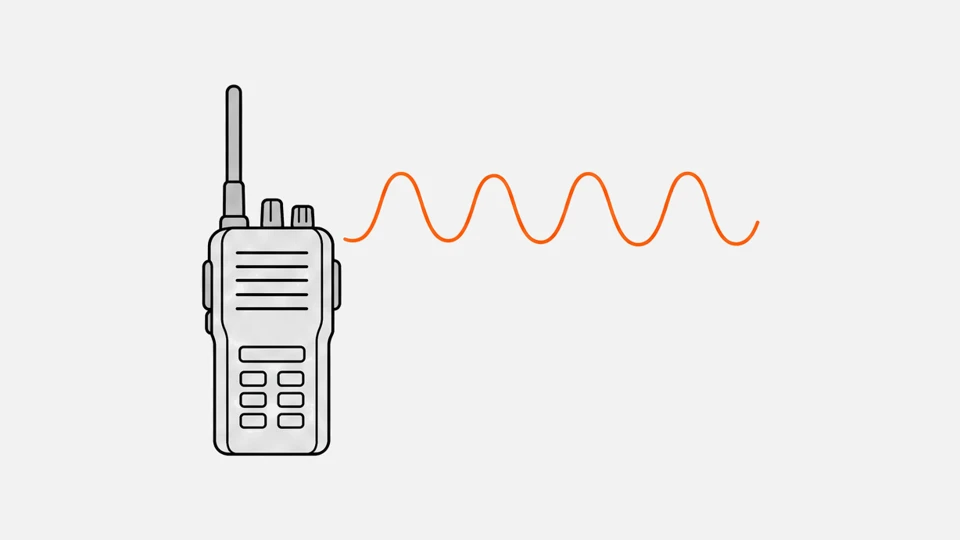
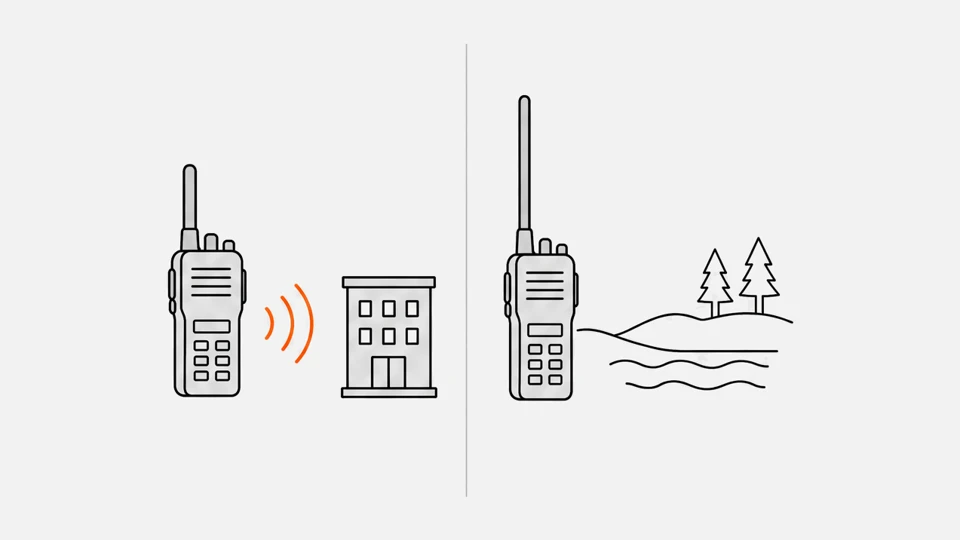
VHF (very high frequency) is the 30–300 MHz band and UHF (ultra high frequency) the 300 MHz–3 GHz band.1 Two-way radios use a narrow slice of each, around 155 MHz and 450 MHz. VHF has the longer wavelength and antenna and the open-country reputation; UHF has the shorter wavelength and the indoor one.2
The ITU names bands by decade of frequency, and HF (3–30 MHz) is the one below VHF, home of CB and shortwave radio.1 Handheld radios sit at 136–174 MHz on VHF and 400–470 MHz on UHF; Motorola's DP4000e covers 136–174 and 403–527 MHz.3
Choose UHF if…
- Your team works inside buildings, such as warehouses, hotels, hospitals and schools
- You work in a town or on a campus with many walls and corridors
- You want a short antenna on a small handheld
- You want a license-free handheld band, such as PMR446 in Europe or FRS in the US
Choose VHF if…
- Your team works in open country, such as farms, forestry, utilities and road crews
- You work on the water, where marine radio is VHF
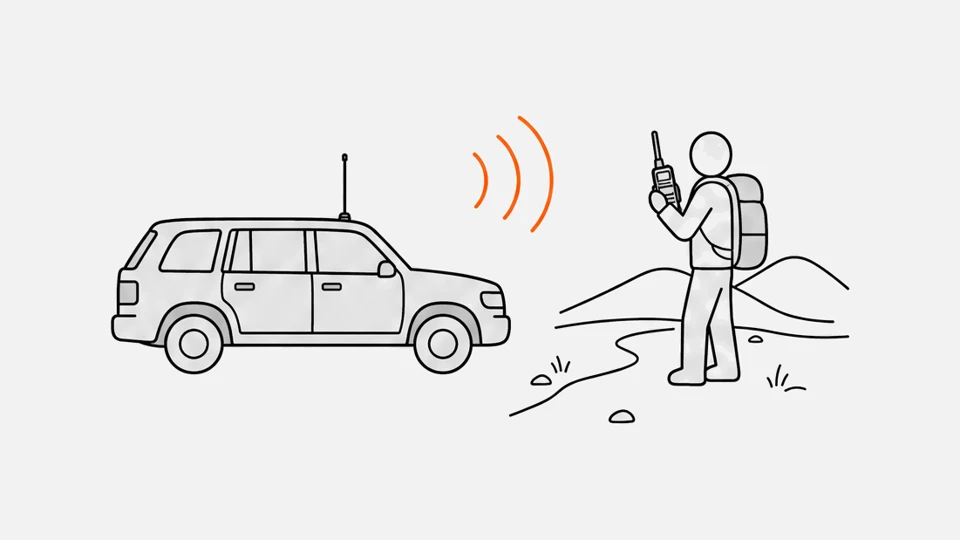
- You can fit a longer antenna, for example on a vehicle
- You already run VHF radios, MURS sets or a 2 m ham radio
How do UHF and VHF compare point by point?
VHF is the open-country band and UHF the indoor band, with a small gap in both cases. The first table uses typical two-way radio values, not the full ITU bands. Distances come from this site's range model for two handhelds held at chest height.5
| Criterion | VHF | UHF |
|---|---|---|
| ITU band | 30–300 MHz1 | 300 MHz–3 GHz1 |
| Handheld radio band | 136–174 MHz3 | 400–470 MHz; up to 527 MHz on some models36 |
| Wavelength | About 1.9 m at 155 MHz7 | About 0.65 m at 460 MHz7 |
| Quarter-wave antenna | About 46 cm7 | About 15.5 cm7 |
| Open country, maker guidance | Farther28 | Shorter range2 |
| Open field, handheld to handheld (model) | 1.1–1.8 km | 1.6–2.7 km |
| Town center (model) | 720 m–1.2 km | 780 m–1.3 km |
| Inside buildings, maker guidance | Limited2 | Strong24 |
| Median building loss, 25 NIST measurements in 11 structures | 42.5 dB | 38.7 dB9 |
| 100 m of LMR-400 cable | 5.0 dB at 150 MHz | 8.9 dB at 450 MHz10 |
| Handheld power (Motorola DP4000e) | 5 W high, 1 W low | 4 W high, 1 W low3 |
Technical details
| Parameter | VHF | UHF |
|---|---|---|
| Free-space loss at equal distance, isotropic antennas | Lower by 9.5 dB (20 log 460/155)11 | Higher by 9.5 dB11 |
| Loss beyond the breakpoint over flat ground | Grows as distance to the fourth power, no frequency term12 | Same12 |
| Handheld stub gain used by the model | −5 dBi (estimate) | −2 dBi (estimate)5 |
| Receiver sensitivity, 12 dB SINAD | 0.16 µV (−122.9 dBm) | 0.16 µV (−122.9 dBm)3 |
| Building entry loss, ordinary building, median | 14.0 dB at 150 MHz | 14.0 dB at 446 MHz13 |
| Building entry loss, metal-coated glass and thick concrete, median | 37.3 dB at 150 MHz | 32.6 dB at 446 MHz13 |
| 200 mm plain concrete wall, ideal slab | 3.9 dB at 150 MHz | 5.5 dB at 446 MHz14 |
| City noise raising a receiver's noise floor (model, 8 dB receiver) | About 9 dB at 150 MHz | None at 446 MHz15 |
What frequencies do UHF and VHF two-way radios use?
Two-way radios use narrow service bands, not all of VHF or UHF: business handhelds at 136–174 and 400–470 MHz, marine radio at 156–162 MHz, PMR446 at 446 MHz, FRS and GMRS near 462 and 467 MHz, MURS at 151–154 MHz, and hams on 2 m and 70 cm.3161718
| Service | Band | Frequencies | Power | License |
|---|---|---|---|---|
| Business radio, US | VHF, UHF | 150–170, 450–470 and 470–512 MHz among others19 | Set per license | FCC license |
| MURS, US | VHF | 151.820, 151.880, 151.940, 154.570, 154.600 MHz17 | 2 W | None |
| Marine VHF | VHF | 156–162 MHz; channel 16 is 156.800 MHz1820 | Ship stations 25 W at most; handheld 6 W or 1 W1821 | Varies by country |
| Amateur 2 m | VHF | 144–148 MHz in the US, 144–146 MHz in ITU Region 1, which includes Europe22 | Set by license class | Exam |
| PMR446, EU and UK | UHF | 446.0–446.2 MHz16 | 0.5 W ERP | None |
| FRS, US | UHF | 462 and 467 MHz, 22 channels23 | 0.5 or 2 W ERP24 | None |
| GMRS, US | UHF | Same channels plus 16 main channels25 | Up to 50 W on main channels, mobile and base25 | $35 for ten years26 |
| Amateur 70 cm | UHF | 420–450 MHz in the US, 430–440 MHz in ITU Region 122 | Set by license class | Exam |
Channel lists are in the frequency charts. For the services, read analog two-way radio, FRS and GMRS and PMR446.
Which goes farther outdoors, UHF or VHF?
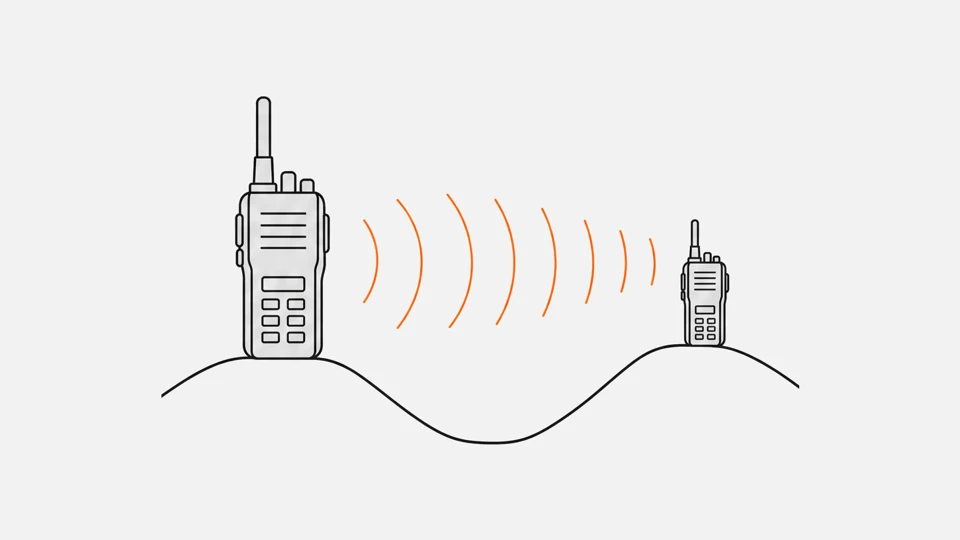
Makers say VHF goes farther in open country, and free-space physics agrees: loss grows with frequency, 9.5 dB more at 460 than at 155 MHz.11 Between two handhelds on flat ground our model finds the bands within 1.5 times of each other, UHF slightly ahead.5
| Setting | VHF, 5 W | UHF, 4 W |
|---|---|---|
| Open field | 1.1–1.8 km | 1.6–2.7 km |
| Suburb | 1.1–1.8 km | 1.2–1.9 km |
| Town center | 720 m–1.2 km | 780 m–1.3 km |
The lower figure holds at 90% of locations, the upper at 50%.5 Over flat ground the ground reflection takes over beyond 5 m on VHF and 13 m on UHF, and the loss no longer depends on frequency.12 What separates the two handhelds is power and stub antenna gain, both estimates.
The model has no hills, trees or elevated antennas, where makers place VHF's edge. Try your own case:
Which is better indoors, UHF or VHF?
UHF, by a small margin. Motorola, Hytera and Icom all recommend it for buildings.248 Across 11 large structures NIST's tables show about 4 dB less loss at 449 than at 162 MHz, and the ITU model gives UHF a 4.7 dB edge in metal-coated buildings. Plain concrete passes VHF slightly better.
| Evidence | VHF | UHF |
|---|---|---|
| NIST, 11 large structures: median loss against clear line of sight | 42.5 dB at 162 MHz | 38.7 dB at 449 MHz9 |
| NIST: receive points where UHF lost less | 14 of 25 | |
| ITU-R P.2109-2, ordinary building, median entry loss | 14.0 dB | 14.0 dB13 |
| ITU-R P.2109-2, metal-coated glass and thick concrete | 37.3 dB | 32.6 dB13 |
| ITU-R P.2040-4, 200 mm concrete, ideal slab | 3.9 dB | 5.5 dB14 |
Inside one building the spread is about 12 dB (standard deviation), three times the gap between bands.9 So the band matters less than where you stand, how many floors lie between radios and what the walls are made of. Check a layout in the range tool.
Why is a VHF antenna longer than a UHF antenna?
Antenna length follows wavelength. A quarter-wave antenna is about 46 cm at 155 MHz and 15.5 cm at 460 MHz, three times shorter, from ARRL's 234/f feet rule.7 Handheld VHF radios use shortened stubs, which give up some gain, so match the antenna to the band printed on the radio.
| ARRL ground-plane wire | VHF, 146 MHz | UHF, 440 MHz |
|---|---|---|
| Element and radial length | 19¼ in (48.9 cm) | 6¼ in (15.9 cm)27 |
The range model assumes a 15–20 cm VHF stub, about a tenth of a wavelength, and a UHF stub with 3 dB more gain; both are estimates.5 The dipole antenna calculator gives lengths for any frequency.
Cable matters more on UHF. LMR-400 loses 5.0 dB per 100 m at 150 MHz and 8.9 dB at 450 MHz,10 so 30 m delivers 71% of the power on VHF and 54% on UHF. The coax loss calculator covers other cables. Dual-band antennas exist for dual-band radios, such as QST's dual-band J-pole.28
Can UHF and VHF radios talk to each other?
No. Radios talk directly only on a frequency both can transmit and receive, and a VHF radio cannot tune to a UHF channel. Hytera says the answer is no for most radios.4 A dual-band handheld covers both bands, but talks to each radio on that radio's own band, and a gateway can link two bands.
Icom's ID-52A PLUS, for example, transmits on 144–148 and 430–450 MHz and watches both bands at once.29 Hytera notes that some high-end public safety radios cover both bands and calls that impractical for most users.4 Test a pair in the compatibility tool, which has a band selector.
Which band fits construction, warehouse, hotel, farm, marine or hiking?
Warehouses, hotels, hospitals and schools suit UHF. Farms, forestry, utilities and road crews suit VHF. Marine radio is VHF only, at 156–162 MHz. Construction depends on the site. For hiking, the license-free handhelds are mostly UHF, with MURS the VHF option in the US.2818
| Use | Band | Why |
|---|---|---|
| Warehouse, hotel, hospital, school | UHF | Walls, floors and corridors24 |
| Building under construction | UHF | Motorola lists construction sites with UHF2 |
| Open earthworks, road crews | VHF | Icom recommends VHF for open sites8 |
| Farm, forestry, utilities | VHF | Open terrain2 |
| Boat, harbor, seaport | VHF | Marine radio uses only VHF818 |
| Hiking | UHF or VHF | FRS and PMR446 are UHF, MURS is VHF231617 |
For range on trails and water see long-range walkie-talkies.
Do PoC radios use UHF or VHF?
Not for your calls. A PoC radio sends voice as data over the mobile network, so there is no UHF or VHF channel to pick. LTE bands such as 800 and 1800 MHz lie inside the ITU's UHF range, but the network chooses them, and coverage replaces radio range.130
In our database, band 3 (1800 MHz) is used by 72 of 73 operators and band 20 (800 MHz) by 66.30 Some operators even run LTE at 450 MHz.31 See what is a PoC radio, PoC vs DMR and the LTE band checker.
Which band fits your team?
Choose UHF if you work mostly indoors, in a town or on a campus. Choose VHF in open country, on water, or to match existing VHF gear. On a mixed site, such as a warehouse with a yard, Motorola's guidance favors UHF for urban settings. If people leave site for miles, add repeaters or PoC.2
License rules by country are in the license checker, and the radio type tool narrows the type.
Questions
What do UHF and VHF stand for?
Ultra high frequency (300 MHz–3 GHz) and very high frequency (30–300 MHz), two of the ITU's band names.1
Is marine radio UHF or VHF?
VHF, at 156–162 MHz, with channel 16 (156.800 MHz) for distress and calling.1820
Sources
- UHF vs VHF · Motorola Solutions
- MOTOTRBO DP4000e series specification sheet · Motorola Solutions
- What is the right frequency? · Hytera
- Radio range model: parameters and sources · poc-radio knowledge base
- Differences between VHF and UHF · Icom America
- LMR-400 flexible low loss communications coax, datasheet · Times Microwave Systems
Show all 31 sources
- 47 CFR 80.215: Transmitter power · eCFR, FCC
- 47 CFR 90.35: Industrial/Business Pool · eCFR, FCC
- IC-M37 VHF marine transceiver · Icom America
- 47 CFR 97.301: Authorized frequency bands · eCFR, FCC
- 47 CFR 95.563: FRS channels · eCFR, FCC
- 47 CFR 95.567: FRS transmitter power · eCFR, FCC
- 47 CFR 95.1767: GMRS transmitter power · eCFR, FCC
- ID-52A PLUS VHF/UHF dual bander · Icom America
- Radio specifications and LTE bands of 73 operators in 22 countries · poc-radio knowledge base
- Measurements of building attenuation in 450 MHz LTE networks (arXiv:2405.09344) · Sorgatz, Lüders, Rademacher