What is an analog two-way radio?
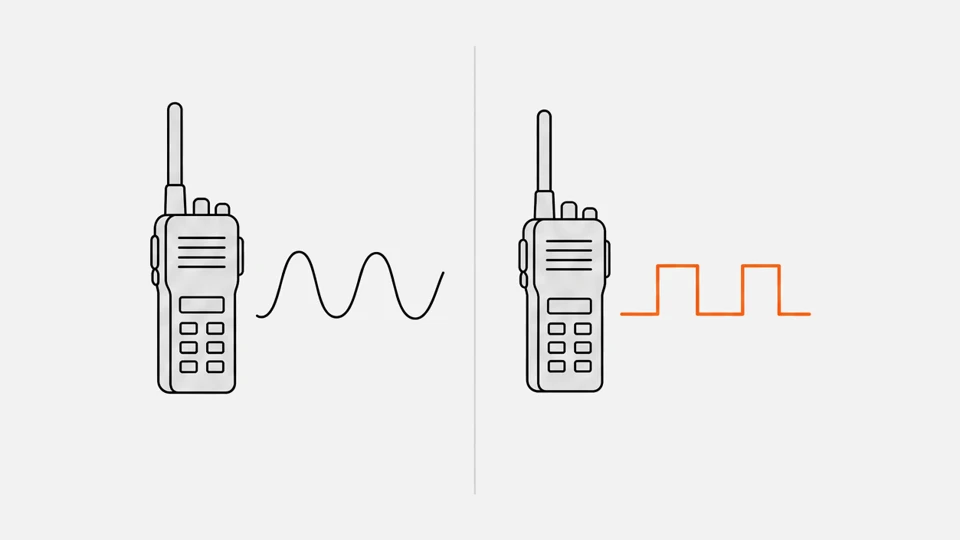
An analog two-way radio carries speech as a continuously varying radio signal, almost always frequency modulation (FM), and both ends use the same channel in turn. You press the push-to-talk key to send and release it to listen. Walkie-talkies, taxi and warehouse radios, marine VHF sets and most amateur FM radios work this way.
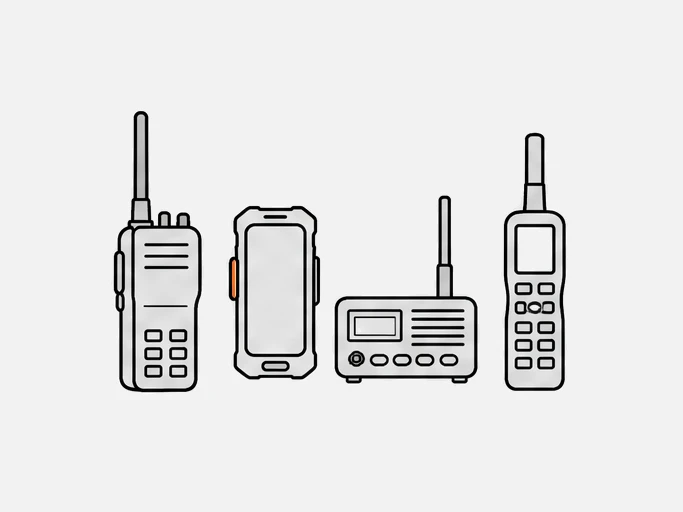
The FCC's emission letters describe it: F is frequency modulation, G is phase modulation, which the rules accept wherever F is named, and E is telephony.1 ETSI's standards for the land mobile service use the same wording, "analogue speech".2 It is one of several types of two-way radio, next to DMR, TETRA and PoC.
How does FM voice work on a two-way radio?
In FM the voice changes the frequency of a steady carrier, so the transmitted frequency swings above and below the channel center in step with the audio. The receiver turns that swing back into sound. The size of the swing, the deviation, is limited so that the signal stays inside its channel.
The limits show up in the FCC rules for license-free and licensed personal radios:
| Channel width | Occupied bandwidth | Peak deviation |
|---|---|---|
| 12.5 kHz (FRS) | 12.5 kHz at most | 2.5 kHz, audio up to 3.125 kHz3 |
| 20 kHz (most GMRS channels) | 20 kHz | 5 kHz4 |
On a 12.5 kHz channel, twice the sum of deviation and top audio frequency, 2 × (2.5 + 3.125) kHz, comes to 11.25 kHz. That is the bandwidth the FCC authorizes for 12.5 kHz equipment in Part 90.5
| Parameter | Analog FM two-way radio |
|---|---|
| Emission | F3E or G3E: FM or phase-modulated telephony1 |
| Channel spacing | 25 kHz (old) or 12.5 kHz; authorized bandwidth 20 or 11.25 kHz5 |
| Calls per channel | One |
| Operation | Push-to-talk, half-duplex; direct (simplex) or through a repeater on a pair of frequencies13 |
| Hand-held power | 4–5 W on licensed business radios, 1 W low (one maker's example);8 0.5–2 W on license-free FRS and PMR446311 |
| Selective calling | CTCSS tones or DCS codes2 |
| Encryption | None in the standard; anyone on the channel can listen |
VHF or UHF: which band suits which radio?
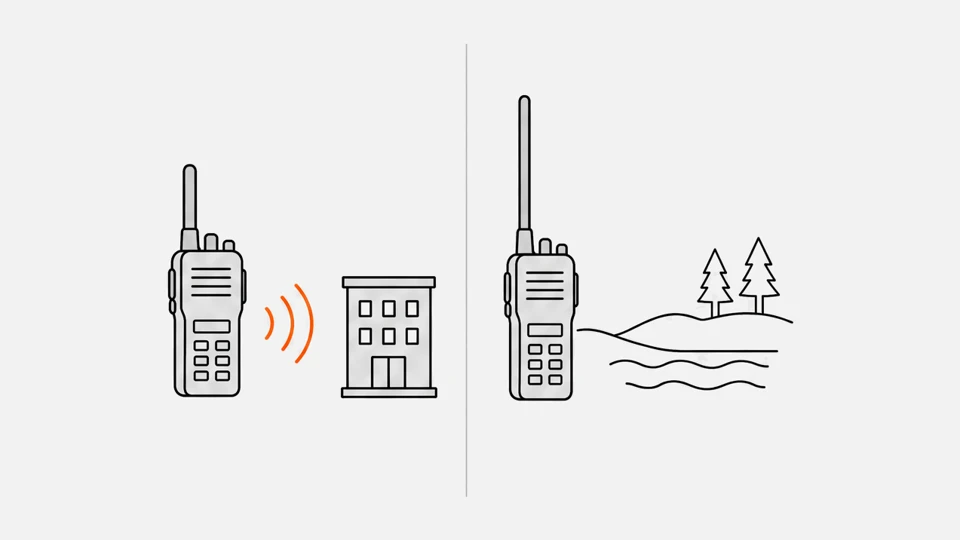
VHF covers 30 to 300 MHz and UHF 300 to 3,000 MHz.6 Two-way hand-helds use roughly 136–174 MHz on VHF and 400–527 MHz on UHF; Motorola's DP4000e is one example.8 The short answer from Motorola: VHF for open ground, UHF for buildings and cities.9
| VHF | UHF | |
|---|---|---|
| Frequency range | 30–300 MHz6 | 300–3,000 MHz6 |
| Example hand-held band (MOTOTRBO DP4000e) | 136–174 MHz8 | 403–527 MHz8 |
| Best setting | Open outdoor areas with few obstructions9 | Indoors and in cities9 |
| Building penetration | Limited9 | Strong, through walls, concrete and floors9 |
| Antenna | Longer9 | Shorter9 |
| Typical use | Farming, forestry, utilities, airports, seaports9 | Hotels, warehouses, schools, construction, hospitals9 |
Power differs a little between bands. Motorola's MOTOTRBO DP4000e lists 5 W high power on VHF and 4 W on UHF, with 1 W as the low setting on both.8 The site's range calculator models a licensed 4 W UHF hand-held at about 1.6–2.7 km in open ground and 0.8–1.3 km in a town, with the lower figure reached at 90 % of locations.
What frequencies do UHF and VHF radios use?
Analog radios work in a handful of service bands rather than anywhere in VHF or UHF. In the US, license-free options are MURS on VHF and FRS on UHF; business radios use licensed Part 90 channels; marine radios use 156–162 MHz. In Europe, PMR446 at 446 MHz is the license-free UHF band.371124
| Service | Band | Frequencies | Power | License |
|---|---|---|---|---|
| MURS (US) | VHF | 151.820, 151.880, 151.940, 154.570, 154.600 MHz24 | 2 W24 | None24 |
| Marine VHF | VHF | 156–162 MHz; channel 16 = 156.800 MHz14 | 25 W ship station16 | Ship station rules vary by country |
| Amateur 2 m and 70 cm (US) | VHF, UHF | 144–148 and 420–450 MHz26 | Up to 1.5 kW PEP | Exam |
| US business (Part 90) | VHF, UHF | Among others 150–170, 450–470, 470–512 MHz7 | Set per license | FCC license, $105 application fee27 |
| PMR446 (EU, UK) | UHF | 446.0–446.2 MHz, 16 analog channels11 | 0.5 W ERP11 | None11 |
| FRS (US, Canada) | UHF | 462 and 467 MHz, 22 channels3 | 0.5–2 W ERP3 | None |
| GMRS (US) | UHF | 462 and 467 MHz; see FRS and GMRS | Up to 50 W on main channels | $35, 10 years27 |
| UK Business Radio, Simple UK Light | VHF, UHF | 19 shared frequencies28 | 5 W ERP28 | £75 for 5 years28 |
Channel lists are in the frequency charts, license rules by country in the license checker.
Why do channels come in 25 kHz and 12.5 kHz?
Channel spacing is the gap between neighboring channels. Older business radios used 25 kHz and newer ones use 12.5 kHz, which fits twice as many channels into the same band. Part 90 authorizes 20 kHz of bandwidth for 25 kHz equipment and 11.25 kHz for 12.5 kHz equipment.5
In the US the change was a rule. Since January 1, 2013, "all stations must operate on channels with a bandwidth of 12.5 kHz or less," unless they meet the efficiency standard of 90.203(j)(3).5
The FCC Enforcement Bureau's advisory of August 22, 2012 (DA 12-1386) told licensees in the 150–174 and 421–470 MHz bands to migrate by that date. It named two ways: 12.5 kHz channels, or technology that carries at least one voice channel per 12.5 kHz.10 A 12.5 kHz analog FM radio meets the first.
The mandate covers licensed business and public safety radios under Part 90. License-free services already use narrow channels: FRS is 12.5 kHz, and analog PMR446 in Europe has 16 channels spaced 12.5 kHz apart.311
What are CTCSS and DCS tones?
CTCSS and DCS are tones and codes sent along with your voice. A receiver with the same setting opens its speaker, and one with a different setting stays quiet; ETSI calls this selectively enabling the audio.2 They filter what you hear and do not scramble the voice.
| CTCSS | DCS | |
|---|---|---|
| Signal | A continuous sub-audible tone sent during the transmission2 | A 23-bit digital code sent at 134.4 bit/s2 |
| How many | 39 standard tones, 67.0 to 250.3 Hz2 | 83 standard codes2 |
ETSI's table has 39 tones, while a Uniden consumer radio counts 38 tones and 83 codes.12 Code numbers differ between brands, so use the Hz value when you set two different makes. The CTCSS and DCS code list translates code numbers between brands. Many repeaters also stay silent until they hear a tone.13
How do repeaters and offsets work?
A repeater receives your signal on one frequency, the input, and retransmits it on another, the output. The gap between the two is the offset. ARRL notes that any operator who can hear the repeater can use it to retransmit over greater distances, which helps hand-helds and mobiles.13
Offsets depend on the band. ARRL lists them for amateur use: 600 kHz on 2 m and 5 MHz on 70 cm, among others.13 Many repeaters need the right CTCSS tone before they retransmit.
Is marine VHF an analog service?
Yes, and it is a well-known one. Marine voice calls use FM-type modulation on VHF channels around 156–162 MHz. In the US, 156.800 MHz (channel 16) is the international distress, urgency, safety, call and reply frequency, and stations on it must send and receive G3E.14
| Marine VHF | Rule |
|---|---|
| Distress and calling | 156.800 MHz, channel 1614 |
| Digital alerting | 156.525 MHz, channel 70, for digital selective calling only15 |
| Ship station power | 25 W at most, reducible to 1 W or less16 |
| Hand-held example | Icom IC-M37: 6 W high, 1 W low, transmits 156.025–157.425 MHz25 |
| Recreational calling | 156.450 MHz, channel 914 |
Channel 70 shows that analog voice and digital signaling share the same set: you talk by FM on channel 16 and send a digital distress alert on channel 70.
What are the pros and cons of analog radio in numbers?
Analog's strengths are simplicity and compatibility: any FM radio on the same channel and tone can talk, with no IDs or talkgroups. Its limits are capacity, one call per channel, no built-in encryption and no data beyond tones. The table lists measurable differences from standards and makers.217
| Measure | Analog FM | Digital (DMR) |
|---|---|---|
| Calls per 12.5 kHz channel | 1 | 2 (two time slots)17 |
| Battery life | Baseline | Up to 40% longer, an industry claim18 |
| Range | Set by power, antenna and terrain | The same as analog by design19 |
| Typical reach with a licensed radio | A few km in town, a few tens of km in open country with vehicle or fixed units20 | Like analog |
The DMR Association's 40 percent figure assumes 5 percent transmit, 5 percent receive and 90 percent idle, and it is the industry group's own claim.18 ETSI describes DMR's aims as better audio, improved battery performance and good quality out to the edge of coverage, with the same range as analog.19
How is analog different from digital radio, and can they talk?
A DMR radio with an analog mode talks to an analog radio on the same channel. Motorola says running both modes lets new digital radios work alongside existing analog ones, so a fleet can switch in steps.21 A digital-only radio cannot decode an analog call.
Check a pair of radios in the digital radio compatibility tool. For the digital side, see DMR, which fits two time slots into a 12.5 kHz channel.17
Are analog radios being phased out?
Some fleets are retiring analog, others are keeping it. A FIRESCOPE white paper of April 16, 2026 says California's Cal Fire has phased out legacy Bendix King and Kenwood radios. It proposes P25 digital capability and at least 1,000 channels as the statewide minimum for fire radios.22
The same paper calls it likely that the National Wildland Coordinating Group will soon remove analog radios from its approved list.22 That is a wildland fire service, not the whole market.
Analog stays in the rules elsewhere. The CEPT decision on PMR446 still designates 446.0–446.2 MHz for analog radios.11 The 2013 US mandate narrowed channels but did not require digital, because 12.5 kHz analog FM meets it.10
How this relates to PoC radio
An analog radio and a PoC radio both give a group a push-to-talk channel, on different networks. Analog talks directly between radios or through a repeater on a licensed or license-free channel. PoC sends voice as data over the mobile network, so it needs coverage but no radio channel of its own.
| Analog FM | DMR | PoC / LTE | |
|---|---|---|---|
| Standard | ETSI EN 300 086 for the land mobile service2 | ETSI TS 102 36117 | Set by the PTT platform; MCPTT for mission-critical use |
| Radio channel | 12.5 or 25 kHz, VHF or UHF | 12.5 kHz, 2 time slots17 | The mobile operator's LTE bands |
| Network | None, or a repeater | Direct, repeater or trunked17 | Mobile network and a PTT server |
| Range | Power, antenna and terrain; a few km in town20 | The same as analog19 | Wherever there is signal |
| Access or license | Permit on business channels; none for FRS and PMR446 | License for Tier II and III17 | A SIM and a PTT service |
| Data | Tones and signaling only | Short data | Mobile broadband |
Hybrid radios put both in one case: 41 of the 291 current models in our database combine LTE with a DMR or analog radio.23 Such a radio uses the mobile network where there is signal and falls back to direct radio where there is none. The comparison with a direct radio network is in PoC vs DMR, and the license-free side is in PMR446.
Which band suits your site is covered in UHF vs VHF; whether to move to digital, in digital vs analog two-way radio.
Questions
What is the difference between VHF and UHF radios?
VHF covers 30–300 MHz and UHF 300–3,000 MHz.6 Motorola's guidance is VHF for open outdoor areas and UHF for buildings and cities, because UHF passes through walls and floors better.9
Does analog radio still work in 2026?
Yes. FM voice remains in use on business channels, marine VHF, amateur bands and PMR446.1114 Some fire and public safety fleets are retiring it, with P25 digital as the replacement.22
Why did the FCC change analog channels from 25 kHz to 12.5 kHz?
To fit more channels into the same band. All Part 90 stations in the covered bands had to use 12.5 kHz or narrower channels from January 1, 2013, or meet an efficiency standard.510
What does a CTCSS tone do?
It makes a receiver play a call only when the tone matches. It does not encrypt the voice, and a radio with the tone off still hears the call.2 ETSI lists 39 tones and 83 DCS codes.2
Can a digital radio talk to an analog radio?
Only if the digital radio has an analog mode and both sit on the same channel.21 Pairs of radios can be checked in the compatibility tool.
How far does an analog hand-held reach?
A few kilometers in town, and a few tens of kilometers in open country for vehicle-mounted or fixed units, according to Latvia's regulator.20 Terrain and antenna height decide the rest.
Sources
- 47 CFR 95.575: FRS emission and deviation limits · eCFR, FCC
- 47 CFR 95.1775: GMRS deviation limits · eCFR, FCC
- 47 CFR 90.209: Bandwidth limitations · eCFR, FCC
- 47 CFR 90.35: Industrial/Business Pool · eCFR, FCC
- MOTOTRBO DP4000e series specification sheet · Motorola Solutions
- UHF vs VHF · Motorola Solutions
- FCC Enforcement Advisory 2012-05: FCC narrowbanding rules (DA 12-1386), 22 August 2012 · FCC Enforcement Bureau
Show all 28 sources
- Uniden PMR446HR-2CK user manual · Uniden (copy hosted by RigPix)
- 47 CFR 80.215: Transmitter power · eCFR, FCC
- Key benefits of DMR · DMR Association
- Professional PMR radios and permits (in Latvian) · Elektroniskie sakari, Latvia
- MOTOTRBO CP100d series portable two-way radios · Motorola Solutions
- Legacy BK Radio Phase Out and Minimum Radio Standards, white paper, 16 April 2026 · FIRESCOPE, California
- Radio specifications of current PoC radio models · poc-radio knowledge base
- IC-M37 VHF marine transceiver · Icom America
- 47 CFR 97.301: Authorized frequency bands · eCFR, FCC