What is the difference between digital and analog two-way radio?
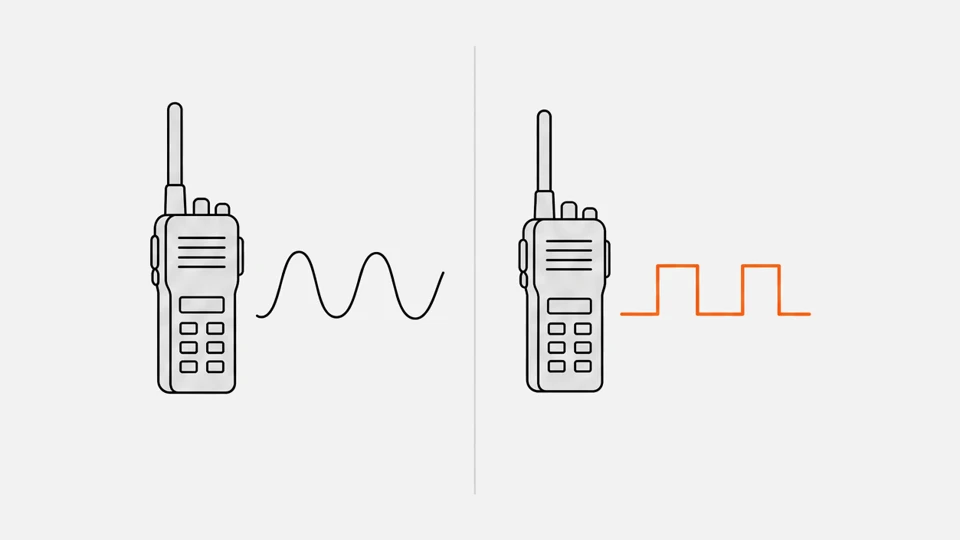
An analog radio sends your voice as a continuously varying FM signal, one call per channel. A digital radio turns speech into bits, adds error-correction bits and sends them, so the receiver can repair noise before you hear it. Digital adds IDs, text and encryption; analog works with any FM radio.12
FM telephony is emission F3E or G3E in the FCC's rules.3 A DMR radio sends 4-level FSK at 4,800 symbols per second, 9,600 bit/s across both time slots.2 DMR Association members agreed on AMBE+2 at half rate, 3,600 bit/s including error correction.124 The standard specifies more than 14 error-correction and checksum codes.2
See analog two-way radio for FM, CTCSS and channel widths, and DMR for the digital side.
Choose Digital if…
- You want caller IDs, text, GPS or lone worker alerts
- You need more calls on the channels you already license
- You need encryption on a licensed business or public safety channel
- You are replacing radios anyway and want a fleet that can add data later
Choose Analog if…
- Your group is small and simple, with no data needs
- You want one radio that talks to any FM radio on the channel
- You use FRS or GMRS in the US, where voice stays analog
- You have a working analog system and no reason to change it
How do digital and analog compare point by point?
Digital wins on audio near the edge of coverage, calls per channel, battery, data and encryption. Analog wins on simplicity, compatibility between brands and license-free use in the US. Range is a tie at equal power. The second table adds numbers from the standards.
| Criterion | Digital | Analog |
|---|---|---|
| Voice path | Vocoder bits plus error correction2 | FM audio3 |
| Edge of coverage | Good quality to the edge, then a fast roll-off1 | Static and garbled speech build up5 |
| Range at equal power | No longer; coding gain goes into quality at the boundary1 | Set by power, antenna and terrain |
| Calls per 12.5 kHz channel | Two in DMR2 | One |
| Battery | Up to 40% longer in DMR, by the DMR Association6 | Baseline |
| Privacy | ARC4 40 bit to AES-2566 | Voice inversion at best7 |
| Data | IDs, text, GPS, alarms28 | Tones and signaling9 |
| Between brands and standards | Standards do not talk to each other2 | Any FM radio on the same channel and tone |
Technical details
| Parameter | Digital (DMR as the example) | Analog FM |
|---|---|---|
| Standard | ETSI TS 102 36110 | ETSI EN 300 086 for the land mobile service11 |
| Channel | 12.5 kHz carrier, two 30 ms slots in a 60 ms frame10 | 12.5 kHz (11.25 kHz authorized) or 25 kHz (20 kHz)12 |
| Transmit duty in a call | 50 percent1 | Continuous |
| Vocoder | AMBE+2, agreed by DMR Association members2 | None |
| Encryption | ARC4 40 bit, DES 64 bit, AES-128, AES-2566 | None in the standard |
| Short data | 626 to 1,130 bytes per message2 | None |
Does a digital radio sound better at the edge of coverage?
Yes, up to the edge. ETSI designed DMR to give good quality to the edge of the planned coverage and then a fairly rapid roll-off.1 Analog users hear static and garbled speech as they approach the limit.5 Digital keeps speech clean longer and then breaks up quickly.
Plan digital coverage to the edge: the margin between clean audio and nothing is smaller than on analog. The DMR Association says digital processing can reconstruct signals from degraded transmissions.2 Check your own site with the range calculator.
Do digital radios have more range?
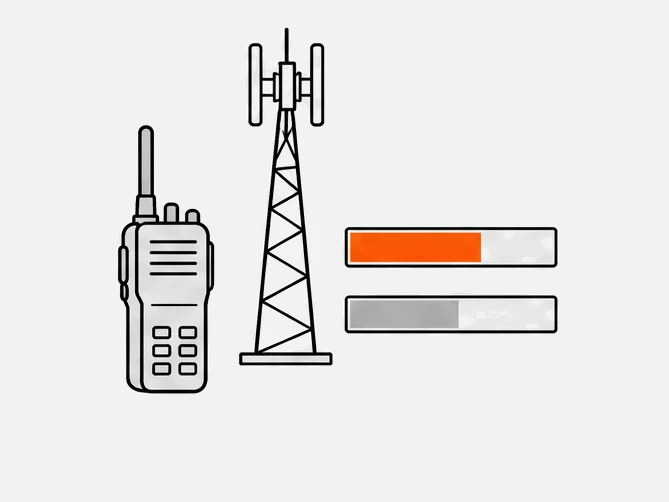
Not at the same power. ETSI wanted a good quality of service out to the range boundary rather than much greater absolute range.1 Hand-held range still follows power, antenna and terrain, and digital hand-helds sit in the same power class: Motorola's DP4000e lists 5 W on VHF and 4 W on UHF.13
The CEPT decision on PMR446 gives the same reason for digital there: quality out to the range limit, not more range.14
Does digital extend battery life?
In DMR, yes, by design. A call uses one of two time slots, so the transmitter is on about half the time.1 The DMR Association claims up to 40 percent more talk time at a 5/5/90 transmit, receive and idle duty cycle, and Motorola gives the same "up to 40%".25
The association cites one maker's 9 hours analog against 13 hours digital on the same radio.2 The battery life calculator plans a shift.
Does digital use spectrum better?
Yes. One 12.5 kHz DMR channel carries two calls in alternating time slots, one talk path per 6.25 kHz, where analog FM carries one. dPMR and NXDN reach the same density with 6.25 kHz channels. The DMR Association calls the two methods equally efficient in theory.2
DMR fits existing 12.5 kHz and 25 kHz licensed channels without re-licensing, and one repeater serves both slots.2 US licensees had to move to 12.5 kHz or narrower channels by January 1, 2013, but 12.5 kHz analog FM meets that rule, so digital was never required.15 DHS says NXDN also uses interleaved 6.25 kHz channels that no 12.5 kHz technology, DMR included, can use.16
Is digital more private?
It can be. Digital voice can be encrypted with a real cipher; standard analog cannot. DMR lists ARC4 (40 bit), DES and AES-128 or AES-256,6 and P25's standard algorithm is AES-256.17 Analog scramblers invert the voice spectrum, which one maker calls low-level security.7 Whether you may encrypt depends on the service.
- Motorola: Basic Privacy gives "basic protection against casual eavesdropping"; Enhanced Privacy is ARC4 with 40-bit keys.8
- NXDN and TETRA: NXDN offers scrambling with 32,000 keys or AES and DES;18 TETRA has TEA air-interface encryption.19
- CTCSS and DCS tones: they decide which calls you hear. They do not scramble voice.11
- Ham radio (US): transmitting messages encoded to obscure their meaning is prohibited, with narrow exceptions in the rule.20
- FRS and GMRS (US): no new certification grant for a transmitter with voice scrambling, for applications filed on or after December 27, 2017.21
What features does digital add?
Digital carries addressed data next to voice. DMR defines individual, group, all-call and broadcast calls, talking-party identification and short data of 626 to 1,130 bytes. Radios add text, GPS, emergency alarms, lone worker and man down. Analog gets some alerts through signaling tones such as MDC 1200.289
- Lone worker and man down: Motorola lists lone worker as an emergency raised if the user does not answer periodic alerts, and man down as one raised by orientation or movement.8
- GPS and text: Motorola lists an embedded GPS receiver and text messaging.8 DMR can poll up to 1,000 radios per site on one channel.6
- Second slot: it can carry data or control signaling, such as emergency pre-emption, during a call.2
Which digital standards exist?
Seven are in common use: DMR, dPMR, NXDN, P25, TETRA, D-STAR and System Fusion. They differ in access method and channel width. P25 serves US public safety, TETRA emergency services, D-STAR and Fusion ham radio; DMR, dPMR and NXDN serve business fleets.
| Standard | Access or modulation | Channel | Main users |
|---|---|---|---|
| DMR | Two-slot TDMA10 | 12.5 kHz | Business; license-free Tier I at 446 MHz2 |
| dPMR | FDMA22 | 6.25 kHz | Business, license-free dPMR44622 |
| NXDN | FDMA18 | 6.25 and 12.5 kHz | Business and industry18 |
| P25 Phase 1 | FDMA23 | 12.5 kHz | Public safety, government23 |
| P25 Phase 2 | Two-slot TDMA, trunked23 | 12.5 kHz | Public safety, government23 |
| TETRA | Four-slot TDMA24 | 25 kHz | Emergency services, transport, utilities25 |
| D-STAR | GMSK26 | 6 kHz occupied | Ham radio26 |
| System Fusion | C4FM 4-level FSK27 | — | Ham radio27 |
A shared vocoder does not make them compatible: the NXDN Forum says AMBE+2 has been adopted in dPMR, DMR, P25 and NXDN,28 yet each wraps it in its own frames. P25 Phase 1 began with the older IMBE.4 Details: DMR, dPMR and NXDN, P25, TETRA.
Can digital and analog radios talk to each other?
Only in analog. A DMR radio with an analog mode can join an analog channel if frequency, channel width and tone match, and it then works without digital features.29 Digital radios of different standards do not talk to each other; a gateway or a multi-mode radio links them.216
The DMR Association says none of DMR, dPMR, NXDN, TETRA and P25 is compatible with another, and ETSI says DMR's own three tiers do not interoperate.210 DHS found that analog FM gives DMR, NXDN and dPMR a common base, but not TETRA, and that FCC rules limit US public safety interoperability channels to narrowband analog FM.16 Kenwood sells radios that switch between NXDN, DMR and analog.30
Test a pair in the compatibility tool.
Do digital radios need a license?
It depends on the band, not the technology. In Europe, DMR and dPMR hand-helds are license-free on 446.0–446.2 MHz at up to 500 mW with a built-in antenna.14 In the US, FRS and GMRS list analog FM voice emissions only, so there is no license-free digital voice radio there.3132
- Europe, license-free: DMR Tier I (16 channels of 12.5 kHz) and dPMR446 (32 channels of 6.25 kHz), direct mode only, no repeaters; the channel counts divide the 200 kHz band by the channel width.142
- US FRS and GMRS: FRS allows F3E and G3E (FM voice) and F2D and G2D (data);31 GMRS adds data emissions such as F1D and G1D, and neither list has a digital-voice emission.32
- Business channels: DMR Tier II and III need a license, as analog business channels do.2
- Ham bands: D-STAR, System Fusion and DMR run on amateur repeaters under an amateur license; see DMR on ham radio.
The license checker shows the rule for your country.
Do digital radios cost more?
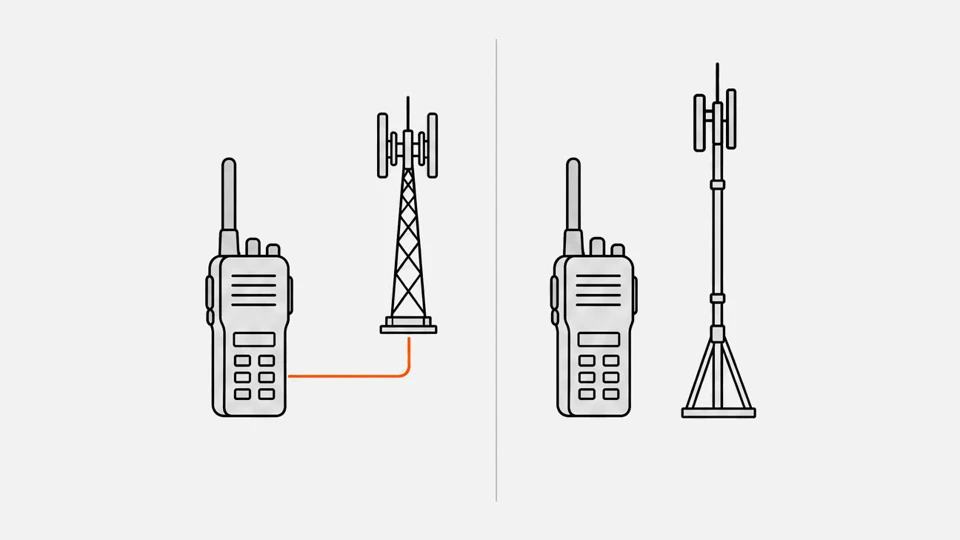
Compare the whole system, not one radio. A dual-mode DMR hand-held also works on analog. One DMR repeater with one antenna carries two calls, where 6.25 kHz FDMA needs a repeater per channel plus combiners, which the DMR Association says can cost many thousand dollars. Motorola says doubled capacity can lower licensing costs.25
Put radios, repeater, antenna, licenses per channel and programming in each quote, and compare them over several years in the cost calculator.
How do you migrate from analog to digital?
Gradually. DMR fits existing 12.5 kHz and 25 kHz channels, so no re-licensing is needed, and Motorola's SLR 8000 repeater runs mixed mode, analog and digital, while you move off a legacy analog system.233 Dual-mode radios cover both until the last analog unit retires.
- Buy dual-mode radios whenever you replace analog ones.29
- Put the repeater into mixed mode so old and new radios share the channel.33
- Move channels and groups to digital as the fleet changes.
- Switch the repeater to digital when the last analog radio is gone.
Digital is not mandated; 12.5 kHz analog FM meets the 2013 US rule.15 Some fleets move anyway: California's FIRESCOPE says Cal Fire has phased out legacy Bendix King and Kenwood radios and proposes P25 capability as the statewide minimum.34
Where does PoC fit?
A PoC radio is digital by nature. It sends speech as data packets over LTE to a server, so there is no radio channel and no FM. Audio at the edge depends on mobile data coverage, not radio signal. The comparison is in PoC vs DMR.
3GPP's mission-critical push to talk requires the AMR-WB speech codec,35 and Zello reports 12 to 45 kbps of voice data while talking.36 In the radio database, 41 of 291 current PoC models pair LTE with a DMR or analog radio.37 See also LMR vs PoC and what is a PoC radio.
Which fits your team, digital or analog?
Pick digital when you need IDs, text, GPS, encryption or more calls per license, or when you are replacing radios anyway. Pick analog for a small group with simple needs, for mixed brands without dual-mode radios, or for license-free use in the US. If both apply, buy dual-mode radios and migrate in steps.
The radio type tool narrows the choice. For the license-free side, read PMR446 and FRS and GMRS.
Questions
What is a digital walkie-talkie?
A walkie-talkie that turns speech into data before sending it. On the license-free band in Europe this means DMR or dPMR on 446.0–446.2 MHz at up to 500 mW.14 In the US, FRS and GMRS voice stays analog FM.3132
Is digital better than analog?
For audio near the edge of coverage, calls per channel, battery and data, yes. For range at equal power, no: ETSI aimed for quality at the boundary, not more distance.1 Analog stays simpler and talks to any FM radio on the channel.
Sources
- Digital vs Analog Radio: a brief comparison · Motorola Solutions
- Key benefits of DMR · DMR Association
- Transcrypt white paper: Basic Scrambler Information (2005) · Transcrypt, published on Police1
- MOTOTRBO at a glance (catalog, 2019) · Motorola Solutions
- IC-F5122D / IC-F6122D NXDN version · Icom America
Show all 37 sources
- 47 CFR 90.209: Bandwidth limitations · eCFR, FCC
- MOTOTRBO DP4000e series specification sheet · Motorola Solutions
- FCC Enforcement Advisory 2012-05: FCC narrowbanding rules (DA 12-1386), 22 August 2012 · FCC Enforcement Bureau
- Public safety interoperability implications of non-P25 radio technologies (July 2016) · DHS Office of Emergency Communications
- P25 CAP Compliance Assessment Bulletin P25-CAB-ENC_REQ: encryption requirements (March 2017) · DHS Science and Technology
- Technical specifications of NXDN · NXDN Forum (archived copy; the live site now asks for a login)
- 47 CFR 97.113: Prohibited transmissions · eCFR, FCC
- 47 CFR 95.381: Voice obscuring features · eCFR, FCC
- Project 25 FAQs, version 1.9 (June 2025) · P25 Technology Interest Group
- D-STAR · Icom America
- What is System Fusion? · Yaesu
- Vocoder · NXDN Forum (archived copy; the live site now asks for a login)
- MOTOTRBO CP100d series portable two-way radios · Motorola Solutions
- NEXEDGE NXDN, DMR and dPMR digital radios · Kenwood Communications Europe
- 47 CFR 95.571: FRS emission types · eCFR, FCC
- 47 CFR 95.1771: GMRS emission types · eCFR, FCC
- MOTOTRBO SLR 8000 repeater · Motorola Solutions
- Legacy BK Radio Phase Out and Minimum Radio Standards, white paper, 16 April 2026 · FIRESCOPE, California
- How much data bandwidth does the app use? · Zello Work Help Center
- Radio specifications of current PoC radio models · poc-radio knowledge base