How it works
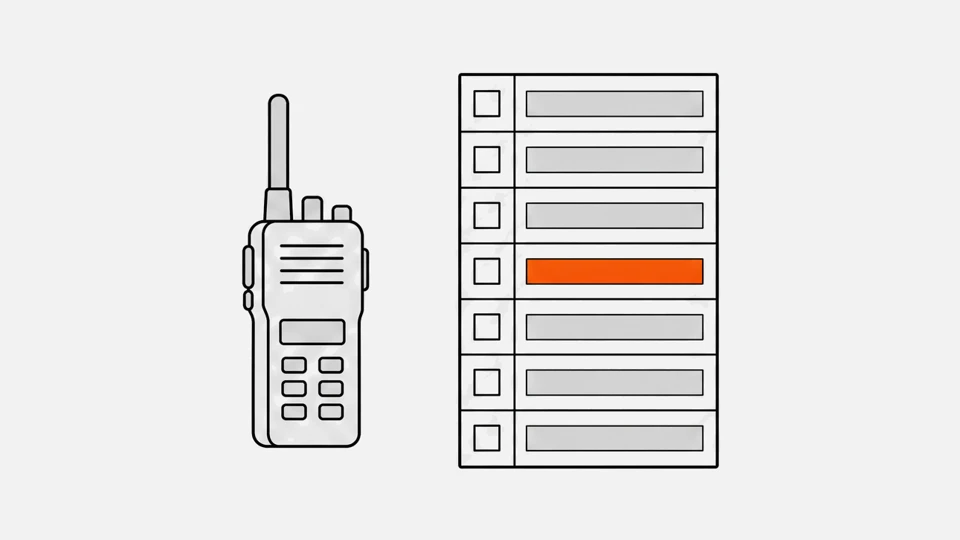
The test draws questions from a bank of 186: 143 on topics every exam shares, and 43 on the rules of the US, Canada, the UK, Germany, Australia and CEPT. Each test takes questions from all eight topics, in about the share the real entry or full exams give them; a question never repeats within one test.2456789
The questions are written for this site in the style of the exams. They are not copied from an official pool. Each official pool is larger and asks some things in its own way: the US, Canadian and German pools are public, so use them for the final weeks.1356
The verdict compares your score with the pass mark of the exam you picked2456710 and with your last tests, kept only in this browser. A clear margin over the pass mark on three tests in a row is a good sign you are ready to book.
Band limits and identification rules differ between countries and ITU regions, so those questions appear only for the country they belong to.11121314
License classes, exams and where to book them, country by country: Ham radio license by country.
Sample questions
May you use codes or encryption to hide the meaning of your messages on the amateur bands?
No, with narrow exceptions such as satellite control. Amateur messages must be open; codes to obscure the meaning are prohibited in most countries. (Rules and licensing)
What does the Q-code QTH mean?
My location is…. QTH means location: 'My QTH is Riga.' (Operating practice)
Which frequency is in the 40 m band?
7.1 MHz. 300 / 7.1 ≈ 42 m. The 40 m band starts at 7.0 MHz in every ITU region. (Electrical theory)
In a power supply, what does the rectifier do?
Turns AC into pulsating DC. Diodes in the rectifier pass current one way, turning AC into pulsating DC; capacitors then smooth it. (Components and circuits)
In FM, what changes with the speech signal?
The frequency of the carrier. Frequency modulation shifts the carrier frequency up and down with the audio; the amplitude stays the same. (Transmitters, receivers and modes)
About how long is a quarter-wave vertical for the 2 m band?
About 50 cm. A quarter of a 2 m wavelength is 50 cm (a little less in practice). (Antennas and feed lines)
What can make a VHF signal reach far beyond the normal horizon on a calm, warm evening?
Tropospheric ducting from a temperature inversion. A layer of warm air above cooler air can bend VHF and UHF signals along the Earth for hundreds of kilometres. (Propagation)
When climbing a mast or tower, what is essential?
A safety harness, and never climbing alone. Falls are the biggest hazard in antenna work. A helper on the ground and proper fall protection save lives. (Safety and interference)