How do amateur radio satellites work?
Most of them work like a repeater in the sky. The satellite listens on one band, the uplink, and retransmits what it hears on another band, the downlink. Because it is hundreds of kilometres up, stations far apart on the ground hear each other while the satellite is in view of both.11
Amateur satellites live in the amateur-satellite service. Worldwide, 144–146 MHz is allocated to it, and the 435–438 MHz part of the 70 cm band is heavily used for amateur satellites. Higher bands, such as 2400–2450 MHz, also carry satellite links.28 In practice, almost everything you will hear starts with 2 m and 70 cm.12
FM satellites and linear transponders
An FM satellite carries one voice channel, exactly like a ground repeater: one station talks at a time and everybody else listens. A linear transponder relays a whole slice of spectrum, so many SSB and CW contacts fit through it at once.1115 In AMSAT's table, AO-7 Mode B is 50 kHz wide, RS-44 60 kHz and FO-29 100 kHz.15
| FM satellite | Linear transponder | |
|---|---|---|
| How many contacts at once | One, like a repeater | Many, side by side in the passband |
| Modes | FM voice, sometimes with a CTCSS tone | SSB and CW |
| Typical gear | Dual-band FM handheld | All-mode radio, ideally full duplex |
| Examples (AMSAT tables, October 31, 2026) | SO-50, AO-91, AO-123, ISS | RS-44, AO-7, FO-29, AO-73, QO-100 |
On a linear transponder, CW sits at the low end of the passband and phone in the upper part. You find your own signal by sending a few CW dits in the middle and tuning until you hear them come back.11
Uplink, downlink and mode letters
Satellite modes are named by two letters: the uplink band, then the downlink band. U/V means you transmit on UHF and listen on VHF; V/U is the reverse. AMSAT lists AO-7 Mode B as U/v and RS-44 as V/u.15 Older texts use single letters, such as Mode B or Mode J.
Full duplex, hearing the downlink while you transmit, is the comfortable way to work satellites: you hear your own signal and correct the frequency as you go. With a half-duplex handheld you cannot hear the satellite while you talk.12
Doppler shift
A low satellite moves fast, so its frequencies shift. They appear higher as it comes toward you and lower as it moves away. The effect is about ±3 kHz on 2 m and about ±10 kHz on 70 cm, and it is stronger on the higher band.1113
The AMSAT primer gives the rule: correct the frequency on the higher band. On a U/V satellite you hold the VHF downlink and move the UHF uplink; on a V/U satellite such as RS-44 or FO-29 you do the reverse.11 On an FM satellite with a handheld, that means keeping the 2 m side fixed and retuning the 70 cm side in small steps as the satellite crosses the sky.1113
Which amateur satellites can you work today?
AMSAT keeps two tables, one for FM satellites and one for linear transponders; both were updated on October 31, 2026. Its live status page collects reports from operators and was updated on November 12, 2026. Check it before a pass: satellites switch modes, run out of battery or fail.141516
| Satellite | Type | Uplink, MHz | Downlink, MHz | Note |
|---|---|---|---|---|
| SO-50 | FM | 145.850, tone 67 Hz | 436.795 | 10-minute timer, armed with a 2 s carrier and a 74.4 Hz tone14 |
| AO-91 | FM | 435.250 | 145.960 | Avoid it in eclipse because of its battery14 |
| AO-123 | FM | 145.850, tone 67 Hz | 435.400 | On AMSAT's FM table14 |
| IO-86 | FM | 145.880, tone 88.5 Hz | 435.880 | On AMSAT's FM table14 |
| ISS | FM repeater | 145.990, tone 67 Hz | 437.800 | Voice repeater mode, ARISS, November 4, 202618 |
| RS-44 | Linear V/u | 145.935–145.995 | 435.610–435.670 | CW beacon 435.60515 |
| AO-7 | Linear U/v and V/a | 432.125–432.175 (B); 145.850–145.950 (A) | 145.925–145.975 (B); 29.400–29.500 (A) | Active only in sunlight15 |
| FO-29 | Linear V/u | 145.900–146.000 | 435.800–435.900 | On AMSAT's linear table15 |
| AO-73 | Linear U/v | 435.130–435.150 | 145.950–145.970 | Telemetry on 145.9351523 |
| QO-100 | Linear S/x, geostationary | 2400.000–2400.500 | 10489.500–10490.000 | 25.9° E15 |
AO-7 is the old-timer. It was launched on November 15, 1974, fell silent in 1981 when its battery failed, and came back in 2002 when the shorted battery went open circuit. Since then it runs straight from its solar panels and works only in sunlight.17
QO-100 is the opposite case: it never sets. Es'hail-2 was launched on November 15, 2018 and carries the first amateur transponders in geostationary orbit, at 25.9° E. AMSAT-UK expects it to link radio amateurs from Brazil to Thailand, and you need a dish of 60 to 90 cm for its 10 GHz downlink. Qatar's QARS and Es'hailSat developed the project, with AMSAT-DL as technical lead; AMSAT then gave it the name Qatar-OSCAR 100.2122
What do you need to work an FM satellite?
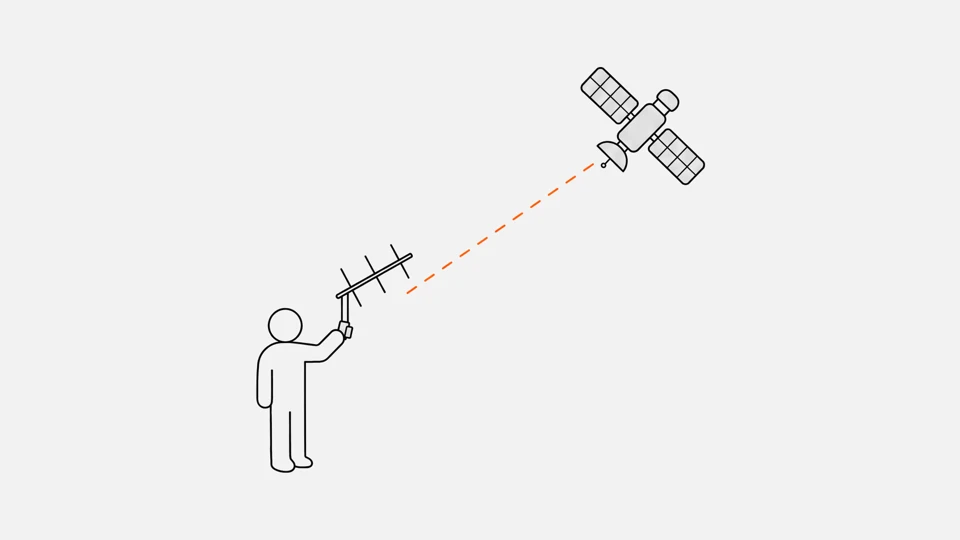
A ham license, a dual-band 2 m/70 cm handheld and a small directional antenna you can hold and turn. The usual choices are an Arrow-type handheld Yagi or an Elk log-periodic. Add a pass prediction, so you know when the satellite rises and where it will cross the sky.1211
How a typical FM pass goes:
- Look up the next pass and its maximum elevation; higher passes give longer and stronger contacts.12
- Program the uplink with its CTCSS tone and a few downlink memories for Doppler.1413
- Point the antenna at the horizon where the satellite rises and follow it across the sky.
- Listen first. Then give your call sign and grid locator, keep the contact short and let others in. The pass lasts from a few seconds to about 15 minutes.12
For SSB and CW through linear transponders you need an all-mode radio, preferably one that can transmit on one band while it receives on the other. The book "Getting Started with Amateur Satellites" by Gould Smith, WA4SXM, published by AMSAT, covers tracking, Doppler tuning, antennas and operating in detail.29
The ham stations on the ISS are run by ARISS, an international group that includes NASA, Roscosmos, CSA, JAXA and ESA; it arranges 60 to 100 school contacts with the crew a year.20 The ISS also carries APRS. AMSAT gives 145.825 MHz as the usual APRS frequency, and the ARISS status page lists the current one for the Russian segment, so check both before you set a radio.1918 Ground APRS is explained in What is APRS?
Which license do you need for satellite contacts?
A regular amateur license. Satellites use amateur bands, so whoever may transmit on 2 m and 70 cm at home may work the FM satellites on them. In the US, a Technician license gives privileges on most satellites, which is why FM satellites are a common first step for new hams.1211
Listening is the easy way in: with a scanner or an SDR you can hear the downlinks and decode telemetry; how SDR receivers work is in What is SDR? How to get the license itself is in How do you get a ham radio license?, and what goes in a call sign is in Ham radio call signs.
How do you track satellite passes?
With orbital elements and a tracking program. Each satellite's orbit is published as a TLE, a two-line element set, in the format used by NORAD and NASA. The second line holds the inclination, eccentricity, mean motion and other values. A program turns them into rise times, directions and Doppler.26
- CelesTrak publishes element sets and documents the TLE format.26
- Gpredict is free GPL software for real-time tracking and pass prediction.27
- Apps and websites. KX9X names GoSatWatch for iOS, AMSATDroid for Android, AMSAT's own website and N2YO.12
Tracking on the web is older than it looks. In 2004 the Project OSCAR website hosted JTrack, a Java applet that drew satellite positions over a world map in the browser, with its own file of orbital elements for amateur satellites.10 In 2005 its news column warned that many hams were struggling to update Keplerian elements after the public element sets moved from NASA's Orbital Information Group to Space-Track, and pointed to TLE Retriever by Dr. T.S. Kelso, founder of CelesTrak.4
What are satellite beacons and telemetry?
A beacon is a signal the satellite sends on its own, so you can find it and check it is alive. Telemetry is data in that signal: voltages, temperatures, solar panel currents. RS-44 has a CW beacon on 435.605 MHz, and AO-73 sends telemetry on 145.935 MHz.1523
The very first amateur satellite was only a beacon. OSCAR 1 sent "HI" in Morse code, and its keying speed changed with its internal temperature, so listeners who timed it were reading telemetry by ear.1
Today listeners decode telemetry with software and send it to the satellite's team:
- FUNcube. AO-73 sends BPSK telemetry on 145.935 MHz, 300 mW in sunlight and 30 mW in eclipse.23 The FUNcube Dashboard decodes it and uploads it to a central data warehouse; in January 2014 it already received more than 5,000 raw packets a day.24
- SatNOGS. The Libre Space Foundation runs a global network of volunteer ground stations that record satellite passes and share the data openly. It began at a 2014 hackathon in Athens and won the first Hackaday Prize.25
Project OSCAR also used the word for its newsletter. "The Satellite Beacon" was a monthly column that clubs could reprint free in their own newsletters; issues ran from August 2004 to May 2005.7
What was Project OSCAR?
The group of California hams who built the first amateur radio satellite. OSCAR stands for Orbiting Satellite Carrying Amateur Radio. Project OSCAR formed on the US West Coast at the end of the 1950s and put OSCAR 1 into orbit on December 12, 1961.124
Sources differ on the founding year: the ARRL describes the group forming around 1958, while Project OSCAR's own site gave 1960.14 Its members included Lance Ginner, K6GSJ, and Chuck Smallhouse, W6MGZ.1
OSCAR 1 to OSCAR 4
OSCAR 1 flew as a secondary payload on a Thor-Agena launch from Vandenberg Air Force Base, California. Its battery-powered 140 mW transmitter sent "HI HI" on 145 MHz for 22 days, and more than 570 amateurs in 28 countries reported hearing it.12
| Satellite | What it did |
|---|---|
| OSCAR 1 | First amateur satellite, launched December 12, 1961; about 10 lb; "HI" beacon whose speed reported the temperature; 22 days; re-entered on January 31, 1962 after 312 orbits123 |
| OSCAR 2 | Same team; better temperature sensing, thermal coating and beacon power2 |
| OSCAR 3 | First amateur satellite with a transponder: about 146 MHz in, 144 MHz out, 1 W; 18 days; about 1,000 amateurs in 22 countries heard through it2 |
| OSCAR 4 | Meant for a high orbit on a Titan III-C; the upper stage failed, but operators still made contacts through it2 |
A full-scale model of OSCAR 1, a gift of Project OSCAR, Inc., went on show at the Smithsonian's Udvar-Hazy Center when it opened on November 1, 2004.5 The ARRL keeps a restored backup unit at its headquarters in Newington, Connecticut, and it still sends "HI".1
AMSAT took over the name in 1969: it was chartered in Washington, DC, on March 3 of that year, and it still grants OSCAR numbers. A satellite usually gets its number only after it reaches orbit, works, and its builders ask for one.222
Project OSCAR in the 2000s
In the 2000s a new Project OSCAR club revived the original Project OSCAR Inc. and, by its own account, became more active after the launch of AO-40. Its stated mission was "to initiate and support activities that promote the Satellite Amateur Radio Hobby".34
Its website, projectoscar.net, was a small hub for West Coast satellite operators:
- Satellite information. A "Birds" page with uplinks, downlinks and status. In November 2004 it listed SO-50 on 145.850 MHz up and 436.795 MHz down with a 67 Hz tone, the same numbers AMSAT gives today, and the ISS crew of Expedition 9.914
- Space symposia. The 2005 West Coast Space Symposium took place on May 7, 2005 at the College of San Mateo; speakers included Robert Twiggs of Stanford.6
- Archive. Papers on OSCAR III from 1963–64, the OSCAR II newsletter and other early documents.8
- Online tracking with JTrack, and the Satellite Beacon newsletter, both described above.107
How are amateur satellites different from satellite push-to-talk?
They serve different people. Amateur satellites carry hobby and experimental traffic from licensed hams, free of charge, during short passes. Satellite push-to-talk is a paid commercial service: a handset or terminal on a network such as Iridium, with group calls available around the clock. Details are in How satellite push-to-talk works.
| Amateur radio satellite | Satellite push-to-talk | |
|---|---|---|
| Who may use it | Licensed radio amateurs | Subscribers of the network |
| Cost | Free; you buy your own radio | Device plus service plan |
| Availability | During passes, up to about 15 minutes, except QO-100 | Continuous, where the sky is visible |
| Traffic | Hobby, experiments, education | Work and safety communications |
For pointing a satellite terminal and estimating the voice delay over each orbit, there is our satellite finder. PoC radios, the subject of most of this site, use mobile networks instead of satellites; the wider picture is in What is ham radio?
Questions
What does OSCAR stand for?
Orbiting Satellite Carrying Amateur Radio. It was the name of the first amateur satellite, OSCAR 1, launched in 1961, and AMSAT now grants OSCAR numbers to working amateur satellites.2
Can I talk through the International Space Station?
Yes, when its cross-band repeater is on: 145.990 MHz up with a 67 Hz tone, 437.800 MHz down. ARISS reported voice repeater mode on November 4, 2026.18
What is the easiest amateur satellite for a beginner?
An FM satellite such as SO-50, worked with a dual-band handheld and a handheld Yagi. KX9X's QST article on FM satellites describes exactly this setup.1214
Is there a geostationary amateur satellite?
Yes. QO-100 on Es'hail-2, at 25.9° E since 2018: 2.4 GHz up, 10.489 GHz down. Its footprint reaches from Brazil to Thailand.2115
Where can I check whether a satellite is working?
On AMSAT's live status page, where operators report what they heard on each pass.16
Sources
- A brief history of AMSAT · AMSAT
- About Project Oscar (2006) · Project OSCAR, archived
- Welcome to Project OSCAR (2005) · Project OSCAR, archived
- Smithsonian exhibit (2006) · Project OSCAR, archived
- 2005 West Coast Space Symposium · Project OSCAR, archived
- The Satellite Beacon · Project OSCAR, archived
- Oscar archives · Project OSCAR, archived
- Satellite information (birds), November 2004 · Project OSCAR, archived
- JTrack online satellite tracking files (2004) · Project OSCAR, archived
Show all 29 sources
- For beginners: an amateur radio satellite primer · Keith Baker, KB1SF, AMSAT
- FM satellites and Field Day, QST, June 2018 · Sean Kutzko, KX9X, reprint on AMSAT
- Working the easy sats down under · VK3JED
- Live OSCAR satellite status · AMSAT
- AO-7 · AMSAT
- Current status of ISS stations · ARISS
- Amateur radio on the ISS · AMSAT
- Es'hail-2 / QO-100 · AMSAT-UK
- Satellites · AMSAT-UK
- SatNOGS FAQ · SatNOGS, Libre Space Foundation
- NORAD two-line element set format · CelesTrak
- Gpredict: free, real-time satellite tracking and orbit prediction software · Alexandru Csete, OZ9AEC