What is a satellite walkie-talkie?
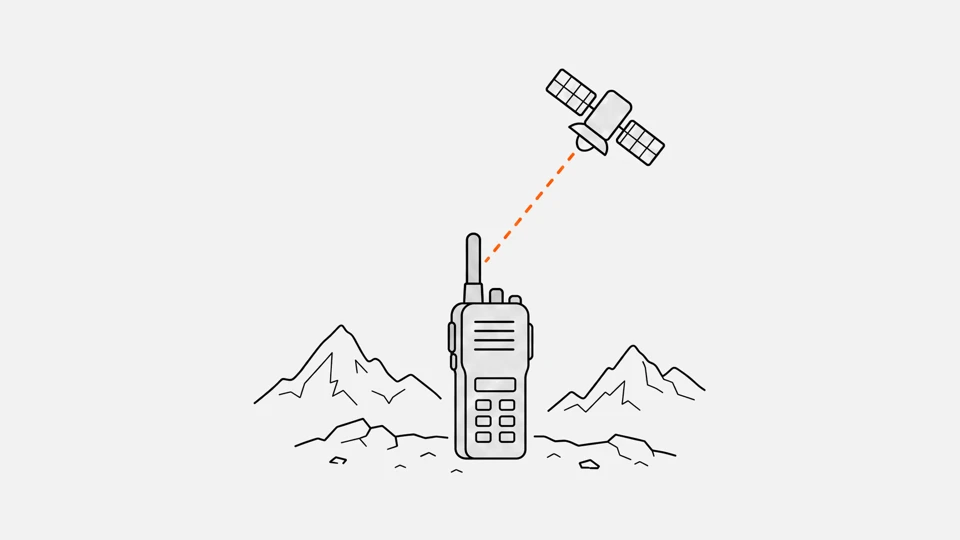
A satellite walkie-talkie is a push-to-talk radio whose link to the rest of the group runs through satellites. You press a button and the team in your talkgroup hears you, wherever the network has coverage. Iridium describes its service as instant group communications "anywhere on the planet", with radios that work like traditional walkie-talkies.1
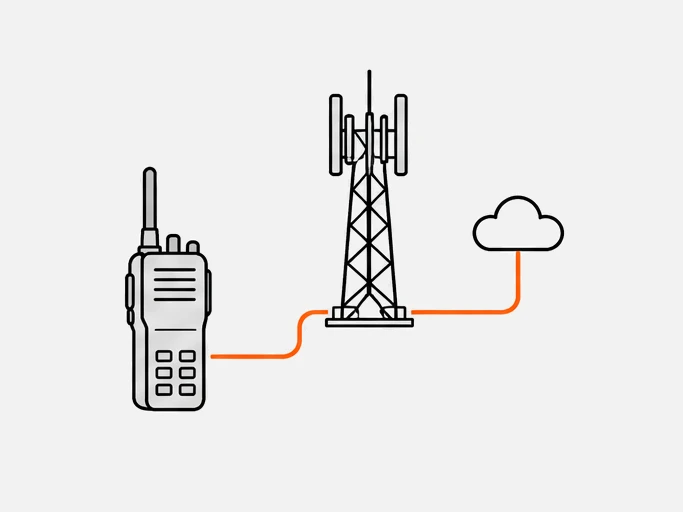
Nothing about the satellite changes how you use it. What changes is the network behind the button. A PoC radio uses a mobile operator's towers; a satellite handset talks to a satellite overhead and needs a view of the sky. Ordinary handhelds with their own radio channel, such as PMR446 sets, do not use satellites at all.
Do walkie-talkies use satellites?
Most do not. License-free, DMR and TETRA radios talk directly or through ground repeaters, and PoC radios use mobile networks. Only a specific class of devices sends push-to-talk voice through satellites, and each works with one operator's network. The types of two-way radio page shows where they sit.
Three kinds of products get called a satellite walkie-talkie:
| Kind | Example | What you get |
|---|---|---|
| Satellite PTT handset | Iridium Extreme PTT, Icom IC-SAT100217 | Group push-to-talk on a handheld, anywhere with a view of the sky |
| Satellite terminal with a PTT service | Viasat PTT Pro, Thuraya Push-to-Talk318 | Push-to-talk through a vehicle or fixed terminal, with cellular and radio links |
| Satellite to ordinary phone | T-Mobile T-Satellite4 | Texting and select apps on the phone you already own |
The third kind is not a walkie-talkie. T-Satellite gives voice chat only inside apps such as WhatsApp.5 There is no group channel or push-to-talk key in the network itself.
Which satellite networks carry push-to-talk?
Three networks sell a push-to-talk service: Iridium in low Earth orbit (LEO), and Viasat's former Inmarsat network and Thuraya in geostationary orbit (GEO). Iridium works on handhelds anywhere on Earth. The two GEO services run through terminals. Globalstar sells phones and trackers, and Starlink Direct to Cell connects ordinary phones.
| Network | Orbit | Push-to-talk | Confirmed facts |
|---|---|---|---|
| Iridium | LEO, about 780 km (485 miles)6 | Iridium PTT, commercial since 201516 | 66 satellites, each cross-linked to four others; coverage reaches the poles; L-band67 |
| Viasat L-band (Inmarsat) | Geostationary | PTT Pro, on the same infrastructure as Viasat's IoT Pro3 | Alphasat over Europe, the Middle East and Africa, I-4 F3 over the Americas, I-4 F2 over Asia-Pacific, I-6 F1 over the Indian Ocean19 |
| Thuraya | Geostationary | Thuraya Push-to-Talk, launched with Cobham SATCOM in February 202218 | Thuraya 4 at 44° E, in global service since November 2025, covering Europe, Africa, the Middle East and Central Asia9 |
| Globalstar | LEO | — | Signals from "over 80% of the Earth's surface"; tracking and messaging products10 |
| Starlink Direct to Cell | LEO | None; apps only | Phone service through T-Mobile in the US; 650+ satellites cited on 1 October 20255 |
Iridium PTT talkgroups are built in a web console, the Iridium PTT Command Center, where administrators also draw the coverage areas. The service is AES-256 encrypted and can connect to existing land mobile radio networks.1 Iridium says changes in the console take effect within seconds.15
Viasat says PTT Pro works with LMR and DMR networks and, with some integration, P25, and switches between satellite, terrestrial mobile networks and line-of-sight radio.3 Thuraya describes its service the same way: it works with any Thuraya broadband terminal and routes traffic over satellite, cellular or LAN, whichever is cheapest and available.18 Viasat plans three I-8 satellites for launch in 2026, with service expected in 2028.19
How big is the voice delay?
Radio waves need 119 ms to reach a geostationary satellite 35,786 km up and another 119 ms to come down. A talkgroup call between two satellite users goes up and down twice, through a ground server, so GEO voice arrives at least 478 ms late. Iridium's legs take about 2.6 ms each.11126
| Path, satellite overhead | GEO, 35,786 km12 | Iridium LEO, about 780 km6 |
|---|---|---|
| One leg, ground to satellite | 119 ms | 2.6 ms |
| One hop: up and down once, for example to a dispatcher on the ground | 239 ms | 5.2 ms plus cross-links |
| Two hops: satellite user to satellite user through the ground server | 478 ms | 10.4 ms plus cross-links |
| Question and reply between two satellite users | About 955 ms | About 21 ms plus cross-links |
These rows follow from the altitude and the speed of light, 299,792 km/s.1112 They are lower bounds. A satellite low in the sky is farther away: at 10° elevation a GEO leg grows to about 135 ms. Coding, buffering, Iridium's cross-links and the ground gateway add more.6
The practical effect is easy to hear. ITU-T G.114 recommends that one-way delay should not exceed 400 ms in network planning, and a GEO talkgroup call between two terminals is past that before any processing.20 People on GEO push-to-talk learn to wait about a second after releasing the key. Iridium says its Extreme PTT sets up a talkgroup call in under two seconds.15
Starlink's phone service also sits in LEO, so its radio delay is close to Iridium's.
Does satellite push-to-talk work indoors?
Not reliably. A satellite handset needs a clear path to the sky, so it works outdoors, in vehicles with an external antenna, or in buildings with an indoor antenna kit. Iridium says its Extreme PTT works on foot, in a vehicle or in a building with accessories, and T-Mobile limits its service to outdoor areas.24
T-Mobile describes its service as working "in most outdoor areas in the U.S. where you can see the sky".4 A geostationary satellite also has to be above the horizon in the right direction: north of the equator it sits toward the south, and lower in the sky the farther you are from the equator.
A satellite handset has no range in the handheld sense: the limit is the network's coverage, not the distance to the other person. Iridium reaches the poles; GEO networks lose the highest latitudes. To see where a geostationary satellite sits for your location, with its azimuth, elevation and delay, use the satellite finder; at a high latitude such as Reykjavík the satellites sit low over the horizon.
Which satellite push-to-talk devices are there?
There are two handhelds for Iridium PTT, the Iridium Extreme PTT and the Icom IC-SAT100, plus gateways that join them to ground radios. On the GEO networks, push-to-talk runs through terminals: Viasat names the Cobham EXPLORER 323, and Thuraya's service uses its broadband terminals. Iridium's partners also build devices on its 9523 PTT transceiver.23161718
| Device | Network | Published facts |
|---|---|---|
| Iridium Extreme PTT (9575PTT) | Iridium | 268 g; IP65; MIL-STD 810F; up to 5 h talk and 16.5 h standby in PTT mode; also phone calls, SMS, SOS and GPS2 |
| Icom IC-SAT100 | Iridium PTT only | Up to 15 talkgroups; IP67; MIL-STD 810G; 1,500 mW speaker; Bluetooth and GPS17 |
| Icom VE-PG4 | Iridium PTT gateway | RoIP router that links the IC-SAT100 with IDAS and analog radios117 |
| Cobham EXPLORER 323 | Viasat PTT Pro | Low form-factor terminal named by Viasat; Cobham and Motorola supply hardware3 |
| Thuraya broadband terminals | Thuraya Push-to-Talk | Private network across satellite, cellular and LAN; integrates LTE and LMR18 |
| IsatPhone 2 | Viasat L-band | Satellite phone with no PTT; up to 8 h talk and 160 h standby8 |
The Extreme PTT is a phone as well as a radio, which is why its specification lists a second set of battery figures for phone mode: up to 6.5 h talk and 54 h standby.2 The IC-SAT100 is the radio-shaped option, with a big speaker for noisy sites. A remote team on Iridium can join a dispatcher's existing radio channel through the VE-PG4, the same idea as a radio over IP gateway.1
What do satellite push-to-talk devices cost?
Expect about £1,250 for an Iridium handset and $70 to $112 a month for its PTT plan, plus a talkgroup fee set by the area it covers. These figures come from a UK dealer, read on 22 October 2026, excluding VAT. Other dealers differ.13
| Item | Price |
|---|---|
| Iridium Extreme PTT handset | £1,247.00 (£1,496.40 with VAT)13 |
| Handset PTT plan, 12-month minimum | $70 per month13 |
| Handset PTT plan, 3-month minimum | $112 per month13 |
| Talkgroup, small (100,000 km²) | $63 per month13 |
| Talkgroup, medium to jumbo (300,000 to 2,250,000 km²) | $70 to $2,240 per month13 |
| T-Mobile T-Satellite, phone add-on | $10 per line per month, or included on Experience Beyond4 |
The talkgroup tiers show the model: you pay for the size of the area a group covers, with unlimited use inside it.13 One US reseller lists a small talkgroup at no charge, so compare offers. A PoC radio on a mobile network has no area charge; for the SIM side, see 4G LTE walkie-talkies.
A year on the 12-month plan with one small talkgroup comes to $840 for the handset plan and $756 for the talkgroup, before the handset itself.13 Add one handset plan for every radio; the talkgroup fee is shared by the whole group.
How does satellite push-to-talk compare with PoC?
A satellite network covers places with no towers, at a higher price and with a delay set by orbit. A PoC radio is cheaper and near-instant wherever the mobile network reaches. The table sets the two next to satellite-to-phone service, the newest option for ordinary phones in the US.
| Satellite PTT (Iridium) | Satellite to phone (T-Satellite) | PoC / LTE | |
|---|---|---|---|
| Standard | Iridium's own service1 | Operator service on LTE phones5 | Set by the PTT platform; MCPTT for mission-critical use14 |
| Radio channel | L-band to the satellite6 | Operator LTE spectrum via satellite5 | The mobile operator's LTE bands |
| Network | Satellites plus ground gateway6 | Satellites plus the carrier network5 | Mobile network and a PTT server |
| Range | Pole to pole;6 needs sky view | Outdoor areas with sky view4 | Wherever the operator has coverage |
| Access or license | Handset, PTT plan and talkgroup13 | $10 per month or an included plan4 | A SIM and a PTT service |
| Data | 2.4 kbit/s in phone mode2 | Limited speeds, select apps4 | Mobile broadband |
PoC data use on a mobile network is covered in the PoC data usage calculator.
How this relates to PoC radio
Satellite push-to-talk and a PoC radio give a group the same press-and-talk experience over different networks. PoC rides on a mobile operator's 4G LTE network; satellite PTT rides on a constellation. Where the mobile network ends, satellite begins, and several services already switch between the two.
The two meet in three places. Satellite PTT services interwork with land mobile radio networks, which lets a remote satellite user join a talkgroup on the ground.13 Viasat's PTT Pro and Thuraya's service switch between satellite, terrestrial mobile networks and local links.318 And direct-to-cell service puts satellite coverage into the phones that already run PoC apps, though today only for texting and select apps.4
For a team that works inside mobile coverage, a PoC radio covers the job. Satellite push-to-talk is for crews that regularly work beyond it: offshore, polar, desert or remote field sites. The wider map of radio types is on public safety radio and push-to-talk.
Questions
What is the range of a satellite walkie-talkie?
The range is the network's coverage, not a distance. Iridium's satellites converge at the poles, so coverage reaches high-latitude regions.6 Geostationary networks such as Viasat L-band cover "all but the most polar latitudes".8 You still need a view of the sky.
Can I use Starlink as a walkie-talkie?
Not as a push-to-talk radio. Starlink Direct to Cell connects ordinary phones through an operator; in the US it comes through T-Mobile T-Satellite, with texting and select apps, and WhatsApp voice chat.45 It has no group channel of its own.
Why is there a delay on satellite calls?
Radio waves need time to reach the satellite and return. At 35,786 km, one geostationary hop takes at least 239 ms, and a call between two satellite users needs two hops, about 478 ms.1112 Iridium's LEO satellites at about 780 km cut each hop to roughly 5 ms.6
Sources
- Iridium Push-to-Talk · Iridium
- Iridium Extreme PTT (9575PTT) · Iridium
- PTT Pro · Viasat
- T-Satellite: Direct to Cell Satellite Phone Service · T-Mobile (read 22 October 2026)
- Iridium network · Iridium
- Iridium NTN Direct · Iridium
- IsatPhone 2 · Viasat
- Globalstar technology · Globalstar
Show all 20 sources
- Speed of light in vacuum · NIST
- Types of orbits · ESA
- Iridium 9575 Extreme PTT and PTT service plans · GTC (UK dealer, prices ex VAT, read 22 October 2026)
- Mission critical services · 3GPP
- What is satellite push-to-talk (PTT)? · Iridium
- Icom IC-SAT100 · Iridium
- Thuraya launches its push-to-talk communications solution with Cobham SATCOM, 28 February 2022 · Thuraya, via PR Newswire
- Satellite safety data link services (ICAO FIT-Asia, 2025) · Viasat, via ICAO