What is CB radio?
CB, short for Citizens Band, is a two-way voice radio service on 27 MHz that anyone can use without a license in the US, the EU and the UK. The US rules describe it as "a mobile and fixed two-way voice communication service for facilitating personal, business or voluntary public service activities".1
Radios are fixed-channel and simplex: you and the other station use the same channel and take turns. There is no network, no subscription and no exam. CB is one of several types of two-way radio, older than PMR446 and built around vehicles and base stations rather than pocket handhelds. Al Gross's equipment was the first approved for the Citizens Band, in 1948.8
What are the CB channels and power limits?
The US has 40 channels from 26.965 MHz (channel 1) to 27.405 MHz (channel 40). AM and FM voice are limited to 4 W of carrier power and single sideband (SSB) to 12 W peak envelope power.1 FM has been allowed alongside AM and SSB since late 2021.1
| Parameter | United States (47 CFR Part 95 Subpart D) |
|---|---|
| Channels | 40, 26.965–27.405 MHz1 |
| Modes | AM and SSB required; FM also allowed1 |
| Power | 4 W AM or FM carrier; 12 W PEP SSB1 |
| Bandwidth | 8 kHz AM and FM, 4 kHz SSB1 |
| License | None; authorized by rule2 |
| Antenna height | 18.3 m (60 ft) above ground, or 6.1 m (20 ft) above the building or tree it is on, whichever is higher1 |
| Amplifiers | External RF power amplifiers prohibited, no exceptions1 |
| Talk time | 5 minutes per conversation, then 1 minute off the channel1 |
| Content | Plain-language voice; no advertising, music or sound effects1 |
The 40 channels are 10 kHz apart, with five gaps in the sequence. Channels 23, 24 and 25 are out of frequency order: 23 is 27.255 MHz, 24 is 27.235 and 25 is 27.245.1 The same frequencies apply in the US, Canada, Australia and the CEPT countries.31213
| Ch | MHz | Ch | MHz | Ch | MHz | Ch | MHz |
|---|---|---|---|---|---|---|---|
| 1 | 26.965 | 11 | 27.085 | 21 | 27.215 | 31 | 27.315 |
| 2 | 26.975 | 12 | 27.105 | 22 | 27.225 | 32 | 27.325 |
| 3 | 26.985 | 13 | 27.115 | 23 | 27.255 | 33 | 27.335 |
| 4 | 27.005 | 14 | 27.125 | 24 | 27.235 | 34 | 27.345 |
| 5 | 27.015 | 15 | 27.135 | 25 | 27.245 | 35 | 27.355 |
| 6 | 27.025 | 16 | 27.155 | 26 | 27.265 | 36 | 27.365 |
| 7 | 27.035 | 17 | 27.165 | 27 | 27.275 | 37 | 27.375 |
| 8 | 27.055 | 18 | 27.175 | 28 | 27.285 | 38 | 27.385 |
| 9 | 27.065 | 19 | 27.185 | 29 | 27.295 | 39 | 27.395 |
| 10 | 27.075 | 20 | 27.205 | 30 | 27.305 | 40 | 27.405 |
Any channel or frequency can be looked up in the frequency charts, which also list Germany's extra 40 channels and the UK 27/81 set.
Which CB channels matter: 9 and 19?
Channel 9 (27.065 MHz) is the emergency channel, and channel 19 (27.185 MHz) is the highway channel. The US rule says channel 9 "may be used only for emergency communications or traveler assistance". Channel 19 is a custom, not a rule: the FCC text never mentions it.1
Operators must also give priority to emergency traffic on every channel.1 Wikipedia calls channel 19 the main highway channel and says it is favored partly because it avoids adjacent-channel interference with channel 9.7 Australia's class license also reserves channel 9 for emergencies.12
How does CB differ in Europe and the UK?
In the EU and other CEPT countries the same 40 channels apply, with a slightly different power rule: 4 W for FM, 4 W (rms) for AM and 12 W peak for SSB. ECC Decision (11)03 makes CB exempt from individual licensing.3 National rules add or trim details.
| Country | Rule | Source |
|---|---|---|
| CEPT | 40 channels, 26.965–27.405 MHz; 4 W FM, 4 W rms AM, 12 W PEP SSB; license-exempt | ECC/DEC/(11)033 |
| Germany | 80 channels: 40 CEPT plus channels 41–80 at 26.565–26.955 MHz, FM only; 4 W FM and AM, 12 W SSB on 1–40 | Bundesnetzagentur Vfg. 21/20214 |
| France | 40 channels; 4 W peak in every mode | Arrêté of 31 March 199210 |
| Netherlands | 40 channels; 4 W PEP in every mode (AM 1 W carrier) | Regeling zonder vergunning11 |
| Canada | General Radio Service, license-exempt; 4 W AM and FM, 12 W PEP SSB | ISED RSS-23613 |
| Australia | Class license; 40 channels; 4 W AM and FM, 12 W PEP SSB | Legislation.gov.au12 |
The UK runs two channel sets. The older UK 27/81 band has 40 FM-only channels at 27.60125–27.99125 MHz. The 40 CEPT channels at 26.965–27.405 MHz were added in 1987, and Ofcom permits AM and SSB on them as well as FM.56
UK CB has been license-exempt since 8 December 2006 on a non-interference, non-protected basis, and the band is shared with the Ministry of Defence. Existing 27/81 sets may still be used, but CEPT channels cannot be added to them.5 The license checker compares the rules in 15 countries.
How far can a CB radio reach?
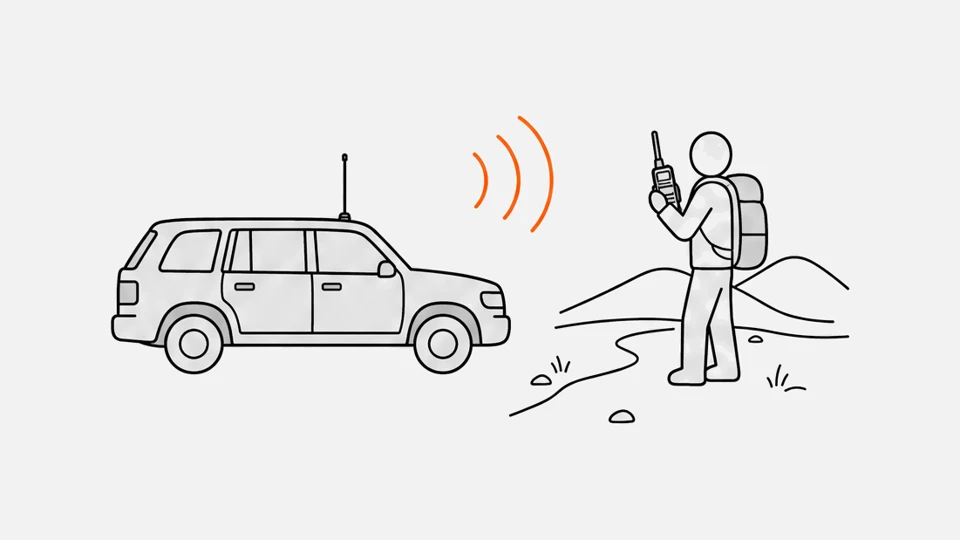
A CB radio reaches about 1 mile on a handheld, 5–7 miles from a vehicle and 10–15 miles from a well-installed base station, by Cobra's figures for ideal conditions. Wikipedia gives 5–30 km (3–19 miles) for a vertical antenna. Hills, trees, buildings and a poorly matched antenna cut it.71819
| Setup | What decides range | Number |
|---|---|---|
| Handheld with its short "rubber duck" antenna | Antenna length, terrain | 3/4 to 1 mile (1.2–1.6 km) in flat, open country19 |
| Handheld, ideal conditions | Antenna type | About 2 miles (3.2 km)18 |
| Vehicle with a roof antenna | Antenna height and match, terrain | 5–7 miles (8–11 km)18 |
| Base station on a mast | Mast height, antenna | 10–15 miles (16–24 km)18 |
| Vertical antenna, any station | Terrain | About 5–30 km (3–19 miles)7 |
| Skywave "skip" | Sunspot activity, time of year | Hundreds to thousands of miles, only sometimes7 |
Cobra adds that these best-case conditions rarely exist, so real range is usually lower.18 Geometry sets a ceiling too: the radio horizon between two antennas 1.5 m up is about 10 km, and about 18 km when one of them stands on a 10 m mast.14
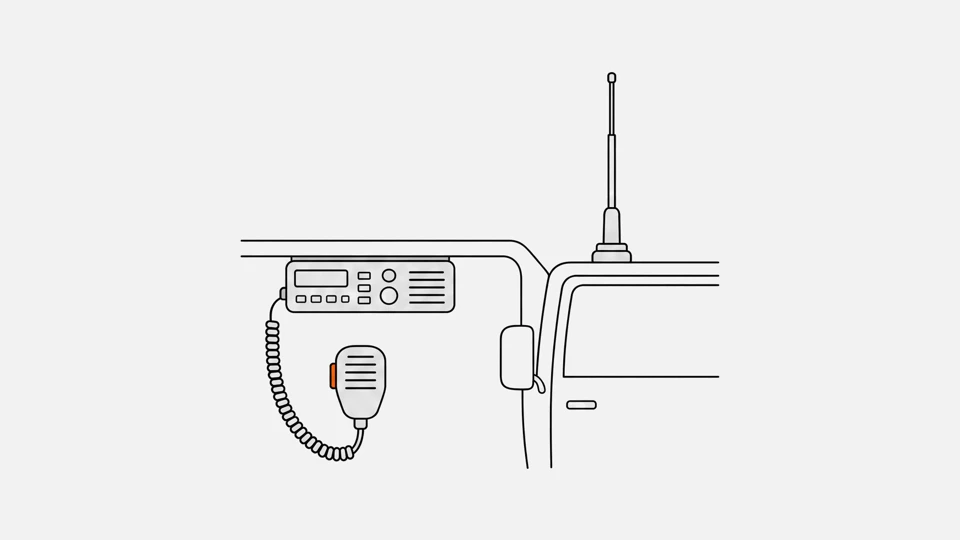
The limits are set by physics and by the rules. A quarter-wave antenna on CB is about 2.8 m long (27 MHz has a wavelength of about 11 m), which is why car CBs use long whips. The power cap of 4 W AM or 12 W SSB, and the US ban on external amplifiers, keep the legal signal modest.1
What is skip?
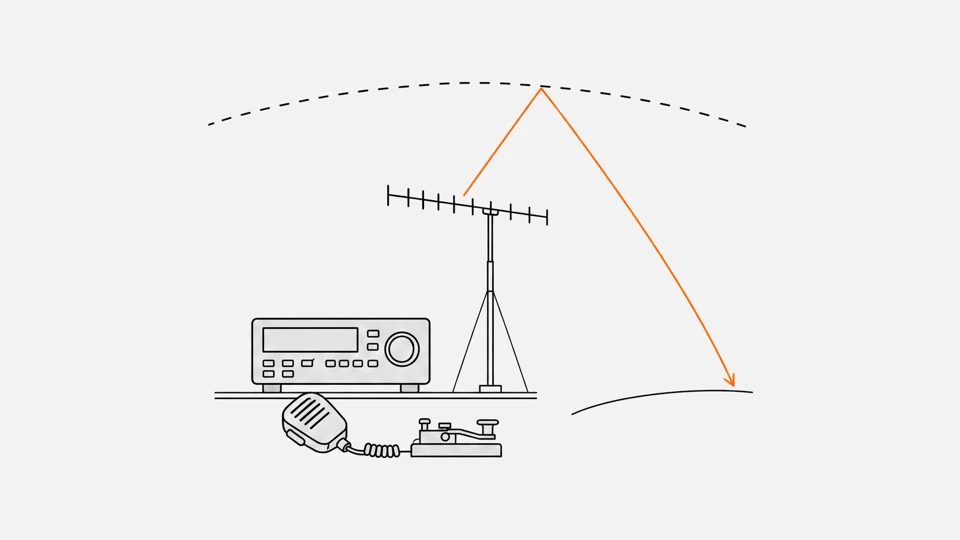
Skip is a skywave effect: at times the ionosphere returns 27 MHz signals to the ground far away, so a station hundreds or thousands of miles off can be heard. Wikipedia says the band stays open for long periods at high sunspot activity and is usually closed at low activity, apart from sporadic-E openings from late spring to mid-summer.7 It is irregular, and it also means distant stations can swamp a local conversation.
The US used to limit CB contacts to 250 km (155.3 miles). The FCC declined to change that rule in 2000, then removed the long-distance restriction in its 2017 reform, effective September 28, 2017.1720 Contact with stations in other countries is still barred, except Canadian General Radio Service stations.1 The range calculator shows ground-wave range for common radio types.
Do truckers still use CB?
Yes, though fewer than in the 1970s. In FreightWaves surveys reported in November 2021, more than 32 % of truckers said they use a CB all the time while driving, 32 % rarely, and more than 17 % never while driving.9
Drivers quoted there describe a split: gravel, dump, oilfield and oversize drivers keep CBs, and others turn them off because of chatter, while some use them for warnings at traffic stops and wrecks.9 Wikipedia dates the original boom to the 1973–1974 oil crisis and the 55 mph limit, when truckers used CB to find fuel and warn about speed traps.7
How do you use a CB radio?
Pick a channel, listen first, press the microphone button, say who you are calling and who you are, and release the button to listen. That is all the radio needs. The US rule asks for plain-language voice, so keep it short and give priority to anyone calling for emergency help.1
- Set the channel: 19 for highway traffic, 9 for emergencies and roadside help.
- Listen for a gap, then press and talk.
- Call the other party, then identify yourself.
- Keep each conversation under five minutes in the US, then leave the channel for a minute.1
- Release the button to hear the reply.
Radio shorthand such as 10-4 ("understood") sits on top of this; the codes and procedure words are listed in the radio codes tool. CB talk is informal and varies by region.
CB vs ham radio vs GMRS: what is the difference?
CB needs no license, has 40 fixed channels and is capped at 4 W or 12 W. Ham (amateur) radio needs an exam, covers many bands from HF to microwave, and in the US allows up to 1.5 kW PEP. The ham 10 m band, 28.0–29.7 MHz, sits just above CB.1516
US GMRS is the third option people weigh. It works on UHF near 462 and 467 MHz, needs a $35 license with no exam, and allows repeaters, which CB does not have.21
| CB | GMRS (US) | Ham radio | |
|---|---|---|---|
| License | None2 | $35 for 10 years, no exam21 | Exam (US Technician: 35 questions, pass with 26)16 |
| Bands | 27 MHz, 40 channels1 | 462 and 467 MHz, 30 channels21 | HF, VHF, UHF, microwave |
| Power | 4 W AM or FM; 12 W PEP SSB1 | Up to 50 W on the main channels21 | Up to 1.5 kW PEP in the US15 |
| Repeaters | None | Yes, 8 channel pairs21 | Yes, many bands |
| Use | Personal, business or voluntary public service1 | Personal and family | Non-commercial, self-training and experiments |
GMRS is covered in FRS and GMRS, the hobby side in ham radio.
How this relates to PoC radio
CB and a PoC radio both put a group on one channel at the press of a button. CB is radio to radio on 27 MHz, with no network. A PoC radio sends voice as data over LTE to a push-to-talk server, so it reaches anywhere with mobile coverage and adds groups, location and recording.
| CB | Closest neighbor, PMR446 | PoC / LTE | |
|---|---|---|---|
| Standard | 47 CFR Part 95 D, ECC/DEC/(11)0313 | ECC/DEC/(15)05 | Set by the PTT platform |
| Radio channel | 27 MHz, 40 channels1 | 446.0–446.2 MHz | The operator's LTE bands |
| Network | None, simplex | None, simplex | Mobile network and a PTT server |
| Range | 5–7 miles mobile, more with skip718 | About 0.1–1 km on a handheld | Wherever the network reaches |
| Access or license | License-free23 | License-free | A SIM and a PTT service |
| Data | Voice only | Voice, short data | Mobile broadband |
Where there is no mobile coverage, as on empty highways and in remote areas, CB still works. For fleets, PoC covers wide areas and many sites. See PoC vs PMR446 for a license-free handheld comparison and what is a walkie-talkie for the handheld side.
Questions
Is a CB radio license-free?
Yes in the US, Canada, Australia and the EU: no individual license is needed if the radio follows the rules.231213 The UK has been license-exempt since 8 December 2006.5
What is the difference between CB and a walkie-talkie?
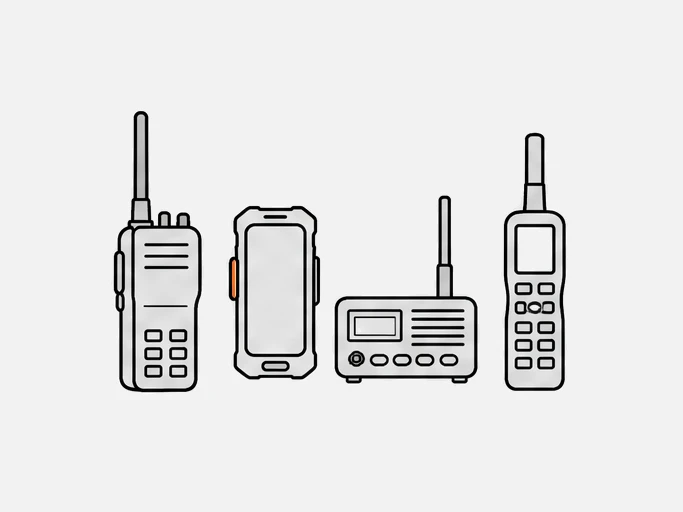
CB is one service on 27 MHz with 40 channels. A walkie-talkie is any handheld two-way radio and can be on FRS, PMR446, business UHF or LTE. Most CBs sit in vehicles or at a base. See what is a walkie-talkie.
Can I use a CB radio in the UK and the EU?
Yes, on the CEPT channels (26.965–27.405 MHz) or, in the UK only, the 27/81 channels, within the national power limits. Check the rules of the country you drive in, since power and modes differ.351011
Does CB work during an emergency?
Channel 9 is reserved for emergencies and traveler help in the US, and operators must give priority to emergency traffic on every channel. It depends on someone being in range to hear you.1
Sources
- 47 CFR Part 95 Subpart D: Citizens Band Radio Service · eCFR (sections 95.903, 95.931, 95.933, 95.935, 95.939, 95.941, 95.957, 95.963, 95.967, 95.971, 95.973)
- Allgemeinzuteilung CB-Funk, Vfg. 21/2021 · Bundesnetzagentur
- UK Interface Requirement 2027: Citizens' Band radio · Ofcom (read through excerpts, not directly)
- UK Interface Requirement 2027.2: CB radio, AM and SSB · Ofcom (read through excerpts, not directly)
- Citizens band radio · Wikipedia
- Al Gross · Lemelson-MIT
- Breaker 1/9: What happened to CB radios? · FreightWaves, 21 November 2021
- Arrêté du 31 mars 1992 (CB radio) · Légifrance
Show all 21 sources
- Regeling zonder vergunning · Overheid.nl
- Citizen band radio stations class license · Australian Government
- RSS-236 Issue 2: Citizens band radio · ISED Canada
- What is the range of a CB radio? · Cobra Electronics
- Range of handheld CB radios · Cobra Electronics
- Personal Radio Service Reform, FCC 17-57, 82 FR 41096 (29 August 2017) · Federal Register, FCC