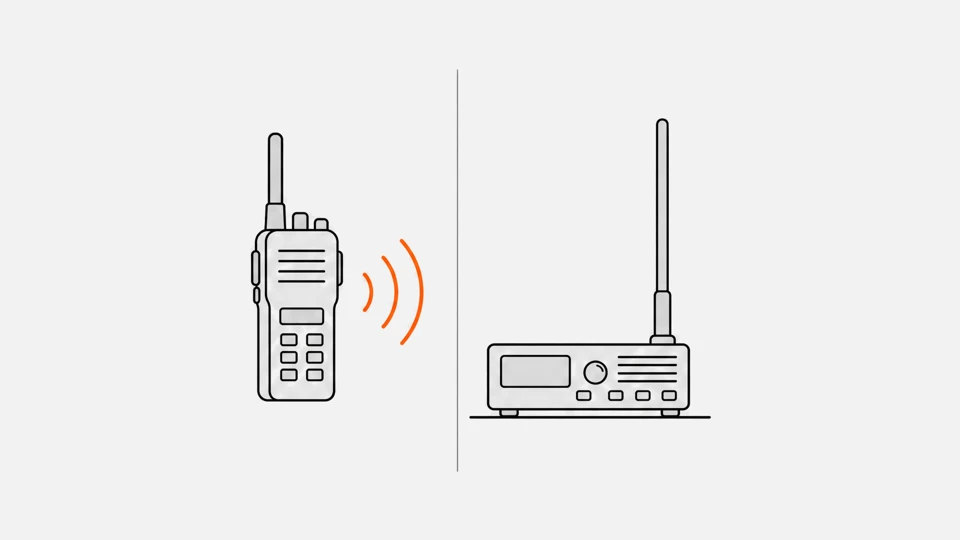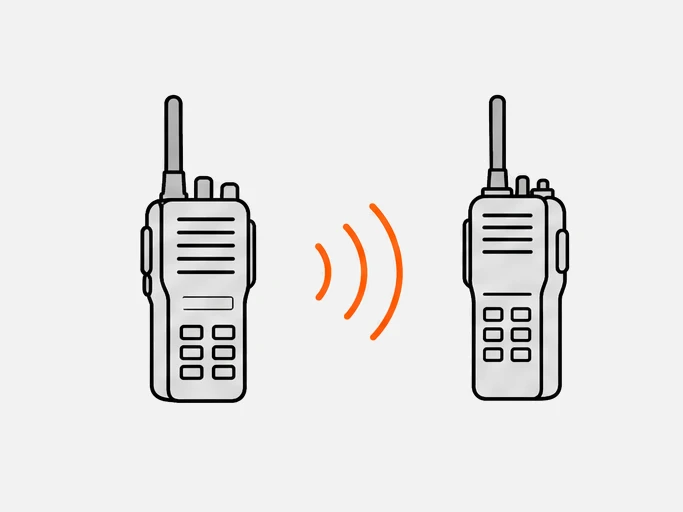
What is a walkie-talkie?
A walkie-talkie is a handheld two-way radio. You press the push-to-talk button to speak and release it to listen. Everyone on the same channel hears you, and only one person can transmit at a time. Most consumer sets work radio to radio with no network, licensed by rule in the US and license-exempt in Europe.789
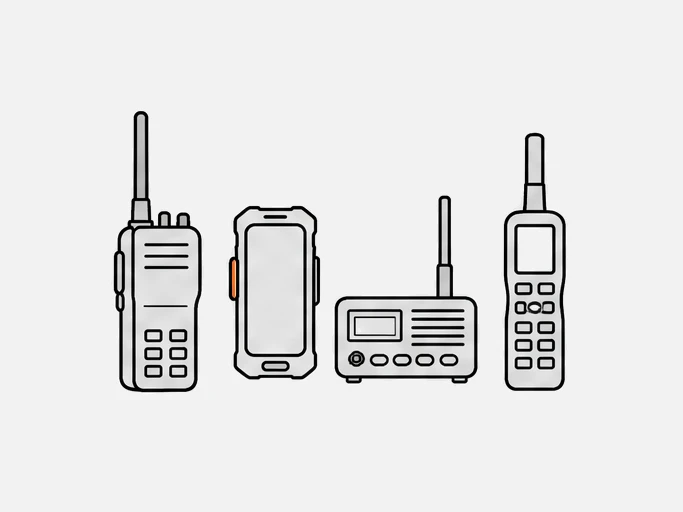
The word covers a wide range of products: a toy with a 27 MHz crystal, a license-free family radio, a business digital handheld and a phone-sized radio that works over the mobile network. What they share is the push-to-talk habit and a group that talks on a channel. The wider family is on what is a two-way radio and types of two-way radio.
How does a walkie-talkie work?
A walkie-talkie is a transmitter and a receiver in one case. While you hold the button the transmitter is on and the receiver is off; when you let go it switches back to listening. This is half-duplex, one direction at a time, and radio to radio on one frequency, which is called simplex.79
| Parameter | Typical consumer set |
|---|---|
| Mode | Half-duplex, push-to-talk; simplex on one channel79 |
| PMR446 (EU, UK) | 446.0–446.2 MHz, hand portable only, integral antenna, 500 mW e.r.p.9 |
| FRS (US) | 22 channels of 12.5 kHz around 462 and 467 MHz; 2 W ERP on channels 1–7 and 15–22, 0.5 W on 8–14; non-removable antenna8 |
| Transmit time-out | PMR446 push-to-talk radios stop transmitting after 180 s9 |
| Who hears you | Anyone on the same channel in range; privacy codes (CTCSS, DCS) only mute other callers on your own radio |
Two radios must be on the same channel to hear each other. Their power, antenna and the terrain decide how far that is, which is why range is the most asked question about walkie-talkies. The numbers are further down.
When were walkie-talkies invented, and by whom?
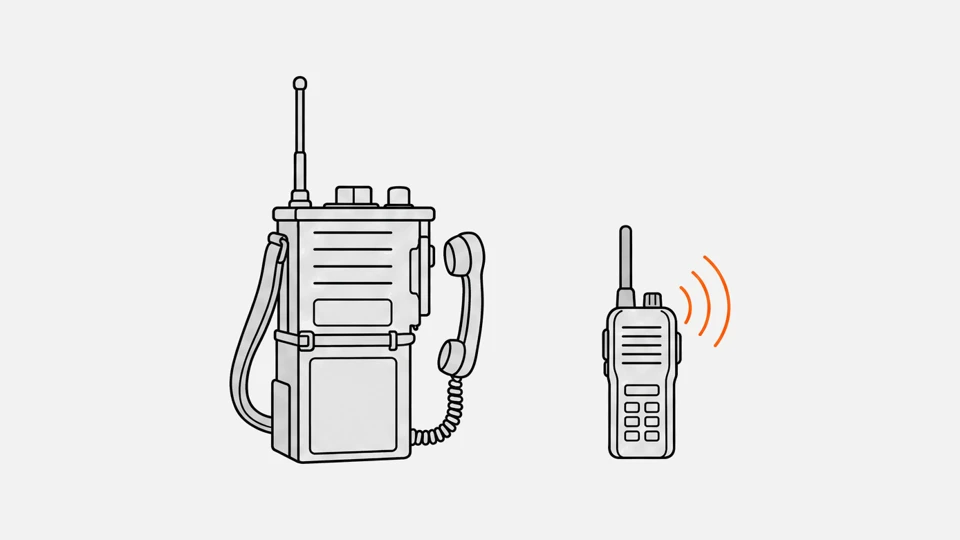
Three efforts from the late 1930s and early 1940s share the credit: Donald Hings in Canada, Al Gross in the United States, and the Galvin Manufacturing team, later Motorola, in the United States. Sources credit each of them, and the record does not settle who was first.13457
| Who | What the sources say | Where they differ |
|---|---|---|
| Donald Hings, Canada | A portable aircraft radio he called the "packset" was in use at the mining company CM&S (Cominco) by 1937; he filed a US patent in Spokane in 1939; about 18,000 C58 sets were made in the war.12 | Ingenium says "Hings built the first walkie-talkie in 1937"; Wikipedia's article says the packset "later became known as" the walkie-talkie.17 |
| Al Gross, US | Born in Toronto in 1918, a Cleveland ham; built handheld radios, later worked on the OSS Joan-Eleanor air-to-ground system.3 | The Lemelson-MIT profile says he invented and patented the walkie-talkie in 1938; the IEEE history site says he patented a design between 1938 and 1941.34 |
| Galvin / Motorola, US | SCR-536 handheld, developed from 1940 under chief engineer Don Mitchell; SCR-300 backpack set under contract from 1940, tested at Fort Knox in spring 1942, in action in the Pacific from August 1943.56 | Daniel Noble is named as the designer of the SCR-300's FM design and Henryk Magnuski as principal RF engineer; Polish accounts also credit Magnuski with the SCR-536.56 |
The name itself points to the SCR-300. The US Army manual describes the set as "primarily intended as a walkie-talkie for foot combat troops", and Wikipedia calls it the first radio widely nicknamed a walkie-talkie.5 "Handie-Talkie" was Motorola's trademark for the SCR-536, which is why "HT" still means a handheld radio. The two names are often mixed up, and one Wikipedia passage even attaches "Handie-Talkie" to Hings's C58, while Ingenium calls it the C58 Pack Set.17
| Wartime radio | Band and mode | Output | Reach | Weight |
|---|---|---|---|---|
| Hings packset (1937) | — | — | 210 km, air to ground (museum figure)2 | 12 lb2 |
| SCR-536 handheld | 3.5–6.0 MHz AM6 | 360 mW6 | A few hundred feet to about 1 mile on land6 | About 5 lb6 |
| SCR-300 backpack | 40–48 MHz FM5 | 0.3 W5 | About 3 miles5 | 32–38 lb5 |
Production figures (about 130,000 SCR-536 and nearly 50,000 SCR-300) come from Wikipedia.
After the war Gross went on to the Citizens Band. The FCC approved his equipment for it in 1948, and he sold about 100,000 radios in the late 1940s, mostly to farmers and the US Coast Guard.4 CB is covered on CB radio.
What types of walkie-talkie are there?
Four groups cover most of what is sold: license-free consumer radios such as FRS and PMR446, licensed business radios on VHF or UHF, digital radios such as DMR, and PoC radios that send voice over the mobile network. They differ in license, range, channel count and running cost.8914
| Type | Example | Access | Typical use |
|---|---|---|---|
| Consumer, license-free | FRS (US, Canada), PMR446 (EU, UK) | No individual license8911 | Family, hiking, small sites |
| Business analog or digital | UHF or VHF handhelds, DMR | Individual or company license in most countries1314 | Warehouses, hotels, building sites |
| Digital | DMR, and digital PMR446 | PMR446 digital is license-exempt; DMR on licensed bands9 | Clear voice, longer battery, data |
| PoC / LTE | Handhelds with a SIM | A SIM and a push-to-talk service | Wide areas, many sites, no radio license |
DMR is the common business digital standard. PMR446 has its own page. A PoC radio looks like a walkie-talkie but sends voice as data, covered in 4G LTE walkie-talkies. To narrow a choice, try the radio type picker.
Can any walkie-talkie talk to another?
Only if both radios share a band, a channel and a mode, and their privacy codes match. US FRS and European PMR446 sets sit on different frequencies, so they never hear each other. Within one service, any brand works: set the same channel number and the same CTCSS tone or DCS code on both radios.8923
| Service | Channels | Frequencies | Power |
|---|---|---|---|
| FRS (US, Canada) | 22, shared with GMRS8 | 462.5500–462.7250 and 467.5625–467.7125 MHz8 | 2 W ERP; 0.5 W on channels 8–148 |
| PMR446 analog (EU, UK) | 16 at 12.5 kHz9 | 446.00625–446.19375 MHz9 | 0.5 W ERP9 |
| Digital PMR446 | 32 at 6.25 kHz or 16 at 12.5 kHz9 | 446.0–446.2 MHz9 | 0.5 W ERP9 |
| Privacy codes | 39 CTCSS tones in ETSI's table, 38 on most consumer radios, plus 83 DCS codes23 | Sent with the voice | They filter, not encrypt |
Brands number privacy codes differently, so match the tone in hertz, not the code number; the CTCSS and DCS code list translates between brands. Channel-by-channel tables for FRS, GMRS and PMR446 are in the frequency charts. An analog radio and a digital one only talk if the digital radio has an analog mode; the compatibility check shows which pairs work.
How far does a walkie-talkie reach?
In a city, usually a few hundred meters at most, and about 1 km in the open for a license-free set. A larger business handheld adds roughly a factor of two. The number printed on a package is usually the best case, with a clear line of sight.
| Situation | Number | Source |
|---|---|---|
| PMR446 in a city, 95 % of connections | 90–96 m | CEPT simulation10 |
| PMR446 suburban | 98–133 m | CEPT simulation10 |
| PMR446 rural | 691–986 m | CEPT simulation10 |
| PMR446, worst-case calculation, rural | 3.2 km | CEPT calculation10 |
| Latvian regulator, city and countryside | A few hundred meters; up to a few km | Regulator guidance18 |
| A maker's claim for one PMR446 model | "up to 9 km line of sight", "13 floors" | Datasheet claim; coverage will vary, the maker adds17 |
| 2 W FRS hand-held, urban / open ground | 0.5–1 mile (0.8–1.6 km) / 1.5–3+ miles (2.4–4.8 km) | Maker's typical figures19 |
| Licensed 4 W UHF handheld, open field | 1.6–2.7 km | Site range model (calculated) |
| Radio horizon, two radios held at 1.5 m | About 10 km | Geometry only |
Read the rows together: the regulator's simulation puts a 0.5 W radio at about 100 m in a city and just under 1 km in open country, a 2 W FRS set does somewhat better, and the maker's claim assumes a clear line of sight. The horizon is a ceiling no handheld reaches; walls, floors, trees and your own body take the rest.1019
Put your own situation into the range calculator to see a plain-language answer for a building, a street or open ground. A PoC radio has no range in kilometers at all: both radios need mobile coverage. Longer-range options are listed in long-range walkie-talkies.
Do you need a license for a walkie-talkie?
It depends on the radio and the country. Consumer sets are built for license-free bands: FRS in the US and Canada, PMR446 in Europe and the UK. Business radios usually need a license, US GMRS needs a $35 license, and a PoC radio needs no radio license, only a SIM and a push-to-talk service.891120
| Region | License-free | License needed |
|---|---|---|
| United States | FRS and CB, no individual license8 | GMRS: $35 for 10 years, no exam; business radios under Part 90, $105 FCC application fee for a new license121420 |
| Canada | FRS and GMRS, license-exempt15 | Business land mobile license |
| United Kingdom | PMR446, 0.5 W11 | Business Radio: Simple UK Light license, £75 for 5 years13 |
| Germany, France | PMR446 general authorization9 | Business radio frequency assignment |
| Australia | UHF CB at 476–477 MHz and 27 MHz CB under a class license21 | FRS, GMRS and PMR446 sets are not covered by it;1621 other services by license |
PMR446 is not allowed in the US, where 446 MHz sits in the amateur 70 cm band, and US FRS and GMRS sets are not license-exempt in the UK or the EU.1122 Radios bought abroad can be illegal at home, so check the band before you buy. The license checker covers 15 countries, and PMR446 has the European detail.
Is a walkie-talkie the same as a two-way radio?
Nearly. A walkie-talkie is a handheld two-way radio; "two-way radio" is the wider term and also covers vehicle radios, base stations and repeaters. In a shop, "walkie-talkie" often means a license-free consumer handheld, and "two-way radio" a licensed business set.7 The detail is in two-way radio vs walkie-talkie.
| Walkie-talkie (consumer) | Business two-way radio | PoC / LTE | |
|---|---|---|---|
| Standard | FRS rules or ETSI EN 303 405 for PMR44689 | Licensed analog or DMR | Set by the push-to-talk platform |
| Radio channel | One shared channel, 12.5 kHz8 | Licensed UHF or VHF channels | The mobile operator's LTE bands |
| Network | None; radio to radio | Direct, repeater or trunked | Mobile network and a PTT server |
| Range | About 0.1 km in a city, up to about 1 km in the open10 | Larger, about 1–2 km in the open (model) | Wherever the mobile network reaches |
| Access or license | License-free89 | License1314 | A SIM and a PTT service |
| Data | Short data on some FRS radios8 | Short data, GPS on digital | Mobile broadband |
How this relates to PoC radio
A PoC radio works like a walkie-talkie: a button, a group and an instant voice. The difference is underneath. A classic walkie-talkie talks radio to radio on its own channel; a PoC radio sends voice as data over a mobile network to a push-to-talk server, so it reaches as far as the network.
The two overlap in practice. A site can run license-free PMR446 handhelds on the floor and PoC radios for vehicles and remote staff. Some push-to-talk platforms also link app users to radio systems through gateways. The comparison with a license-free radio is in PoC vs PMR446, and with a licensed digital network in PoC vs DMR.
Questions
What is another word for a walkie-talkie?
Handheld radio, two-way radio, HT (from Motorola's Handie-Talkie trademark) or handie-talkie. In the US, shops sell them as FRS or GMRS radios; in Europe as PMR446 radios.7
Can FRS and GMRS walkie-talkies talk to each other?
Yes. FRS shares all 22 of its channels with GMRS, and the rules let FRS units talk to GMRS stations. PMR446 radios use 446 MHz, so they do not talk to US FRS or GMRS sets.89
Do walkie-talkies need a cell signal?
No. License-free and business walkie-talkies talk radio to radio and need no network. A PoC radio does need mobile data or Wi-Fi.
Sources
- Inventing the Walkie Talkie · Rossland Museum
- Al Gross · IEEE Engineering and Technology History Wiki
- Al Gross · Lemelson-MIT
- SCR-300 (cites US Army TM 11-242 and Noble, Electronics, January 1945) · Wikipedia
- SCR-536 (cites McElroy, QST, January 2005) · Wikipedia
- Walkie-talkie · Wikipedia
- ECC Report 369: PMR 446 power increase · CEPT ECC
Show all 24 sources
- Motorola XT400 series specification sheet · Motorola Solutions
- PMR446 · Electronic Communications Office, Latvia
- Cobra support article 47001184443: typical FRS/GMRS radio range · Cobra Electronics
- Radiocommunications (Citizen Band Radio Stations) Class Licence 2025 · Federal Register of Legislation, Australia
- 47 CFR 97.301: Authorized frequency bands · eCFR, FCC
- 47 CFR 95.967: CBRS transmitter power limits · eCFR, FCC