How does a ham radio contest work?
Stations call and answer each other as fast as they can for 24 to 48 hours. Every contact needs a short exchange, such as a signal report and a zone number. Contacts earn points, and the score is the points multiplied by the number of different zones, countries or prefixes worked.18
In CQ World Wide, for example, a contact with another continent is worth 3 points, and the multipliers are the CQ zones and countries worked on each band. A log full of easy contacts loses to a smaller log with many multipliers.1
The big contests run on fixed weekends every year:
| Contest | When | Exchange | Multipliers |
|---|---|---|---|
| CQ World Wide DX | SSB: last full weekend of October; CW: last full weekend of November; 48 h | Signal report + CQ zone | CQ zones + countries, per band |
| CQ WPX | SSB: last weekend of March; CW: last weekend of May; 48 h | Signal report + serial number | Prefixes, once per contest |
| CQ 160-Meter | CW: last full weekend of January; SSB: last full weekend of February; 48 h from 2200 UTC | Signal report + US state, Canadian province or CQ zone | US states, Canadian provinces, countries |
| ARRL International DX | CW: third full weekend of February; phone: first full weekend of March; 48 h | US and Canada send state or province; others send power | Countries for US and Canada, states and provinces for the rest |
| IARU HF World Championship | Second full weekend of July; 24 h | ITU zone; headquarters stations send their society's abbreviation | See the rules |
| ARRL Field Day | Fourth full weekend of June; held since 1933; more than 31,000 participants | See the rules | See the rules |
Source: the organizers' rules pages, October 2026.12781011121314
Logs go in as electronic Cabrillo files, uploaded on the contest's website within a few days. A contest calendar such as WA7BNM's lists hundreds of smaller events, from state QSO parties to single-band sprints.146
What is the CQ World Wide DX Contest?
The largest ham radio contest. It runs for 48 hours, SSB on the last full weekend of October and CW on the last full weekend of November. In 2025 it set a record with 19,005 logs: 10,576 for SSB and 8,429 for CW. The modern contest began in 1948.23456
Everyone works everyone. Stations send a signal report and their CQ zone, for example 599 05. Points depend on where the other station is:1
| Contact | Points |
|---|---|
| Different continents | 3 |
| Same continent, different countries | 1 |
| Different countries inside North America | 2 |
| Same country | 0, but it still counts as a multiplier |
The organizer says more than 35,000 people take part. The SSB weekend of 2025 produced 5,148,149 contacts in the logs.25
Coming dates: SSB on October 24–25, 2026, and October 30–31, 2027; CW on November 28–29, 2026, and November 27–28, 2027. Each weekend starts at 00:00 UTC on Saturday.12
How is the CQ WPX Contest different?
The multipliers are prefixes, the first part of a call sign, such as N8, W8 or WD8. Each prefix counts once for the whole contest, not once per band, and special event prefixes such as LY1000 count too. The exchange is a signal report and a serial number from 001.78
The contest grew out of a CQ magazine award for working all prefixes. Contacts with other continents are worth 3 points on 10, 15 and 20 m and 6 points on 40, 80 and 160 m, which rewards the harder low bands.78
- When. SSB on the last weekend of March, CW on the last weekend of May. The 2027 dates are March 27–28 and May 29–30. A separate WPX RTTY contest runs in February.78
- Off-times. Single operators may work 36 of the 48 hours, in blocks with breaks of at least 60 minutes. Multi-operator stations may work all 48 hours.8
- Size. In 2026 the SSB weekend drew 8,345 logs and the CW weekend 5,711.9
What is the CQ 160-Meter Contest?
A contest on the 160 m band (1.8 MHz) only, held since 1960. CW runs on the last full weekend of January, SSB on the last full weekend of February. Both last 48 hours from 2200 UTC on Friday; single operators may work 30 of them and multi-operator stations 40.1011
Contacts with other continents are worth 10 points, with the same continent 5 and with your own country 2. The multipliers are the 48 US states plus DC, 14 Canadian provinces and territories, and countries. Stations outside the US and Canada send their CQ zone.11
The rules are strict about crowding a narrow band: one calling frequency per station, no switching between two frequencies, and no self-spotting. The 2027 dates are January 29–31 for CW and February 26–28 for SSB.1011
What are the entry categories?
By the number of operators, transmitters and power. A single operator enters at high power (up to 1,500 W), low power (100 W) or QRP (5 W). Multi-operator stations choose how many signals they put out. Overlays such as Rookie and Youth compare similar entrants inside the main categories.1
| Category in CQ WW | Who and how |
|---|---|
| Single Operator | One person, no spotting help, one signal on the air at a time |
| Single Operator Assisted | Uses spots from the DX cluster, CW Skimmer or the Reverse Beacon Network |
| Multi-Single | A team with one running signal, which may change band once every 10 minutes, plus one station that may only work new multipliers |
| Multi-Two | Two signals on different bands, each limited to 8 band changes per clock hour |
| Multi-Multi | One signal per band, on several bands at once |
| Multi-Distributed | A team operating from more than one site |
| Overlays | Classic, Rookie and Youth (25 or younger) |
Source: CQ WW rules, 2026.1
Assisted single operators made up 41.2% of the SSB entries in 2025.5 A CW Skimmer decodes every CW signal in a receiver's passband at once, and the Reverse Beacon Network shares such decodes from receivers around the world; it grew out of an idea of March 2008.4243
Top single operators often work SO2R, single operator two radios: they listen on a second radio while transmitting on the first. The rules still allow only one transmitted signal at a time.441
What is a contest superstation?
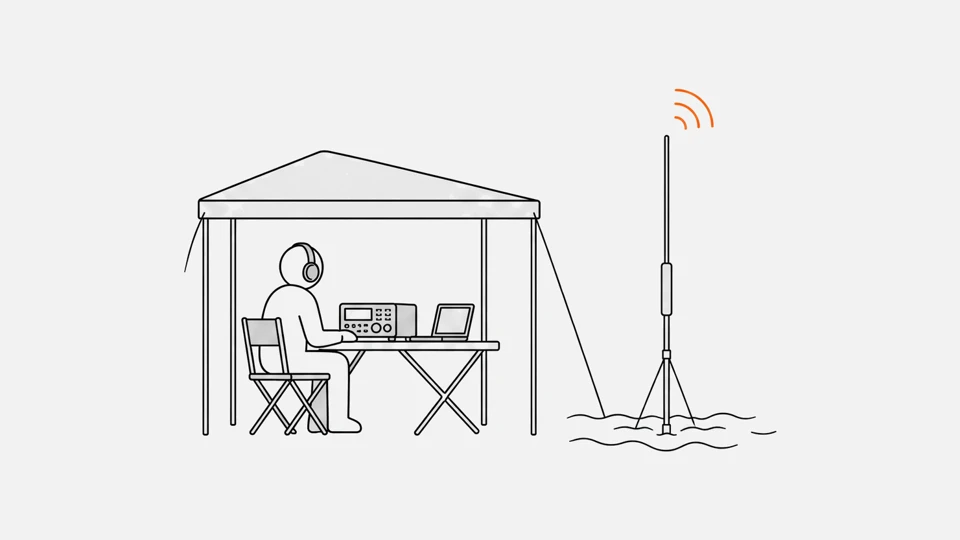
A station built to win: several towers, stacked antennas for each band, amplifiers and room for a team. Many sit on Caribbean islands. In CQ World Wide a Caribbean station is in North America, so its contacts with the US are worth 2 points each, while contacts between two US stations earn none.11819
Islands add a radio advantage. The CQ WW results of 2008 put it this way: "Once your antenna sees salt water, you suddenly have a natural amplifier."17
Known Caribbean stations and their documented results:
| Call sign | Where | Result |
|---|---|---|
| PJ2T | Curaçao | CQ WW CW 2013, Multi-Multi: 14,839 contacts, 39,795,573 points18 |
| 8P5A | Barbados | CQ WW SSB 2025, single operator: 10,631 contacts, 17,700,546 points, second in the world195 |
| P40L / P49Y | Aruba | World record, CQ WW CW 2025, Multi-Single Low: 16,732,105 points; the 215th contest from the station in 22 years15205 |
| V26B | Antigua | CQ WW SSB 2025, Multi-Multi: 31.9 million points, in the world top ten5 |
The all-time Multi-Multi records were set in Morocco: CN8WW scored 78,170,508 points in CQ WW SSB 2000, CN2AA scored 73,299,950 in CQ WW CW 2014 and 121,573,336 in CQ WPX SSB 2015, all Multi-Multi.1516
A real example: 6Y1V, Jamaica
6Y1V was the contest station of K1LZ, Krassy Petkov, and KY1V, David Kopacz, built in 2006 on the land of 6Y5GC, George Campbell, above Hopewell, 17 km west of Montego Bay. From 2006 to 2009 it won CQ WPX SSB in its class and placed second and third in the world in CQ WW.212223491728
The partners met in 2005 on the CY9SS expedition and formed the station partnership in 2006. Within four months a shipping container left for Jamaica, and seven months later everything was installed. 6Y5GC owned the property and looked after it.22
| 6Y1V, Jamaica | |
|---|---|
| Site | Hopewell, Hanover Parish, about 850 ft (260 m) above sea level and a mile from the sea |
| Radios | Four Icom IC-7800 and a Yaesu FT-1000MP Mark-V, with Acom 2000A amplifiers |
| Towers | Six; a 135 ft (41 m) tower carried two SteppIR yagis at 70 and 130 ft, and a 105 ft rotating tower carried stacked monobanders for 20, 15 and 10 m |
| Low bands | An 80 m four-square, slopers for 160 m, and Beverage and K9AY receiving antennas |
| Built for | Every category, including SO2R |
Source: the 6Y1V station pages of 2007, archived; the team's 2008 report gives the tower as 140 ft.2329
Its results in the official databases:
| Contest | Category | Contacts | Points | Place |
|---|---|---|---|---|
| CQ WW SSB 2006 | Multi-Single | 5,783 | 6,987,825 | North America winner49 |
| CQ WW CW 2007 | Multi-Single | 6,148 | 10,377,640 | |
| CQ WW SSB 2007 | Multi-Multi | 11,056 | 15,461,181 | |
| CQ WPX SSB 2008 | Multi-Two | 6,974 | 29,018,014 | World winner, North American record26 |
| CQ WPX CW 2008 | Multi-Two | — | 20,507,972 | Second in the world, North American record27 |
| CQ WW SSB 2008 | Multi-Two | 8,840 | 14,094,054 | Second in the world17 |
| CQ WW CW 2009 | Multi-Two | 10,078 | 17,192,104 | Third in the world, North America winner28 |
Source: CQ WW and CQ WPX score databases and results articles.2425
The WPX SSB team of 2008 set out to beat the North American Multi-Two record of just under 16 million, held by V47KP since 2003. They claimed more than 30 million.29
How do young hams get into contesting?
Through youth groups and programs that put them at strong stations. WWYC and YOTA bring young hams together, while IARU Region 1 and some station owners invite them to operate big stations in contests. CQ WW and CQ WPX rank operators aged 25 or younger in a Youth overlay.35373918
- WWYC, World Wide Young Contesters. Founded in November 1999 by OZ1AA, LZ5AZ, YT7AW and SM3WMV; members are under 30.3536
- YOTA, Youngsters On The Air. Summer camps since 2011, an official IARU Region 1 activity since 2014, with about 80 young hams each year in a different country. In December young operators use YOTA call sign suffixes.37385051
- IARU Region 1 Youth Contesting Program. Started in 2015; hams aged 26 or younger operate from big stations such as 9A1A, ES9C, 4O3A, LX7I, LZ9W, OZ5E and DP9A.3940
- ARRL Rookie Roundup. Short contests for hams licensed in the current year or the three years before.41
6Y1V ran its own Young Ham Contest Program, which KY1V introduced in 2003. Each year one ham aged 21 or younger won an all-expenses trip to operate CQ WW: airfare, license fees, lodging and food. Applicants wrote an essay of at least 500 words in English and needed their parents' permission.303134
| Year | Winner | Age | Contest |
|---|---|---|---|
| 2003 | W2AU, Daniel Bradke | 14 | CQ WW CW |
| 2004 | CT1ILT, Filipe Lopes | 17 | CQ WW SSB |
| 2007 | LU9ESD, Manu Siebert | 20 | CQ WW SSB |
| 2008 | IZ7KHR, Francesco Cozzi | 20 | CQ WW SSB |
| 2009 | EA3ALZ, OZ7AM, RV9LM and UU4JMG | — | CQ WW CW |
Source: the 6Y1V youth program pages, archived; ARRL Contest Update, October 15, 2008; CQ WW score database.30323324
The first two winners operated before the Jamaica station was built in 2006. KY1V wrote that similar programs followed in Britain, New England and Australia.31 The 2007 winner kept going: in CQ WW SSB 2025, LU9ESD placed third in the world among single operators at high power, as HD8R, with 17,032,032 points.5
How are contest logs checked?
By software and people, against every other log. A contact missing from the other station's log, or a call sign copied wrong, is removed and costs a penalty of twice its points. Duplicates and wrong exchanges are removed without penalty. In CW 2025, 95.6% of contacts could be cross-checked.16
CQ WW publishes the results each year with a write-up, a searchable score database, records and public logs. Its log checking reports list each top entrant's missing contacts, busted calls and unique calls.4847
The rules go further for the top places. The five leading single operators must record their audio, and a person must start every frequency change, call and log entry: robots are not allowed. Disqualification exists, and the contest director calls it a last resort.15
To start, all you need is a radio, an antenna and logging software. N1MM Logger+, the most widely used contest logger, is free.45
Does PoC radio have anything like contests?
No. A PoC radio talks over the mobile network, so every contact sounds the same whether it crosses a street or an ocean, and there is nothing to chase. Contest points depend on distance and on radio conditions across the ionosphere, which is the whole game of ham radio.
If you need to talk across a country without a license or antennas, see What is a PoC radio? and the types of two-way radio. For the ham radio side, start with What is ham radio? and How do DX expeditions work?
Questions
What is the biggest ham radio contest?
The CQ World Wide DX Contest. In 2025 it received 19,005 logs, 10,576 for SSB and 8,429 for CW, a record.46
When is CQ WW 2026?
SSB on October 24–25 and CW on November 28–29, 2026, from 00:00 UTC Saturday to 23:59 UTC Sunday.1
What does SO2R mean?
Single operator two radios: one person listens on a second radio while transmitting on the first, with only one signal on the air at a time.441
Sources
- CQ WW DX Contest rules, 2026 · CQ WW, World Wide Radio Operators Foundation
- CQ World Wide DX Contest · CQ WW
- History of the CQ WW DX Contest · CQ WW
- Log statistics · CQ WW
- 2025 CQ WW DX SSB results · CQ WW
- 2025 CQ WW DX CW results · CQ WW
- CQ WPX Contest · CQ WPX
- CQ WPX Contest rules · CQ WPX
- Log statistics · CQ WPX
- CQ World Wide 160-Meter Contest · CQ 160
Show all 51 sources
- CQ 160-Meter Contest rules · CQ 160
- IARU HF World Championship · ARRL
- ARRL Field Day · ARRL
- All-time records · CQ WW
- All-time records · CQ WPX
- 2008 CQ WW DX SSB results · CQ WW
- Score search: PJ2T · CQ WW
- Score search: 8P5A · CQ WW
- P40L / P49Y contest station · Aruba QTH
- 6Y1V Contest Superstation, home page, 2008 · 6Y1V, archived
- About 6Y1V, 2007 · 6Y1V, archived
- 6Y1V station, 2007 · 6Y1V, archived
- Score search: 6Y1V · CQ WW
- Score search: 6Y1V · CQ WPX
- 2008 CQ WPX SSB results · CQ WPX
- 2008 CQ WPX CW results · CQ WPX
- 2009 CQ WW DX CW results · CQ WW
- 6Y1V, CQ WPX SSB 2008, claimed score, by W4PA · 3830 score reflector, archived
- Young Ham Contest Program, 2009 · 6Y1V, archived
- 6Y1V news, 2008 · 6Y1V, archived
- 6Y1V news, 2009 · 6Y1V, archived
- About WWYC · World Wide Young Contesters
- WWYC history · World Wide Young Contesters
- Youth Committee · IARU Region 1
- New Youth Contesting Program (YCP) · IARU Region 1
- ARRL Rookie Roundup · ARRL
- CW Skimmer · Afreet Software, VE3NEA
- A short history of the Reverse Beacon Network · Reverse Beacon Network
- Single operator contesting and SO2R · N1MM Logger+
- N1MM Logger+ · N1MM Logger+
- WA7BNM Contest Calendar · Bruce Horn, WA7BNM
- Public log checking reports · CQ WW
- Results · CQ WW
- 2006 CQ WW DX SSB results · CQ WW
- Youngsters On The Air · YOTA
- YOTA · RSGB