What is a PoC DMR radio?
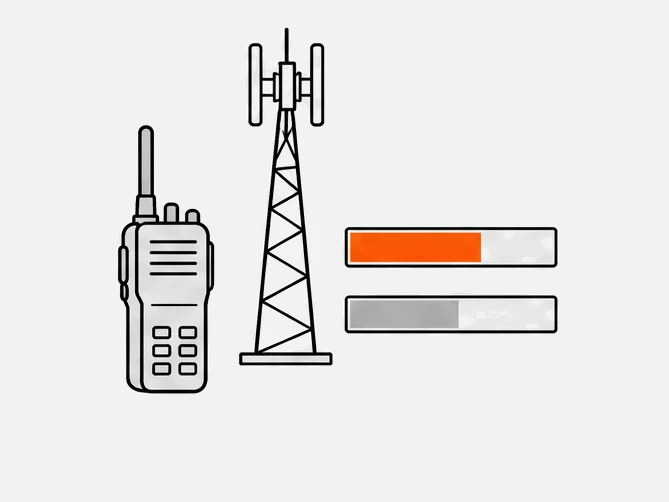
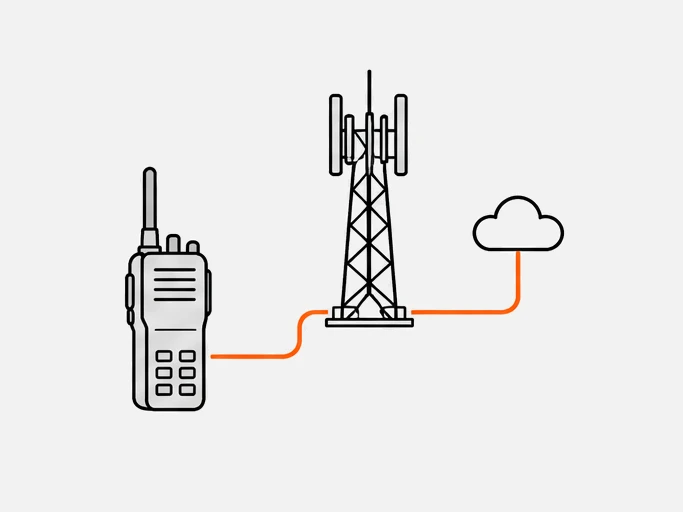
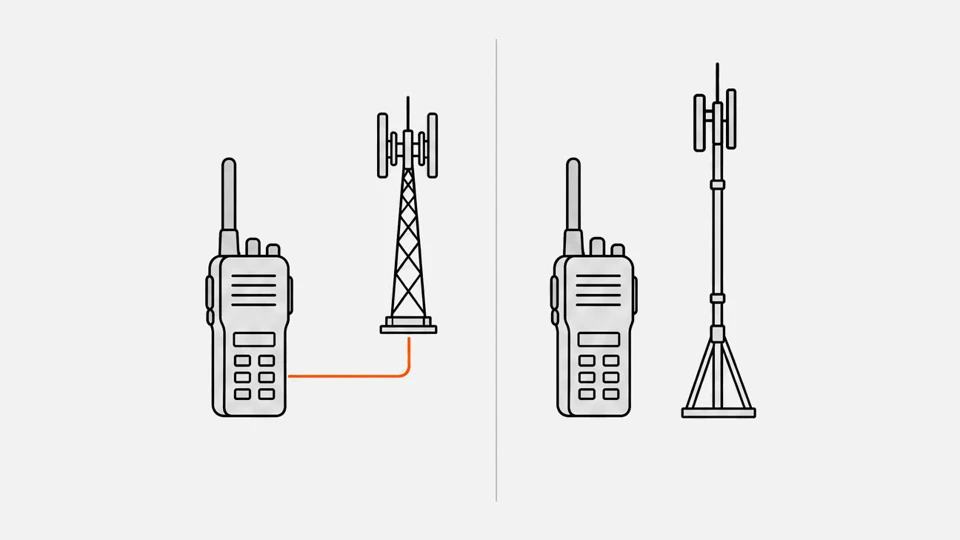
A PoC DMR radio, also called a dual-mode or hybrid radio, puts an LTE push-to-talk radio and a DMR transceiver in one handset. The LTE side reaches anyone with mobile coverage; the DMR side talks radio to radio or through a repeater. Some models pair LTE with an analog radio instead of DMR.
In our catalogue, 21 current models combine LTE with DMR and 20 with an analog FM radio; 29 of the 41 run Android.1 Hytera describes its PDC680 as a mission-critical DMR radio and an Android smartphone in a single device.2
| Part | What it does | What it needs |
|---|---|---|
| LTE / PoC side | Group and private calls over 4G or Wi-Fi, location, messages | SIM with data, a PTT service |
| DMR side | Digital calls radio to radio or through a DMR repeater | DMR channels, usually a license |
| Analog side (some models) | FM calls with ordinary UHF or VHF radios | Channels, usually a license |
How does a dual-mode radio switch between PoC and DMR?
Higher-end dual-mode radios switch on their own. Hytera's PDC680 registers on the DMR trunked network and the LTE network with the same ID and picks the network for each call; Inrico says its IRC380 uses DMR or 4G and Wi-Fi without manual switching. Other models use a mode key or channel.23
- Automatic switching needs both networks set up for the same users, such as a DMR trunked system and a PoC service from the same maker.2
- Two PTT keys let the user choose the network per call: Inrico gives the IRC380 a dual PTT design for public and private network calls.3
- Separate programming: the DMR side is set up with the maker's programming software, the LTE side in the PTT platform's admin console.
Why choose a PoC DMR radio?
A dual-mode radio fits teams that need both reach and independence. LTE carries calls between cities; DMR keeps a site talking in basements, tunnels or remote areas without mobile coverage, and reaches an existing DMR fleet directly. One handset replaces a phone and a radio on the belt.
Good at
Which PoC DMR radios are there?
The table lists every current model in our catalogue with LTE plus DMR or analog: 41 radios from 21 makers. Wouxun has the most models, all LTE with analog; Hytera, Inrico, Kirisun, Telox and UNIWA make LTE and DMR models. The radio side shows the frequency ranges the maker states.1
| Radio | Type | Radio side | System |
|---|---|---|---|
| Anysecu E81 | PoC + DMR | UHF | Android 9 |
| Boxchip A3Pro-A | PoC + DMR | 136–174 MHz, 400–470 MHz | Android 7.1 |
| Boxchip S900A Plus | PoC + DMR | 136–174 MHz, 400–470 MHz | Android 9.0 |
| Caltta GH960S | PoC + DMR | 350–400 MHz | — |
| Estalky E966 | PoC + DMR | 400–470 MHz, 136–176 MHz | Android 10 |
| Estalky V900D | PoC + DMR | VHF and UHF | Android 12 |
| Hytera PDC580 | PoC + DMR | 136–174 MHz, 400–470 MHz | — |
| Hytera PDC680 | PoC + DMR | 136–174 MHz, 340–470 MHz | Android 10 |
| Hytera PDC690 | PoC + DMR | 340–470 MHz | — |
| Inrico IRC380 | PoC + DMR | 400–480 MHz, 136–174 MHz | Android 10 |
| Inrico IRC390 | PoC + DMR | 400–480 MHz, 136–174 MHz | Android 10 |
| Kirisun TD60 Pro | PoC + DMR | — | Android 7.1 |
| Kydera LTE-DR880UV | PoC + DMR | 300–390 MHz, 200–280 MHz | — |
| QYT NHAD-309 | PoC + DMR | 400–470 MHz | — |
| QYT NHAD-800D | PoC + DMR | 136–174 MHz, 400–470 MHz | — |
| Talkpod S60 | PoC + DMR | — | Android 14 |
| Telox BN500 | PoC + DMR | 136–174 MHz, 400–470 MHz | Android 13 |
| Telox BN800 | PoC + DMR | 400–470 MHz | Android 14 |
| UNIWA P2 Plus | PoC + DMR | 400–480 MHz, 350–390 MHz | Android 9.0 |
| UNIWA P4 | PoC + DMR | 400–470 MHz, 136–174 MHz | Android 9.0 |
| UNIWA P8 | PoC + DMR | 400–470 MHz, 350–390 MHz | Android 14 |
| Icom IP730D | PoC + analog | 136–174 MHz | — |
| Icom IP740D | PoC + analog | 350–470 MHz, 400–520 MHz | — |
| KSUN CT80 | PoC + analog | UHF | — |
| Poclink POC-1 Ultra | PoC + analog | — | — |
| QYT NHA-271 | PoC + analog | 400–470 MHz | — |
| QYT QNH-530 | PoC + analog | 136–174 MHz, 400–470 MHz | — |
| Radtel P81 | PoC + analog | 400–470 MHz | — |
| Retevis MateTalk L2 | PoC + analog | 136–174 MHz, 400–470 MHz | Android 10 |
| SenHaiX SHX-8900 | PoC + analog | VHF and UHF | — |
| SenHaiX SPTT-N70 dual-mode | PoC + analog | 400–470 MHz, 400–700 MHz | — |
| Tesunho TH-680 | PoC + analog | VHF and UHF | — |
| Tidradio TD-M2 Pro | PoC + analog | 400–480 MHz | — |
| UNIWA P5 | PoC + analog | — | Android 9.0 |
| Wouxun KG-V55 | PoC + analog | 430–440 MHz | — |
| Wouxun KG-V81 | PoC + analog | VHF and UHF | — |
| Wouxun KG-V98 | PoC + analog | VHF and UHF | — |
| Wouxun KG-WV10 | PoC + analog | 400–470 MHz | — |
| Wouxun KG-WV20 | PoC + analog | VHF and UHF | — |
| Wouxun KG-WV51 | PoC + analog | 400–470 MHz | — |
| Wouxun KG-WV966 | PoC + analog | 400–480 MHz, 430–440 MHz | — |
Three models side by side, from the makers' own pages:
| Hytera PDC680 | Inrico IRC380 | Retevis MateTalk L2 | |
|---|---|---|---|
| Radio side | DMR, UHF 340–470 MHz, VHF 136–174 MHz2 | DMR Tier II, UHF 400–480 MHz, VHF 136–174 MHz3 | Analog, VHF 136–174 MHz and UHF 400–470 MHz7 |
| Radio power | UHF 1/4 W, VHF 1/5 W2 | UHF 2/4 W, VHF 5 W3 | 1/5 W7 |
| System | Android 102 | Android 103 | Android7 |
| Battery | 2,400 mAh, 4,000 mAh optional2 | 3,100 mAh3 | see the MateTalk L2 card |
| Sealing | IP68 (2 m, 4 h), IP662 | IP68 (1.5 m, 30 min)3 | see the card |
| Switching | Automatic, same ID on both networks2 | Automatic, dual PTT3 | see the card |
Check the LTE bands against your operator before buying: the band checker covers 73 operators in 22 countries.1
Do you need a license for a PoC DMR radio?
The LTE side needs no radio license, only a SIM and a PTT service. The DMR or analog side does on business channels: most dual-mode radios work in the 136–174 and 400–480 MHz ranges, where regulators such as Latvia's and Germany's issue individual frequency assignments.568
- Latvia requires a frequency-assignment permit for professional PMR radios in 30–87.5, 146–174 and 406–470 MHz.5
- Germany's Bundesnetzagentur accepts applications for conventional digital business radio as DMR Tier II or dPMR.6
- License-free DMR is Tier I on the PMR446 band, at 0.5 W with no repeaters.9
More country rules are in two-way radio licensing and the license checker.
Is a PoC DMR radio better than a gateway?
A gateway links a PoC talk group to a DMR channel at one point, so ordinary DMR radios and PoC radios hear each other. A dual-mode radio puts both networks in each user's hand. A gateway suits a mixed fleet; dual-mode radios suit people who move between coverage areas.
| Dual-mode radio | Radio gateway | |
|---|---|---|
| Where both networks meet | In each handset | At one gateway site |
| Works with radios you already own | Yes, on the DMR side | Yes, through the gateway |
| Direct calls in a mobile dead zone | Yes, on DMR | Only within range of the DMR repeater |
| Typical cost | A dual-mode radio per user | One gateway plus a radio and a PTT seat |
Zello, for example, links its channels to two-way radios through gateways and counts each gateway as a paid seat.1011 The gateway side, codecs and bandwidth are in radio over IP; the choice between the two technologies is in PoC vs DMR.
Questions
Can a PoC DMR radio talk to an ordinary DMR radio?
Yes, on its DMR side, when both radios share the frequency, color code, time slot and talkgroup. DMR radios from different makers interoperate where both follow the ETSI standard; the DMR Association certifies interoperability.412
Does a dual-mode radio need a SIM card?
For the LTE side, yes: a SIM with mobile data and a PTT service, or a Wi-Fi connection. The DMR side works without a SIM.
Which push-to-talk apps run on a PoC DMR radio?
Android dual-mode radios can run PTT apps such as TASSTA or Zello Work, depending on the model; check a radio in which radios run my app. Some ship with their maker's own service.1
Is a hybrid radio the same as a PoC DMR radio?
Usually. Makers say hybrid, dual-mode or PoC + DMR for the same idea. Some hybrids pair LTE with analog FM instead of DMR, like the Retevis MateTalk L2.7
Sources
- PoC radio catalogue: specifications and LTE bands · poc-radio knowledge base
- PDC680 dual-mode rugged radio · Hytera
- IRC380 PoC and DMR dual-mode radio · Inrico
- Professional PMR radios and permits (in Latvian) · Elektroniskie sakari, Latvia
- Betriebsfunk: Wichtige Hinweise zum Ausfüllen der Antragsunterlagen (in German) · Bundesnetzagentur, Germany
- Mobile 3G/4G/5G devices: what to check before buying (in Latvian) · Elektroniskie sakari, Latvia
- Radio gateways for Zello · Zello
Show all 12 sources
- Zello Work pricing · Zello
- DMR interoperability certification · DMR Association