How much does the Poclink POC-1 Lite cost to run?
The POC-1 Lite costs €179.95 for a 2-pack in Poclink's EU store (seen 9 October 2026) and $199 in the US store. Poclink includes its Standard Global Plan for 84 countries for a free term, then $29 a year. Wider coverage costs $69 or $99 per radio per year.
| Plan | Countries on Poclink's list | Price per radio |
|---|---|---|
| Standard Global | 84 | Included for a free term; $29 a year after it |
| Essential Global | 130 | $69 a year |
| Premium Global | 169 | $99 a year |
- Countries. The 84 are mostly Europe, the US and Canada. Mexico, Brazil and the UAE start on the $69 plan; Japan and New Zealand are on the $99 plan only. Australia, India, South Korea and China appear on none of the three lists (checked 30 October 2026).
- Term. Poclink's US Lite page gives 3 years free, then $29 a year, with a lifetime upgrade at $49 once per radio at purchase. The EU Lite page calls the plan a lifetime free Standard Global Plan, and the home page and a Poclink blog post still give one free year.
- Offer. The home page marks its no-fee line as a "limited-time offer". Poclink asks Lite buyers to keep the order ID for renewal rates.
- Keeping it active. Poclink says it will contact you to confirm that the radio is still in use and take you through a verification. Its Terms of Service never mention a lifetime plan.
My view: "lifetime" and "worldwide" do not belong together here. Check your countries on the coverage list, get the plan term in writing and keep your order receipt.
Who makes the Poclink POC-1 Lite?
HPYJ USA LLC, a Las Vegas company, holds the FCC record for the ID Poclink prints on its EU Lite page: 2BN5N-HPN323. The FCC test photos show the Lite's body with an HPY-J logo. Poclink's manuals print the same Las Vegas street address as the HPYJ USA LLC record.
| Record | What it shows |
|---|---|
| Poclink EU Lite page, tech specs | Prints "FCC-ID 2BN5N-HPN323" next to the band list B1/3/5/7/8/20/28/38/40/41 |
| FCC record 2BN5N-HPN323 | Grantee HPYJ USA LLC, Las Vegas; device "TD-LTE/LTE FDD terminal", model HPN323; granted 19 April 2025 |
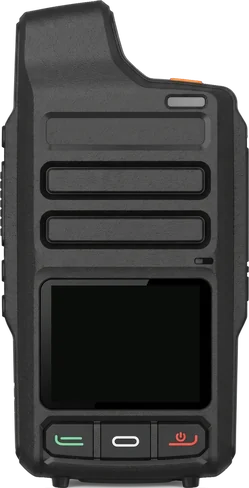
| FCC external photos of HPN323 | The Lite's body: stub antenna on the left, top key on the right, green, round and red keys under the screen, horizontal speaker grille. An "HPY-J" logo sits where Poclink prints its own |
| Poclink Lite and Titan manuals, page 2 footer | Poclink Tech LLC, 5940 S Rainbow Blvd, Las Vegas, Nevada 89118, the street address HPYJ USA LLC gives on its FCC record |
| Poclink Ultra manual, 2025 edition (copy on Manuals+), legal notice | "Copyright 2025 HPYJ USA LLC" and software "developed by HPYJ USA LLC, marketed under the Poclink brand". The July 2026 editions of the POC-1 manuals read "Copyright © 2026 Poclink Tech LLC" |
- Poclink's own statement. Poclink's About page says it designs its hardware, firmware and app in-house and does not white-label. The records above are listed next to it so you can read both.
- What it means for a buyer. Spare parts, repairs and firmware depend on the HPYJ platform. The FCC files also give a view inside the radio, shown in the next section.
What do the FCC test files show for the Poclink POC-1 Lite?
The FCC file for HPN323 lists measured output between 0.215 W and 0.24 W on four US LTE ranges, two RF exposure reports and internal photos. They show one shielded LTE module, two SIM slots marked SIM1 and SIM2, and the LTE antenna printed on a flex strip.
| Frequency range | Output (ERP/EIRP as printed on the grant) |
|---|---|
| 824-849 MHz | 0.23 W |
| 1710-1755 MHz | 0.24 W |
| 1850-1910 MHz | 0.215 W |
| 2500-2570 MHz | 0.22 W |
- Other ranges. The grant also lists 699-716, 704-716 and 777-787 MHz. All are US LTE ranges, matching the US band set in Poclink's NA manual.
- Internal photos. One shielded LTE module labelled "M12", two SIM slots (SIM1, SIM2), an LTE antenna on a flex strip and two gold battery contacts.
- Exhibits on record. User manual, internal and external photos, label, four test reports, two RF exposure reports and cover letters. The block diagram, schematics and parts list are confidential.
Which LTE bands does the Poclink POC-1 Lite use?
Poclink's EU Lite page lists B1, B3, B5, B7, B8, B20, B28, B38, B40 and B41. The NA manual and the FCC grant for HPN323 cover US bands instead. Ask Poclink in writing which band version ships to your country before you order.
| Source | LTE bands |
|---|---|
| Poclink EU Lite page | B1/3/5/7/8/20/28/38/40/41 |
| Poclink Lite manual, NA version, 3 July 2026 | US set: B2/4/5/7/12/13/17/38/41/66 |
| FCC grant HPN323 | US LTE ranges: 699-716, 704-716, 777-787, 824-849, 1710-1755, 1850-1910, 2500-2570 MHz |
- Why it matters. B20 and B28 are the low bands European networks use outside cities; the US set has neither. Use the band checker on this page with your operator.
Do Poclink's POC-1 Lite claims hold up?
Some do, with conditions the ads play down. The Lite is a real LTE radio on a shared platform, but its maker, battery and plan term read differently in different documents. This table compares the claims with Poclink's own documents, the published specs and the FCC files for HPN323.
| Poclink says | What the documents show |
|---|---|
| We design our hardware in-house and don't white-label | The FCC ID Poclink prints for the Lite belongs to HPYJ USA LLC, and the test photos show the Lite body with an HPY-J logo. |
| Lifetime free Standard Global Plan, 84 countries | The US Lite page says 3 years free, then $29 a year; lifetime costs $49 per radio at purchase. Coverage beyond the 84 countries costs $69 or $99 a year. |
| 3,000 mAh battery | HPN323's own OEM manual says 3.7 V and 6,000 mAh. The two documents disagree. |
| Continuous use 3-5 days, standby 10 days | John Galea saw about 2% an hour on an Ultra with mixed LTE and FRS use, so about 50 hours per charge at that rate. |
| Works worldwide with a multi-carrier SIM | LTE works where a network your plan includes reaches. The EU band list has B20 and B28; the NA manual lists US bands. |
| CE Certified | The Lite page states it and prints a US FCC ID. Ask the seller for the CE declaration. |
| Weighs just 130 g | The spec table and the manual say 136 g. |
What do Poclink buyers report?
Scores depend on who hosts them: 4.9 in Poclink's own store, 2.6 to 3.8 elsewhere. The reviews below cover Poclink as a company and its POC-1 radios, with hands-on figures from a buyer of the Ultra, which shares the Lite's body and battery size.
| Where | Rating | Reviews |
|---|---|---|
| Poclink store, POC-1 Ultra page | 4.9 | 1,672 |
| Trustpilot | 3.5 | 32 |
| App Store, Poclink app | 3.8 | 24 |
| Google Play, Poclink app | 2.6 | 23 |
- Trustpilot. 53% five-star and 28% one-star. Of the 11 one- and two-star reviews, five describe radios that failed or cut out, three poor or no network, and three delivery or return trouble. Poclink answered 72% of negative reviews.
- The app. App Store and Google Play reviews complain most about logins: being signed out, or not getting back in. Some praise support.
- A hands-on review of the same platform. John Galea bought his radios himself for CAD 562 and reports about 2% battery an hour on mixed LTE and FRS use and about 3% an hour mostly on FRS; at 2% an hour a full charge lasts about 50 hours. One of his radios froze after about four hours in patchy coverage and came back only with the battery out; Poclink support pushed an over-the-air update. He calls the LTE calls clear, with immediate push to talk. His radios were POC/FRS units, the Ultra with the same body and battery size.
- Dependence on Poclink. Galea points out the risk of the model: if Poclink's servers stop, voice, messages and location stop with them.
- Videos. 12 of the 13 YouTube reviews we found carry affiliate links or discount codes in their descriptions, so treat them as advertising. The one Lite video, from techmania on 12 September 2026, carries an Amazon affiliate link.
- A positive outside view. A June 2026 Kiplinger column by lawyer H. Dennis Beaver recommends Poclink and calls its ads honest. It is about a rival, Rapid Radios, and does not cover the SIM plan terms.
My verdict: the Lite is the cheapest way into the Poclink platform at €179.95 per pair, and it works inside the 84 countries. Judge it on the plan and bands you need.
Will it work in your country?
Poclink lists 7 LTE FDD and 3 LTE TDD bands for the POC-1 Lite on its EU page, including B1, B3, B7, B8, B20 and B28.
Try the push-to-talk apps on the POC-1 Lite
These services list the POC-1 Lite as supported. Pick one and try what it can do.
The radio's keys work too: PTT plays the next call (hold it to talk), the knob or ▲▼ change the group, ◀▶ switch the app’s screens, the red key stops.
About Poclink →Website ↗Ports and buttons
Turn the radio to see every side, the top and the bottom. Tap a row to find the part.
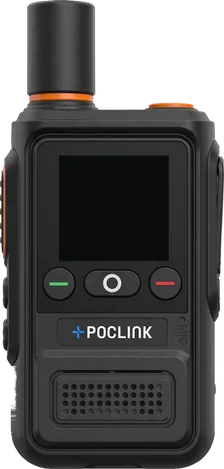
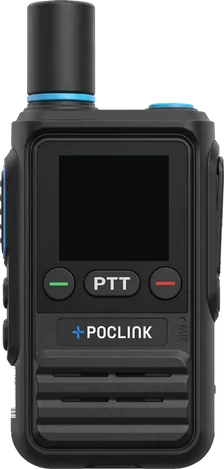
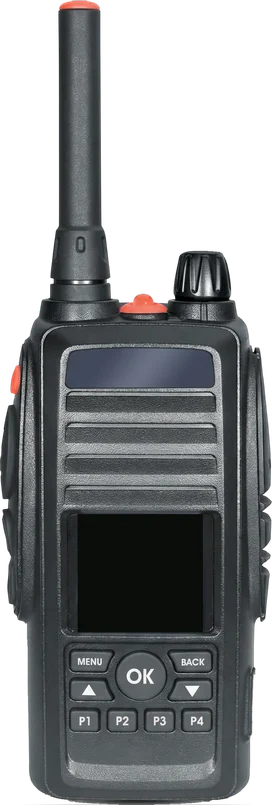
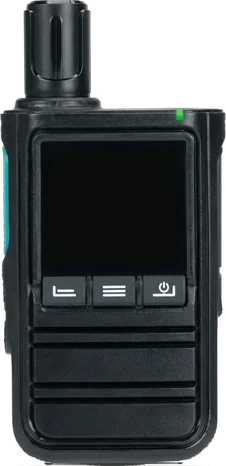
| Antenna | Top left, short black stub antenna; the Lite has no coloured ring at its base |
|---|---|
| Power key | Top, right of the antenna, red pill key; long press switches the radio on or off, short press turns the screen off |
| LED | Top; red while transmitting, green while receiving |
| PTT key | Left side, long red-outlined key; hold to talk |
| Volume up key | Left side, below the PTT key; volume up or scroll up; long press on the home screen creates a group over Bluetooth |
| Volume down key | Left side, below Volume up; volume down or scroll down; long press on the home screen joins the group created over Bluetooth |
| Headset port | Right side, under a rubber cover; K-type 2-pin headset |
| Screen | Front, 1.44-inch colour display with the 4G, SIM, Bluetooth, volume and battery status bar |
| Menu / OK key | Front, left of the centre key, green; opens the menu and confirms |
| Member shortcut key | Front, round centre key; opens the member list |
| Back key | Front, right of the centre key, red; goes back, and in a private or voice call leaves the temporary group |
| Speaker | Front, below the Poclink logo plate; ribbed louvre grille |
| USB-C port | Bottom, centre; the charging light sits at the bottom left of the port, red while charging and green when full |
| Belt clip | Back, centre; removable |
| Battery and SIM slots | Back, under the removable 3,000 mAh battery; two SIM slots marked SIM1 and SIM2 and two gold battery contacts |
How big is it?
The POC-1 Lite next to other radios, to scale. Pick up to three to compare.
Full specifications
Values come from the sources listed at the end of the page. Where they disagree, both values are shown.
| LTE FDD bands | B1/B3/B5/B7/B8/B20/B28 (EU page); US set in the NA manual |
|---|---|
| LTE TDD bands | B38/B40/B41 |
| SIM | Pre-installed; two SIM slots under the battery; Standard Global Plan in 84 countries included, free for a term (US page: 3 years, then $29 a year; EU page: lifetime) |
| Connection | 4G and Bluetooth |
| Paid SIM plans | Essential Global: 130 countries, $69 a year; Premium Global: 160+ countries, $99 a year; per radio, one year from activation |
| PTT platform | Poclink app and server; works with the Pro and Ultra on the same platform |
|---|---|
| Groups | Up to 100 groups and 200 members per group |
| Encryption | AES-256 voice encryption (Poclink states) |
| Screen | 1.44-inch |
|---|---|
| Battery | 3,000 mAh (Poclink); 3.7 V 6,000 mAh (HPN323 OEM manual)Sources differ |
| Battery life (published figure) | Continuous use 3-5 days; standby 10 days (Poclink states) |
| Charging | USB-C, 5 V 1 A, 2-3 h |
| Water and dust rating | IPX4 |
|---|---|
| Weight | 136 g (spec table and manual); 130 g (marketing text)Sources differ |
| Size | 87 x 29 x 55 mm |
| Housing | ABS |
| Antenna | Short stub on the top left |
| Keys | PTT, volume up and down on the left; power on top; green Menu/OK, round member-list key and red Back under the screen |
|---|---|
| Status LED | Top LED: red while transmitting, green while receiving |
| Headset port | K-type (2-pin) |
| USB | Type-C |
| Bluetooth | Supported; range 33 ft |
|---|---|
| Wi-Fi | None listed; Wi-Fi is the Pro |
| Satellite positioning | GPS (live location in the Poclink app) |
| FCC ID | 2BN5N-HPN323 (printed by Poclink); grantee HPYJ USA LLC |
|---|---|
| CE | "CE Certified" (Poclink states) |
| Warranty | 1 year |
Where sources disagree
- Battery3,000 mAh (Poclink) · 3.7 V, 6,000 mAh (HPN323 OEM manual)
- Weight, g136 g (spec table and manual) · 130 g (marketing text)
- SIM plan term3 years free, then $29 a year (US page) · Lifetime (EU page) · 1 free year (home page)
- LTE bandsB1/3/5/7/8/20/28/38/40/41 (EU page) · US set (NA manual)
Questions
Who makes the Poclink POC-1 Lite?
The FCC ID Poclink prints on its EU Lite page, 2BN5N-HPN323, belongs to HPYJ USA LLC in Las Vegas. The FCC photos show the Lite body with an HPY-J logo. Poclink's About page says it designs its hardware in-house.
Is the Poclink POC-1 Lite legit?
Poclink Tech LLC sells real radios and buyers report working calls. Ratings run from 4.9 in its own store to 3.5 on Trustpilot and 2.6 on Google Play, and the free plan covers 84 countries for a term, not the world.
Is the Poclink Lite free to use worldwide?
No. The included Standard Global Plan covers 84 countries for a free term, then $29 a year. Essential costs $69 and Premium $99 per radio per year, and Australia, India and South Korea are on no list.
What is the difference between the Poclink Lite and Ultra?
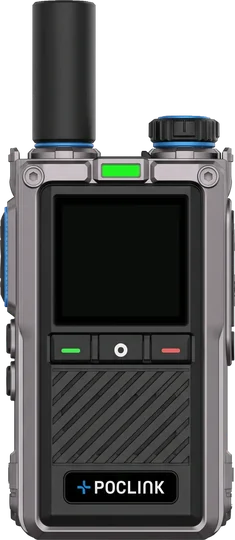
The Lite is LTE only at €179.95 per 2-pack. The Ultra adds 16 analog channels and a second PTT key at €359.95. Both share one body, a 3,000 mAh battery and a 1.44-inch screen.
How big is the Poclink POC-1 Lite battery?
Poclink says 3,000 mAh. The OEM manual for the FCC model HPN323 says 3.7 V and 6,000 mAh. Poclink quotes 3 to 5 days of use and 10 days standby.
Which LTE bands does the Poclink POC-1 Lite support?
Poclink's EU page lists B1, B3, B5, B7, B8, B20, B28, B38, B40 and B41. The NA manual lists the US set. Confirm in writing which version ships to you.
Does the Poclink Lite have a SIM?
Yes. A SIM is pre-installed, and the FCC internal photos show two SIM slots marked SIM1 and SIM2. The plan on it covers 84 countries.