How it works
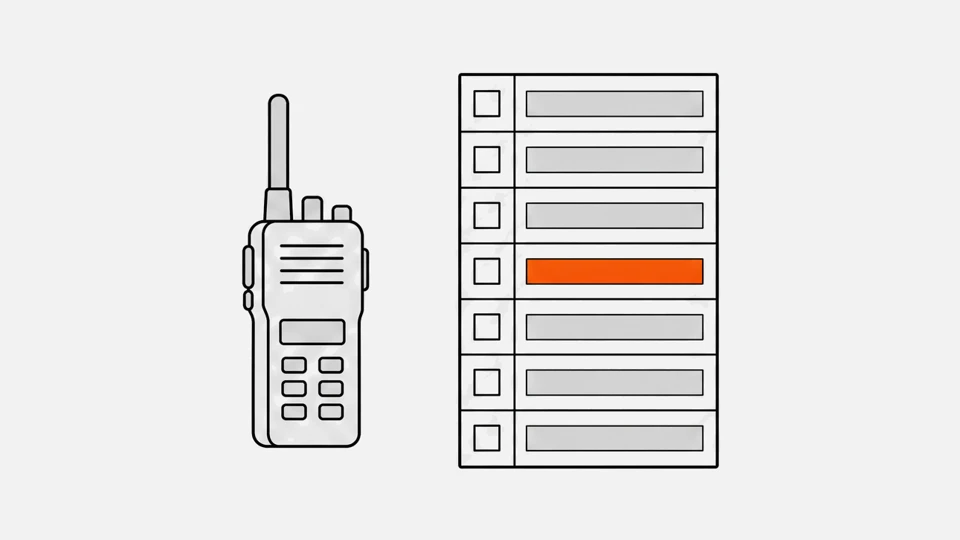
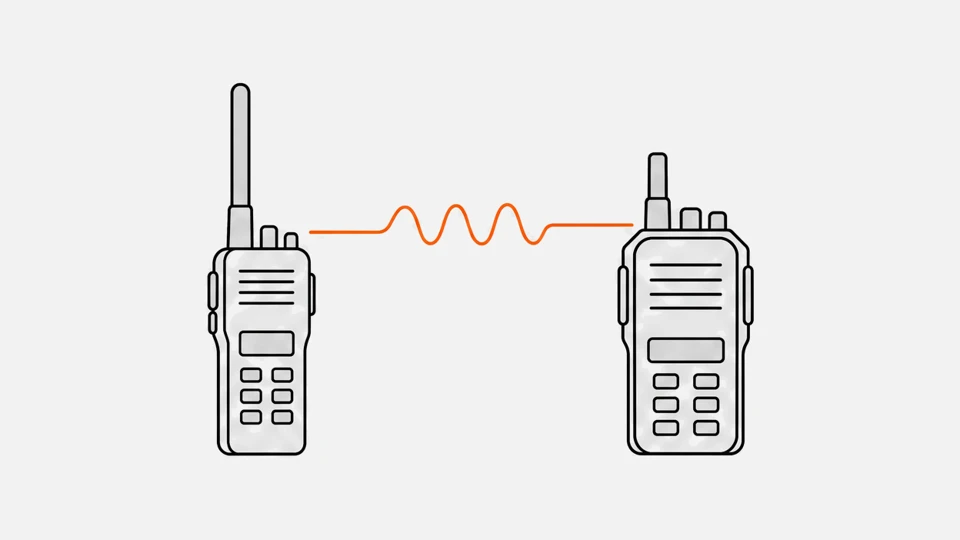
Two radios talk directly only when they share three things: a band, an air interface and the settings of that interface. The box checks the first two and lists the third. DMR puts two time slots in a 12.5 kHz channel;1 dPMR and NXDN use 6.25 kHz FDMA;24 P25 Phase 1 is FDMA on 12.5 kHz and Phase 2 two TDMA slots in the same width;56 TETRA has four slots in 25 kHz.7 Ham radio adds D-STAR and Yaesu's System Fusion.89
Sharing a vocoder is not enough. dPMR, NXDN, DMR, System Fusion and P25 Phase 2 all use AMBE+2 voice coding,10 yet each wraps it in its own frames and signalling, so none decodes another. Where both radios have analog FM channels, they can always meet there, without digital features such as IDs, text or encryption.
PoC radios carry voice over the mobile network instead of a radio channel: they meet a radio system only through a radio-over-IP gateway (what radio over IP is). Bandwidth for such a link: RoIP bandwidth calculator.
Digital radio modes compared
| Mode | Standard | Access | Channel | Vocoder | Analog FM too |
|---|---|---|---|---|---|
| Analog FM | Analog | FM, one call per channel | 25 or 12.5 kHz | None: the voice itself | — |
| DMR (Tier I and II) | ETSI | TDMA, 2 time slots | 12.5 kHz | AMBE+2 | Usually |
| dPMR | ETSI | FDMA | 6.25 kHz | AMBE+2 | Usually |
| NXDN | NXDN Forum | FDMA | 6.25 or 12.5 kHz | AMBE+2 | Usually |
| P25 Phase 1 | TIA-102 | FDMA | 12.5 kHz | IMBE (full rate) | Usually |
| P25 Phase 2 | TIA-102 | TDMA, 2 time slots | 12.5 kHz | AMBE+2 (half rate) | Usually |
| TETRA | ETSI | TDMA, 4 time slots | 25 kHz | ACELP | No |
| D-STAR | JARL | FDMA, GMSK | 6 kHz | AMBE | Usually |
| System Fusion (C4FM) | Yaesu | FDMA, C4FM | 12.5 kHz | AMBE+2 | Usually |
| PoC over LTE | PTT platform | IP over the mobile network | The operator's LTE bands | Set by the app (often Opus or AMR) | No |
The standards, explained: DMR, dPMR and NXDN, P25, TETRA, land mobile radio.