Which two-way radio is best for you?
The best two-way radio is the one whose specifications match your answers, not the one with the longest range on the box. Work through distance, license, group size, network, digital or analog, band, toughness, battery and budget, in that order. Each step names the tool or comparison that settles it.
- Distance and place: how far, indoors or out.
- License: none, by rule, or individual.
- Group size: channels and codes.
- Network: direct radio or PoC.
- Digital or analog.
- UHF or VHF.
- Toughness: IP code and drop tests.
- Battery: hours per shift.
- Accessories.
- Budget: purchase and running costs.
When you have the answers, the radio picker shortlists radios from them and compare radios sets two or three side by side.
How far do you need to talk, and where?
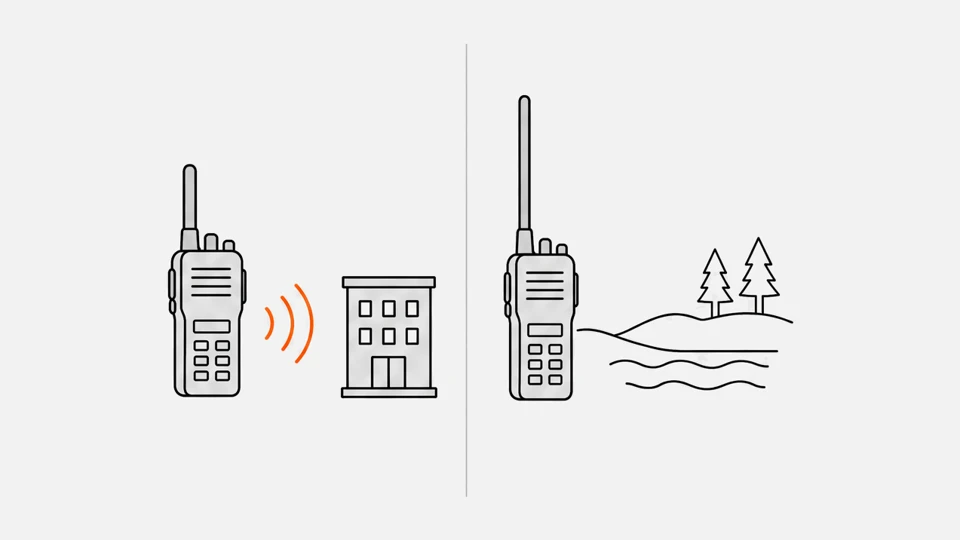
License-free handhelds reach a few hundred meters in a town and a few kilometers in open country. Two radios on flat ground cannot pass about 10 km whatever their power, because the horizon is in the way.1 Walls and floors shorten the distance further, so the place matters as much as the radio.
| Setting | What to expect |
|---|---|
| PMR446 in a city | A few hundred meters2 |
| PMR446 in the countryside | Up to a few kilometers2 |
| FRS or GMRS handheld, normal conditions | ½ to 2 miles3 |
| Any handheld, flat ground, antennas at head height | About 10 km (6 miles), a ceiling1 |
Model your own site in the range calculator, which takes the radio, the surroundings and the number of floors. Long-range walkie-talkies covers what limits range and what goes further: repeaters, PoC and satellite.
Do you need a license?
Many handhelds need no license: PMR446 is exempt in CEPT countries and US FRS is operated by rule. US GMRS needs an individual license, $35 for ten years. Business channels are licensed to the operator. A PoC radio needs no radio license, because it uses the mobile network instead of a radio channel.
| Radio | License | Rule |
|---|---|---|
| PMR446 (CEPT countries) | None | Exempt from individual licensing4 |
| FRS (US) | None | Authorized by rule5 |
| GMRS (US) | Individual license, $35 application fee, ten-year term | FCC fee guide; ten-year term in 47 CFR 95.170567 |
| Business UHF or VHF, analog or DMR | A license for your channels | US: eligible persons hold authorizations8 |
| PoC radio | No radio license; a SIM and a platform plan | Mobile network |
Rules differ by country. Check yours in the license checker, compare the two US services in FRS vs GMRS, and read two-way radio licensing for business channels.
How many people and channels do you need?
A small group fits on one channel of any license-free radio: PMR446 has 16 analog channels and FRS has 22. Everyone nearby shares the channel and only one person transmits at a time. A privacy code mutes other groups without making a call private. Dozens of groups call for DMR or PoC.
- PMR446: 16 analog channels at 12.5 kHz spacing from 446.00625 MHz.4
- FRS: 22 channels, each 12.5 kHz wide, shared with GMRS.9
- Codes: a receiving radio blocks a signal whose code does not match, which mutes other users on your channel. With the code at zero, it passes everything.10
- DMR: one 12.5 kHz channel carries two calls in two time slots.11
See types of two-way radio for how the families differ, and DMR for the licensed digital option.
Should the radio use a network?
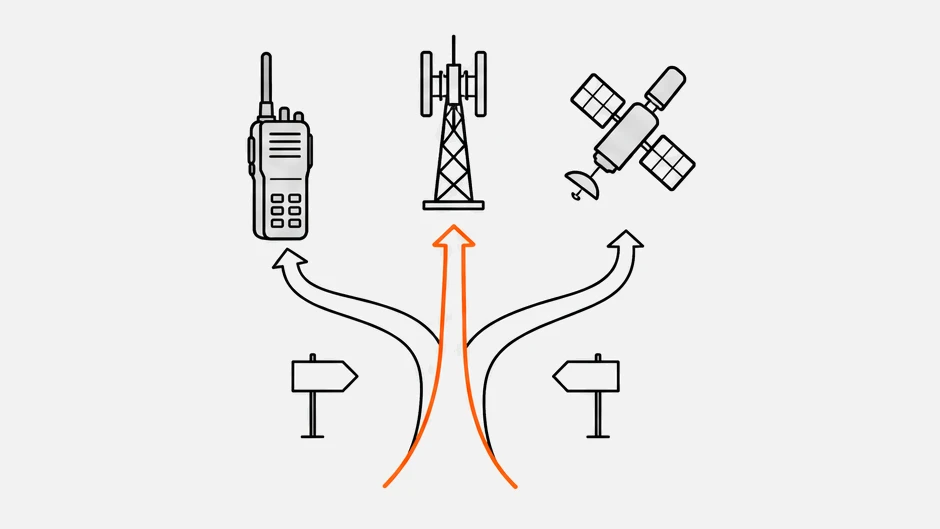
A direct radio needs no network: it works wherever two radios are in range and has no monthly fee. A PoC radio needs mobile coverage and a push-to-talk service, but the distance between users does not matter. Three answers pick the type: distance, mobile signal and running cost.
Direct radios suit a site, a trip or a place with no signal. PoC suits teams spread over towns or countries, or cases where the coverage is already there. PoC vs PMR446 and land mobile radio vs PoC put the two side by side, and what is a PoC radio explains how the network path works.
Should you choose digital or analog?
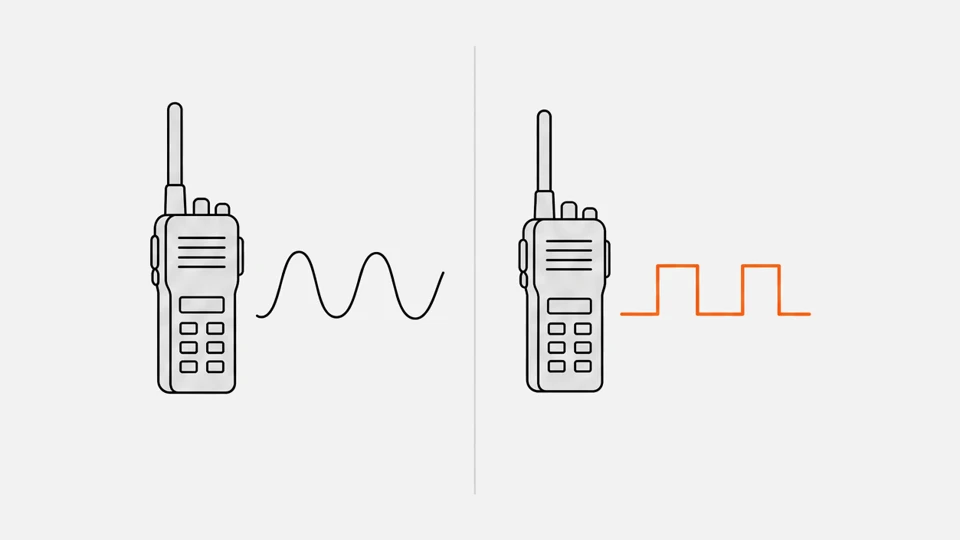
Choose analog for the simplest radios that talk to any FM radio on the channel. Choose digital for caller IDs, text, encryption or more calls per channel. At equal power digital does not add range: ETSI says the coding gain keeps audio good out to the coverage edge, not beyond it.12
Analog and digital radios from different makers do not always interwork, so check before mixing brands with the digital radio compatibility tool. Digital vs analog radio covers audio, battery, privacy and migration.
Should you choose UHF or VHF?
Choose UHF for buildings and towns, VHF for open country. Motorola says VHF travels farther in open outdoor areas, while UHF passes through walls and concrete better.13 Radios on different bands cannot talk to each other, so the whole team has to pick one.14 PMR446 (446 MHz) and FRS/GMRS (462 and 467 MHz) are UHF.
| Site | Band | Reason |
|---|---|---|
| Warehouse, hotel, school, hospital, factory, construction | UHF | Better in buildings13 |
| Farm, forestry, utility, airport | VHF | Longer in open terrain13 |
UHF vs VHF goes through antennas, indoor loss and dual-band radios.
How tough should the radio be?
Read two ratings. The IP code states how much dust and water the case keeps out: IPX7 means 30 minutes under 1 m of water.15 MIL-STD-810H lists drop tests, with default heights of 1.22 m for 26 drops or 1.5 m for 5 drops.16 Makers rarely state the drop count or the surface.
| Code | Meaning in IEC 60529 |
|---|---|
| IP5X | Dust-protected: some dust may enter, not enough to harm operation15 |
| IP6X | Dust-tight |
| IPX4 | Splashing water from any direction |
| IPX5 / IPX6 | Water jets: 12.5 l/min through a 6.3 mm nozzle, or 100 l/min through 12.5 mm |
| IPX7 | Temporary immersion: 30 minutes, lowest point 1 m under water |
| IPX8 | Continuous immersion, depth and time agreed between maker and user |
An IP67 mark alone makes no jet claim and IP66 alone makes no immersion claim; a case that passes both is marked IP66/IP67.15 Decode any marking in the IP rating decoder. One consumer-radio guide rates its radio IP54 (splashes only, covers sealed),10 while a PoC radio datasheet lists IP67.17
What battery does a shift need?
Check the duty cycle behind the hours. Makers usually quote run time at 5% transmit, 5% receive and 90% standby, so a heavy talker gets fewer hours than the rating.18 A radio rated 18 hours at 5:5:90 covers a light 12-hour shift; heavy talking shortens it, so plan a spare battery or a second charge.
Quoted hours are only comparable on the same cycle. Motorola rates the TLK 110 at 18 hours on 5:5:90,17 and Hytera rates the PNC360S at 20 hours on 10-10-80.19 Hytera says lithium radio batteries last around 18 to 24 months in service.18 The DMR Association claims up to 40 percent more talk time for two-slot digital radios.11
Enter shift length, talk time and charger slots in the battery life calculator to get swap times and a charger plan.
Which accessories matter?
Accessories decide how a radio feels after the first hour. Check them against the exact model, because connectors, holsters and batteries differ by maker and often by model. Four kinds matter most for daily work: audio, chargers, spare batteries and carrying.
- Speaker microphone or earpiece: keeps the radio on your belt and lets you talk with gloves on. Some radios use a VOX headset for hands-free talk.10
- Chargers: a desktop charger for one radio, a multi-unit charger for a fleet, or USB charging for trips.
- Spare batteries: the cheapest way to double a shift.
- Carry: belt clip, lanyard, holster or chest harness, matched to how people move.
What does a two-way radio cost to run?
License-free handhelds have no running cost beyond batteries, and GMRS adds a $35 license every ten years.6 A PoC radio adds a data SIM and a platform fee. Published prices in October 2026 run from $8.00 per user per month (Zello Work Core)20 to $24.95 per radio per month (Peak PTT);21 others quote on request.
Add the purchase price, accessories, SIMs and fees over your planned months in the cost calculator. PoC radio SIM card and cost breaks down data use and plans.
Which radio fits your situation?
Match your case in the first column, then follow the other columns to the radio type and the tool or comparison that settles it. Types are named by what they are, not by maker, and each row can be checked against the sections above.
| If you need… | Choose… | Check with |
|---|---|---|
| A family trip or hike, a few kilometers, no paperwork | License-free UHF handheld: FRS in the US, PMR446 in CEPT countries | Range, FRS vs GMRS |
| More power and repeaters for a US family or club | GMRS handhelds with a license | License checker |
| Staff in one building: shop, hotel, warehouse | UHF business handhelds, analog or DMR, licensed | UHF vs VHF |
| A farm, forest or open site | VHF business radios | UHF vs VHF |
| Calls with IDs, text or encryption on licensed channels | Digital radios such as DMR | Digital vs analog |
| Several sites, towns or countries | PoC radios with a platform plan | PoC vs PMR446 |
| Wet, dusty or rough work | A case rated for the conditions (IP67, MIL-STD-810H listed) | IP rating decoder |
| A shift longer than the battery rating | Spare batteries and a charger plan | Battery life |
| A shortlist from your answers | Radios filtered by your needs | Radio picker |
Questions
What is the best walkie-talkie for hiking?
A license-free UHF handheld, FRS in the US or PMR446 in CEPT countries, with a clear line between users. Expect ½ to 2 miles on FRS and a few hundred meters to a few kilometers on PMR446.23
What is the best two-way radio for a small business?
For one building, licensed UHF handhelds or a PoC radio. For several sites, PoC. The radio type picker lists which types fit your distance, signal and cost.
What is the best walkie-talkie for a family?
A license-free pair or set of FRS or PMR446 radios. Add a GMRS license only for more power or repeaters in the US; immediate family members may use a GMRS station under one license.7
Which brand is the best?
The brand matters less than the fit: the right band, license class, IP rating and battery for your work. Compare models side by side on those points in compare radios, from each maker's own datasheet.
Sources
- Rec. ITU-R P.834: Effects of tropospheric refraction on radiowave propagation · ITU-R. Effective Earth radius factor 4/3.
- PMR446 radios, licensing and range (in Latvian) · Elektroniskie sakari, Latvia
- GXT1000VP4 two-way GMRS handheld radio · Midland
- 47 CFR 95.563: FRS channels · eCFR
- Talkabout T38 user guide (MN007504A01-AB) · Motorola Solutions
Show all 21 sources
- DMR Association white paper: Benefits and features of DMR · DMR Association
- UHF vs VHF · Motorola Solutions
- UHF radio vs VHF radio · Hytera
- MIL-STD-810H, Method 516.8 Procedure IV, Tables 516.8-IX and 516.8-X · US Department of Defense (DLA ASSIST), copy on EverySpec
- TLK 110 data sheet · Motorola Solutions
- Charging two-way radios and battery life · Hytera Canada
- PNC360S PoC radio · Hytera
- Zello pricing · Zello
- Peak PTT pricing matrix · Peak PTT