What is a business two-way radio system?
A business two-way radio system is the set of radios, channels, links and software a team uses to talk. It can be a few handhelds on one channel, or a network of repeaters, consoles and PoC phones across a country. The parts are the same; the scale changes.
The US FCC defines a land mobile radio system as a group of base, mobile and associated control and fixed relay stations that provide radio communications over a single area of operation.1 That is the classic business system, described in land mobile radio. A PoC radio sends the same push-to-talk calls over a mobile network instead (what is a PoC radio?). Most real systems mix the two.
What are the parts of a business radio system?
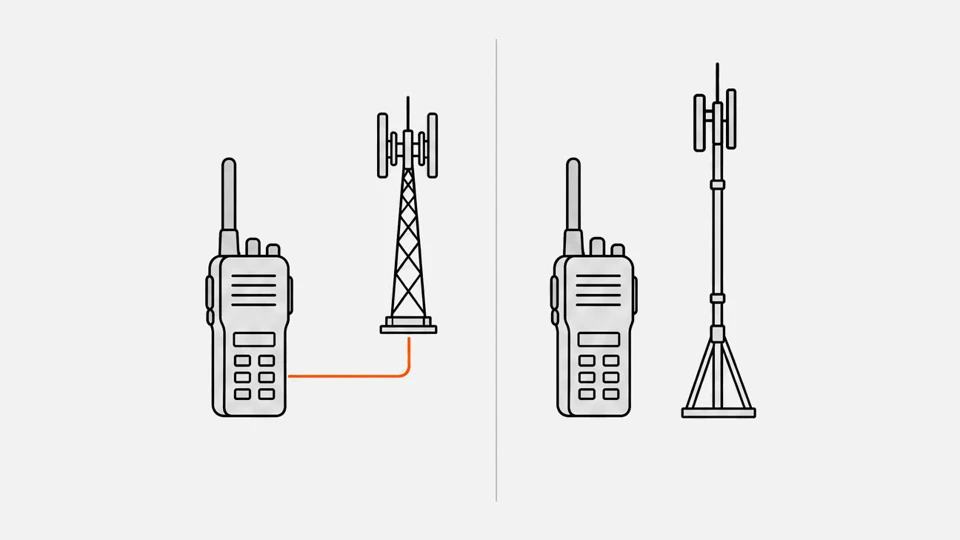
Nine parts make up a full system: radios, channels, repeaters, a link between sites, PoC, a dispatch console, a gateway, accessories and programming software. A small team uses only the first two. Each later part solves one problem the earlier ones leave open.
| Part | What it does | Add it when |
|---|---|---|
| Handheld and mobile radios | Portable radios for people, mobile radios for vehicles | Always |
| Channels | The frequencies the team shares: license-free or licensed | Always |
| Repeater | Receives each call and retransmits it from a high point | Radios cannot reach each other directly |
| Site link or trunking | Joins repeaters at several sites, or shares a pool of channels | More sites, or more users than channels |
| PoC over LTE | Carries calls over the mobile network | People work beyond any radio site |
| Dispatch console | Lets an operator call groups from a PC | A control room or a supervisor needs to talk to everyone |
| RoIP gateway | Puts a radio channel on an IP network | Systems, sites or PoC must be joined |
| Accessories | Earpieces, speaker microphones, chargers, spare batteries | Shifts longer than a battery lasts |
| Programming software | Sets channels, groups, tones and buttons | Always; fleets add management tools |
Should a business use license-free or licensed channels?
License-free channels cost nothing to apply for but fix power and antenna and forbid repeaters. Licensed business channels cost a regulator's fee and give your own channel, more power and repeaters. Small single-site teams often start license-free; teams that outgrow one building move to a license.
| Channels | License | Power | Repeaters |
|---|---|---|---|
| PMR446 (Europe) | None | 0.5 W ERP, built-in antenna2 | Not allowed2 |
| FRS (US) | None | 2 W ERP; 0.5 W on channels 8–143 | Not allowed3 |
| Business radio, US (FCC Part 90) | $105 to apply, up to 10 years45 | Set by the license | Allowed |
| Business radio, UK (Ofcom) | Simple UK Light: £75 for five years, 19 shared frequencies, 5 W ERP6 | 5 W ERP on that license | No base stations on that license6 |
| Business radio, Ireland (ComReg) | €22 per piece of equipment plus a fixed €227 | Set by the license | Separate system licenses7 |
Most new US applications need frequency coordination first, so wait for the authorization before you buy radios.8 PMR446 has 16 channels in analog and in DMR Tier I, and 32 in dPMR.2 Rules, fees and exemptions by country are in two-way radio licensing and the license checker; frequency charts list the channels.
When does a business need a repeater?
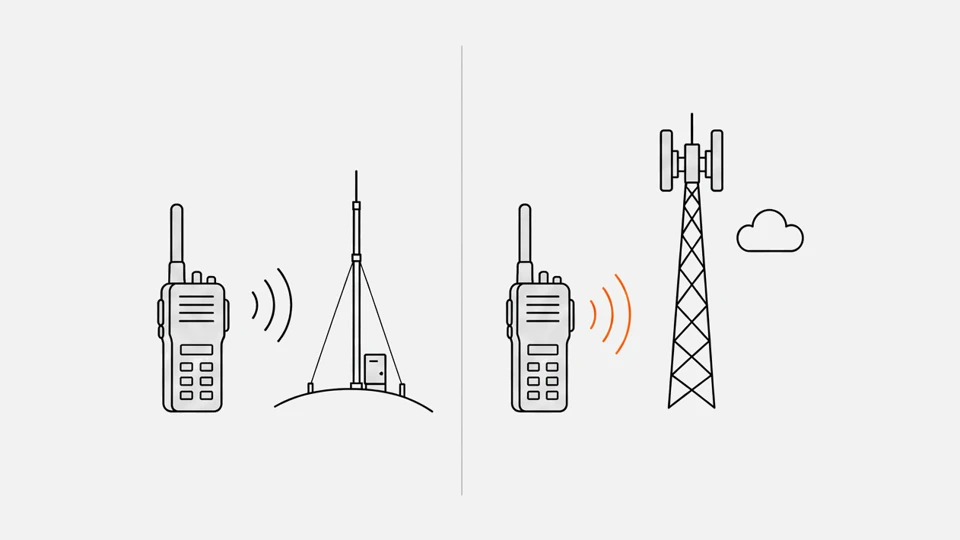
When handhelds cannot reach each other directly: across a large building, a campus or hilly ground. A repeater is a fixed station on a high point that receives each call and retransmits it, so a radio only has to reach the repeater. License-free services such as PMR446 do not allow repeaters.2
The FCC calls this a mobile relay station: it automatically retransmits on a mobile-service frequency what originates on the mobile's transmit frequency.1 A DMR repeater carries two calls at once in one 12.5 kHz channel, one per time slot.9 Some repeaters run analog and digital together, so a fleet can move to digital in steps.10 How height and terrain set the range is in long-range walkie-talkies; DMR explains the slots.
How do multi-site and trunked systems work?
A conventional system gives each group a fixed channel. A trunked system shares a pool of channels and assigns an open one to each call.1 A multi-site system links repeaters at several locations over IP so radios roam between them. The choice depends on user numbers and sites.
Digital Mobile Radio (DMR) has three tiers: Tier II is conventional, Tier III is trunked on 66–960 MHz.11 ETSI publishes the trunking protocol as TS 102 361-4.12 Makers sell their own names for these designs, which the table describes generically.
| Design | What it does | Example from a maker |
|---|---|---|
| Single-site trunking without a controller | Shares channels at one site | Motorola Capacity Plus: over 1,000 users share one system, up to 12 voice paths13. Hytera XPT works without any control channel14 |
| Repeaters linked over IP | Radios roam across sites; one channel per site, no system controller | Motorola IP Site Connect: up to 15 sites on a standard IP network15 |
| Multi-site trunking without a controller | Links adjoining single sites | Motorola Capacity Plus Multi-Site16 |
| Tier III trunking | Central control of channels over one or many sites | Motorola Capacity Max supports ETSI Tier III, up to 3,000 users per site (2015 launch)17 |
| Standards-based trunking | Shared networks built to one standard, mostly for public safety and utilities | P25, TETRA1819 |
Capacity figures in the table are the makers' own. DMR, P25, NXDN, dPMR and TETRA have no direct digital interoperability, except through gateways and maker-specific solutions.19
Where does PoC over LTE fit in a business system?
PoC fits people who work beyond any radio site: delivery crews, field staff, branches in other towns. It needs a SIM and a service plan instead of a radio license, and it reaches as far as mobile coverage does. Most business systems keep radio on site and add PoC for staff outside it.
Plans are public. Zello Work costs $8 (Core) or $15 (Plus) per user a month with monthly billing, October 2026.20 AT&T's Enhanced Push-to-Talk starts at $5 (Standard) or $20 (Advanced) per user a month, October 2026.21 A hybrid radio holds both links: Hytera's PDC680 registers on DMR and LTE with one ID and switches automatically.22 CISA calls it unlikely that LTE displaces land mobile radio and expects the two to merge.23 The trade-offs are in LMR vs PoC and PoC vs DMR.
What do dispatch consoles and RoIP gateways do?
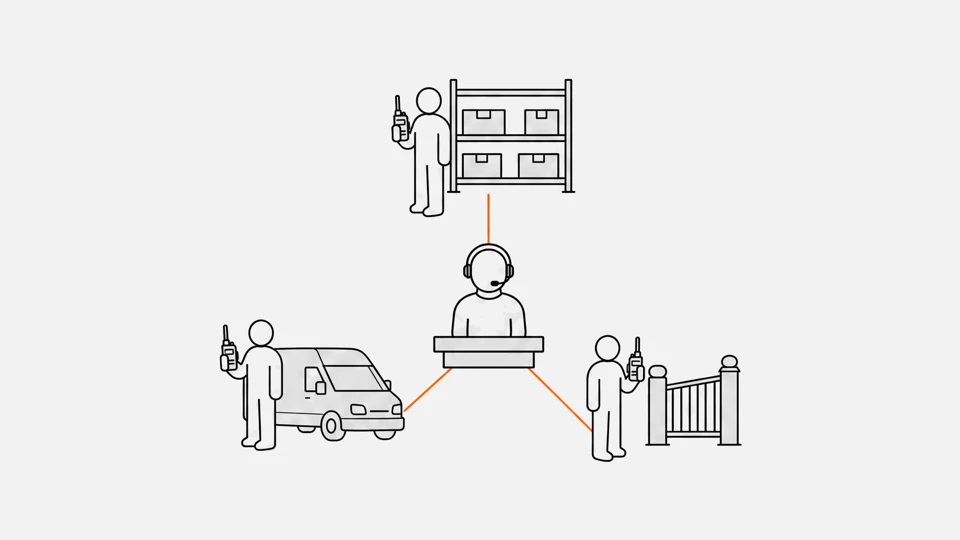
A dispatch console lets an operator call radio groups from a PC, send text and see locations. A radio-over-IP (RoIP) gateway puts a radio channel on an IP network so a console, a remote site or a PoC service can join it. Both are optional.
One maker's console runs on a Windows PC at any distance from the radios and connects over IP to a radio server. Voice and texting are standard; GPS tracking and voice recording are optional add-ons. It covers conventional, IP Site Connect, Capacity Plus and Capacity Max systems.24 On P25, a console from another maker connects through the standard CSSI interface.18
A gateway such as the JPS NXU-2B carries full-duplex audio and a push-to-talk signal across IP, and its maker names consoles and PoC platforms among the things it joins.25 Bandwidth per channel is in the RoIP bandwidth calculator; radio over IP covers the setups.
Which set-up fits which business?
One site needs handhelds only. A campus adds a repeater or single-site trunking. A city links sites over IP or uses Tier III. A nationwide team uses PoC and keeps radio for the sites that need it. Move down a row only when the row above stops working.
| Scale | Typical set-up | Channels and license | Adds |
|---|---|---|---|
| One site: shop, restaurant, small warehouse | Handhelds on one or two channels | PMR446 or FRS, or a few licensed digital radios | Nothing else |
| Campus: hospital, factory, resort, school | Licensed handhelds and vehicle radios, one or more repeaters | Business license; single-site trunking when channels run short | Console, accessories, programming |
| City or region: bus fleet, utility, several sites | Repeaters linked over IP, multi-site trunking or Tier III | License per site; ComReg lists €625 per channel per base in the first year7 | Console, RoIP gateway |
| Nationwide: logistics, retail chain, security | PoC over LTE on a carrier or platform plan | None for the radio; SIM and plan | Gateway to radio at key sites |
The radio type tool turns distance, coverage and license questions into a first answer, and how to choose a two-way radio covers the radios themselves.
What does a business radio system cost to run?
Running cost depends on the set-up. License-free radios cost nothing to run, licensed channels add a regulator's fee, and PoC adds a monthly fee per user. Radios, repeaters and sites are bought up front. The cost calculator adds your own quotes over one, three or five years.
| Cost | Figure | Applies to |
|---|---|---|
| US license application | $105; license term up to 10 years45 | Licensed US channels |
| UK Simple UK Light | £75 for five years6 | Licensed UK handhelds |
| Irish radio system license | €625 per 12.5 kHz channel per base in year one, €1,000 on renewal7 | Repeater and base systems |
| Zello Work, monthly billing | $8 or $15 per user a month20 | PoC |
| AT&T EPTT, October 2026 | From $5 or $20 per user a month21 | PoC |
| Battery replacement | Lithium-ion cells fall to 80 percent of capacity after 300–500 charges26 | All radios |
| Programming software | Motorola offers its radio programming software as a complementary download27 | Business radios |
Put your own radio, site and plan quotes side by side in the cost calculator. The monthly data a PoC SIM needs is in the PoC data calculator.
How do you plan channels and talk groups?
List the roles, give each role the groups it needs, and keep groups few. Pick a coordinator who can hear every group, then write the order in which the team switches if its main way of talking fails. The communication plan tool builds this and prints a card for each role.
That order is called PACE: Primary, Alternate, Contingency, Emergency. CISA says a PACE plan defines the triggers that move an organization from its primary to its backup capabilities.28 Two levels should not share one path: a PoC radio, a phone call and a text all ride the mobile network and fail together. Incident teams in the US write the same channel plan on FEMA's ICS 205 form.29
Radios that share a channel can be given tones or codes so each group hears only its own (privacy codes). Build the plan in the radio communication plan tool.
How long do batteries last on a shift?
Plan from the hours a full charge gives, less a reserve. Makers rate runtime on 5 percent talking, 5 percent listening and 90 percent standby, which assumes the radio idles most of the time. A 10-hour battery with a 20 percent reserve gives 8 planned hours, so a 12-hour shift needs two batteries per radio.
Hytera Canada describes the 5-5-90 cycle as its time assumption, and Motorola rates its TLK 110 at 18 hours on 5:5:90.3031 Motorola puts lithium-ion cells at 300–500 charges before they fall to 80 percent of capacity.26 The battery life calculator turns shift length, spares and charger slots into a plan.
How are radios programmed and managed?
Business radios are configured from a PC with the maker's programming software, which sets channels, talk groups, tones and buttons. Large fleets add radio management for templates and updates over the air. PoC fleets are managed from a web console instead.
Motorola's customer programming software lets you view and change radio settings from a PC.27 P25 systems add over-the-air rekeying (OTAR) for encryption keys.18 PoC services are managed from a web console; AT&T's, for example, has a web-based tool for contacts, talkgroups, features and permissions.21 Keep one programmer and one template per radio model, so every radio in a group has the same channels and buttons.
Can different radio systems talk to each other?
Only through a gateway, a standard interface or a radio that holds both links. Radios of different makers work together within one standard when certified: the DMR Association tests listed functions between two makers.32 Across standards, a gateway or console is the usual bridge; see radio over IP and the digital radio compatibility tool.
Questions
What is the difference between a two-way radio system and a walkie-talkie?
A walkie-talkie is one radio. A system adds the channels, repeaters, consoles, gateways and software that connect many radios. See two-way radio vs walkie-talkie.
Do business radios need a license?
Licensed business channels do, from the national regulator. License-free services such as PMR446 and FRS do not, but fix power and antenna and forbid repeaters.23
How many radios can one system hold?
Motorola says Capacity Plus lets over 1,000 radio users share one system, and Capacity Max is rated at up to 3,000 users per site.1317 Conventional channels hold as many as can share them without crowding.
Can analog and digital radios work together?
Yes, if the digital radio has an analog mode and both sit on the same channel. Motorola says running both modes lets new digital radios work alongside existing analog ones.33
Is a PoC radio a replacement for a radio system?
For staff spread across towns, often yes. For a site where calls must work with no mobile network, radio stays. Many fleets run both (LMR vs PoC).
Sources
- 47 CFR 90.7: Definitions, Private Land Mobile Radio Services · eCFR, US government
- 47 CFR Part 95, Subpart B: Family Radio Service · eCFR, US government
- 47 CFR 90.149: License term · eCFR, US government
- Business Radio licence management · Ofcom, UK
- Business Radio licensing · ComReg, Ireland
- 47 CFR 90.175: Frequency coordination requirements · eCFR, US government
- MOTOTRBO SLR 8000 repeater · Motorola Solutions
Show all 33 sources
- The DMR standards · DMR Association
- MOTOTRBO Capacity Plus · Motorola Solutions
- XPT Extended Pseudo Trunking System · Hytera
- MOTOTRBO IP Site Connect · Motorola Solutions
- MOTOTRBO Capacity Plus Multi-Site · Motorola Solutions
- P25 frequently asked questions, version 1.9 (2025) · P25 Technology Interest Group
- Public safety interoperability implications of non-P25 radio technologies (July 2016) · DHS Office of Emergency Communications
- Zello Work pricing · Zello
- Enhanced Push-to-Talk · AT&T Business
- PDC680 dual-mode rugged radio · Hytera
- SmartPTT PLUS dispatch software application · Motorola Solutions application catalog
- JPS NXU-2B Radio over IP (RoIP) gateway datasheet (Rev. 8, 2020) · JPS Interoperability Solutions
- MOTOTRBO energy buyer's guide · Motorola Solutions
- Business Radio Customer Programming Software (CPS) · Motorola Solutions
- Priority Communications: PACE · CISA, SAFECOM
- Charging two-way radios and battery life · Hytera Canada
- TLK 110 datasheet · Motorola Solutions
- DMR interoperability certification · DMR Association
- MOTOTRBO CP100d series portable two-way radios · Motorola Solutions