What is two-way radio dispatch software?
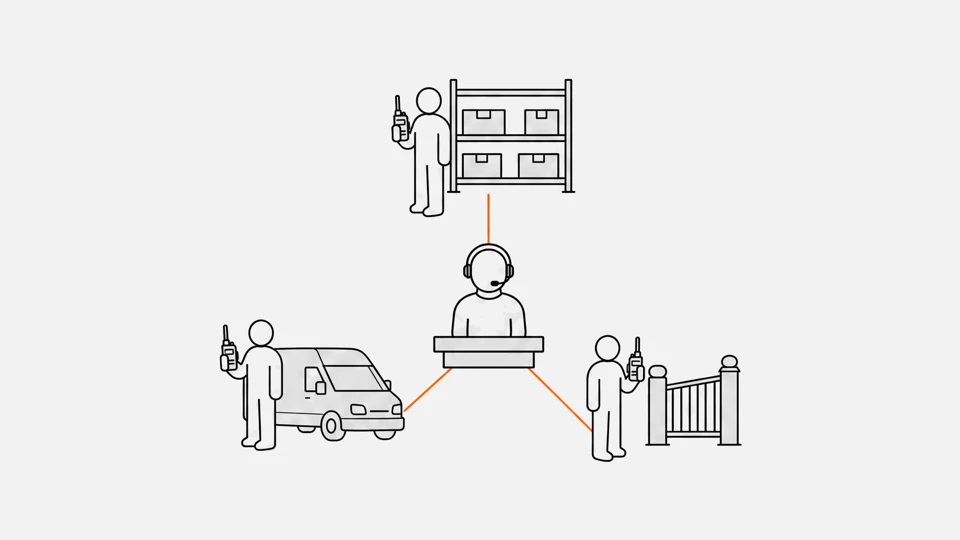
Two-way radio dispatch software lets an operator at a desk talk to groups of radios, see where they are, answer alarms and replay calls. It runs either as a console connected to a radio system or as a browser or desktop dispatcher inside a push-to-talk platform.12
The operator is the dispatcher and the screen is the console. A console shows each talkgroup as a button, lists incoming calls and lets the dispatcher answer or key up with a click. Avtec Scout, for example, sorts its call queue by priority, emergency before regular, then by arrival time, oldest first.3
For the wider system around a console, see business two-way radio systems and land mobile radio.
What does a dispatch console do?
A dispatch console lets one operator monitor many talkgroups, call a group or a single radio, patch groups together, receive emergency alarms and see radio positions. Most consoles also send text, replay recent calls and record. Which of these a console can do depends on the radio system behind it.
| Function | What the dispatcher gets | Example from vendor documents |
|---|---|---|
| Group and private calls | Talk to a talkgroup, one radio or everyone | Hytera SmartDispatch handles private, group and all calls, with up to 8 voice dispatching channels per client console4 |
| Call alert and radio control | Ring a radio, check it, disable a lost one | Scout lists call alert, unit check, unit stun, unit kill and unit revive3 |
| Patching | Join two talkgroups or channels so users hear each other | Up to five patches per Scout console; omniGate patch groups of four talk paths over unicast and up to 32 over multicast35 |
| Emergency and priority | Alarm tones, a priority queue, taking over a busy channel | TASSTA T.Rodon sounds emergency tones and lets priority calls take over a channel; RealPTT has 10 priority levels67 |
| Map and location | Live positions, history, a call from the map | Hytera tracks radios on demand or at a set interval and plays back routes; it works only with GPS radios4 |
| Text | Messages to one radio or a group | Hytera sends and receives DMR standard text messages; SmartPTT PLUS adds email48 |
| Lone worker | An alarm when a person goes down or stops moving | TASSTA bases lone worker protection on automatic man-down notifications6 |
Scout calls the functions beyond plain push-to-talk "advanced radio features", and DMR and P25 radios support them.3 A console can use a feature only when the radio system passes it through, so the same screen offers more on a trunked digital system than on a simple analog channel.
What kinds of dispatch consoles exist?
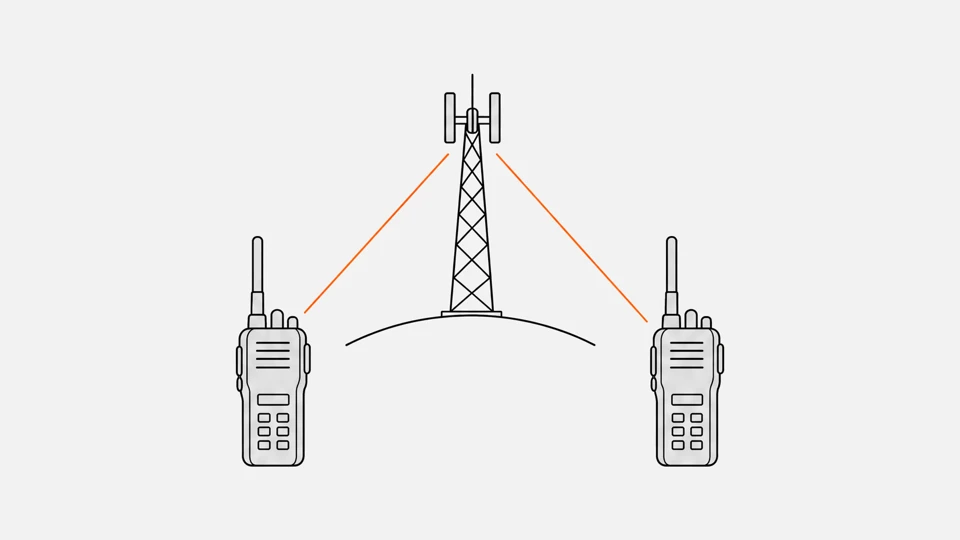
There are three kinds. A desk console connects to radios through a control station or a radio-over-IP gateway. An IP console attaches to a trunked system through its own console interface. A browser or desktop dispatcher belongs to a PoC platform and reaches phones and PoC radios over the internet.
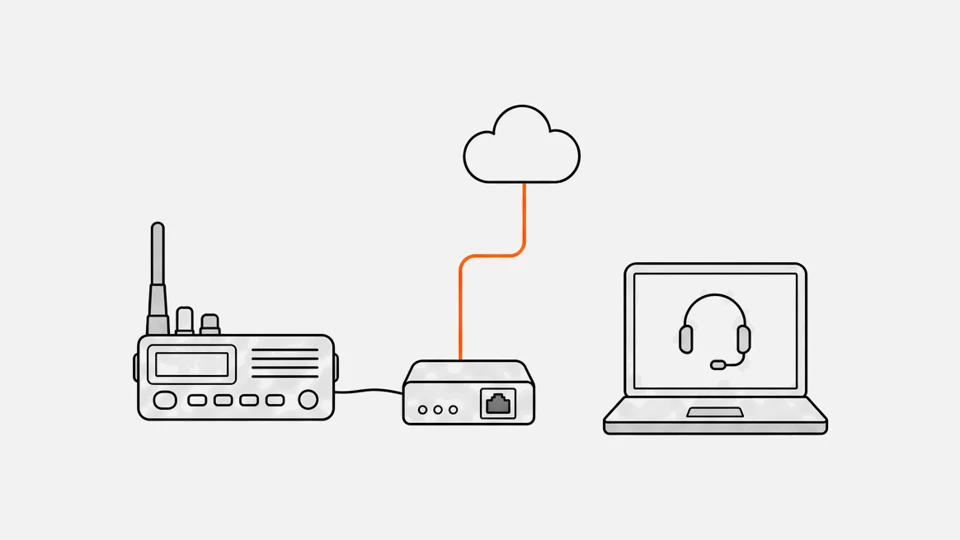
Desk console with a control station or RoIP gateway. The console talks SIP and RTP to a gateway, and the gateway keys a conventional radio. Omnitronics' omniGate sits between omnicore consoles and IPR and DRG hardware gateways; analog IPR110+ units carry one channel and IPR400 S2 units four.5 Scout lists Kenwood and Tait P25 control stations among its endpoints.3 A hardware gateway takes about 12 console connections on most models, while omniGate gives up to 128 consoles access to each gateway.5
IP console on a trunked system. The console uses the system maker's interface and needs no donor radio. Scout connects to Motorola ASTRO 25 P25 systems through CSSI, the console subsystem interface, and to MOTOTRBO Connect Plus, Multi-Site Capacity Plus and Capacity Max.93 omniGateDMR links DMR Tier 2 and Tier 3 systems over AIS, and omniGateP25 links P25 trunked systems over CSSI and conventional ones over DFSI.5 AIS is the DMR Association's standard protocol between DMR infrastructure and applications.10
TETRA consoles. Motorola's DIMETRA Dispatch Communication Server serves TETRA systems, and Omnitronics lists a gateway for DAMM TetraFlex.115 The radio side is in TETRA, DMR and P25.
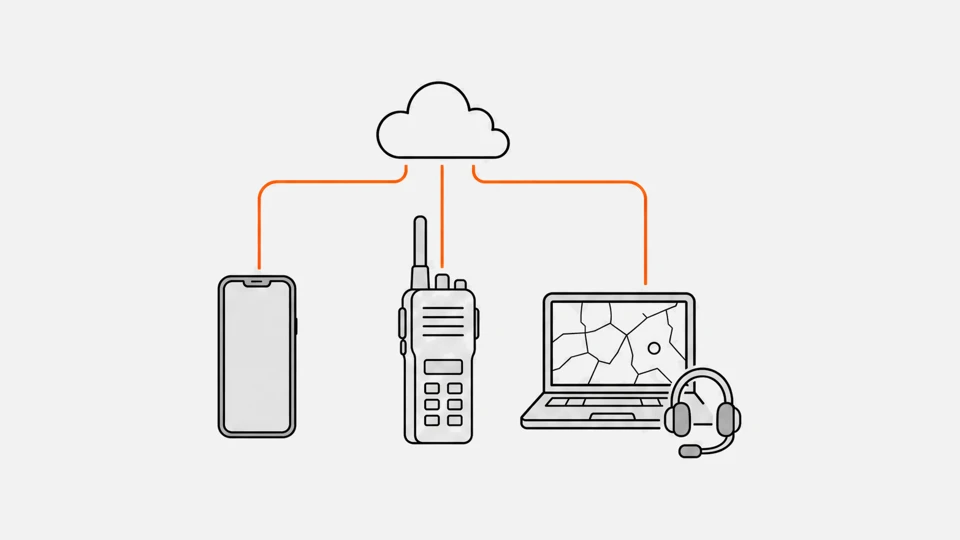
PoC dispatcher. The operator logs in to a browser page or a desktop app, and every phone and PoC radio on the platform appears as a user. WAVE PTX Dispatch, for example, needs no software installed, and Zello's Dispatch Hub is a Windows and macOS app.12
Which consoles work with DMR, P25, TETRA and analog radios?
Each radio system has one or two consoles built for it. Avtec Scout, SmartPTT PLUS and TRBOnet PLUS cover MOTOTRBO, Hytera SmartDispatch covers Hytera DMR, and Omnitronics reaches analog, DMR, P25 and TETRA through separate gateways. Check the system type and software version before buying.
| Console | Radio systems named by the vendor |
|---|---|
| Avtec Scout | Motorola's official radio dispatch solution for MOTOTRBO; P25 through CSSI; four console models; the 2019 capability guide also lists conventional radio interfaces, DMR Tier II and III, NXDN and SIP phone systems9123 |
| DIMETRA Dispatch Communication Server | Motorola TETRA11 |
| Hytera SmartDispatch | DMR Tier II conventional networks, repeaters in single-station mode or over IP4 |
| Omnitronics omnicore | Analog, DMR Tier 2 and 3, P25 and TETRA, each through its own gateway5 |
| SmartPTT PLUS | MOTOTRBO simplex and conventional, IP Site Connect, Capacity Plus, Linked Capacity Plus, Connect Plus and Capacity Max; GPS, recording and phone interconnect are options8 |
| TRBOnet PLUS | MOTOTRBO local and wide area; voice calls, recordings, tracking and employee safety monitoring12 |
| Zetron ACOM and MAX Dispatch | ACOM combines telephony and radio in centralized or distributed control rooms; MAX Dispatch v3.0 added DMR AIS Tier II and III in 2015, tested with Hytera Tier II and Tait Tier III1314 |
Versions matter for every row. The Scout guide cited here is release 4.10 from October 2019, SmartPTT PLUS lists its own MOTOTRBO firmware requirements, and Zetron's AIS release is from 2015, so ask the vendor for the current compatibility list before ordering.3814
Can dispatch software record calls?
Yes. A radio console records in two ways: an instant recall recorder replays the latest calls on the console itself, and an external logging recorder archives every talkgroup with radio ID, talkgroup and time. PoC platforms store calls on their server, for periods from 3 months to 2 years.
Scout works with analog and IP logging recorders from Accurate Always, CVDS, Equature, Eventide, Exacom, HigherGround, Jotron, NICE, Synergon, Uptivity and Verint, and its own Instant Recall Recorder lets a dispatcher replay history.3 Eventide's NexLog records P25, DMR, MOTOTRBO and DIMETRA IP radio systems, radio-over-IP networks and dispatch consoles.15 On a Tait P25 system it captures talkgroup audio over an ISSI network connection, and a search filters by radio ID, talkgroup ID, date and time.16
Recordings are available immediately for replay and export.16 Hytera's SmartDispatch server stores all calls, including phone-interconnect calls, and searches them by call time or caller ID.4 Scout's Activity History lists calls and talkspurts, and with the Instant Recall Recorder installed a dispatcher can play them back from the list.3
| PoC platform | How recording works |
|---|---|
| RealPTT | The web platform keeps audio for 3 months; call logs play from the PC dispatcher7 |
| Privox | Relays voice through the server without storing it17 |
| TASSTA | Keeps call records on the network for months6 |
| Zello Work | Message Vault in Plus and Enterprise stores voice, text, locations and dispatch calls for 2 years by default; admins choose 30, 60 or 90 days, 6 months, 1 year or 2 years18 |
Do PoC platforms include a dispatcher?
Most do. AT&T, Motorola WAVE PTX, PeakPTT, Privox, RealPTT, TASSTA, WalkieFleet and Zello Work each include a browser or desktop dispatcher; Voxer sells an admin console for teams. The table lists them alphabetically with the functions each vendor documents and the price as published.
| Platform | Dispatcher | Documented functions | Price as published |
|---|---|---|---|
| AT&T Enhanced Push-to-Talk and FirstNet | Web Dispatch in a browser | Talkgroup patching for mutual aid, mapping, user location, simultaneous sessions, affiliation monitoring, streaming video19 | $220.00 per seat a month, June 2024 brief19 |
| Motorola WAVE PTX | Web console, nothing to install | Several talkgroups, group, individual and broadcast calls, text, photos, files, map, logging1 | $32 a month on the base package, dealer list of June 202520 |
| PeakPTT | Dispatch Seat in Chrome, Firefox, Safari or Edge; Everest for Windows | Live location on satellite maps, geofence and speed alerts, playback of transmissions; Everest adds embedded recording and an SOS button2122 | $12 a month per seat; Everest $79 for one talk channel2122 |
| Privox | Browser console | Channel list, live channel, shift roster, sensor panel, chats, map with callsign and speed; a dispatcher can speak into any group without joining it23 | On request23 |
| RealPTT | Windows program and browser page | Map, group and private calls, circle call, geofences, SOS alarms, track playback, stun, remote microphone7 | Sold through agents7 |
| TASSTA | T.Rodon for Windows and iPad; T.Mugen in a browser | Multiple group calls on one or more screens, dynamic groups, emergency calls, lone worker alerts, guard tours, remote microphone or camera624 | On request6 |
| Voxer | Business Account Console | Users, teams, multiple admins and a private network25 | Business $6 per user a month, billed yearly25 |
| WalkieFleet | Windows PC Dispatch Console; web dispatcher | Voice and video PTT, emergency processing, dynamic groups, geofencing, guard tours, event log26 | €49 per dispatcher a month through PoC Me27 |
| Zello Work | Dispatch Hub for Windows and macOS | Shared call queue, accept and transfer, maps, hotkeys2 | Core $8.00, Plus $15.00 per user a month28 |
Pricing models differ. Zello Work includes the dispatcher in the per-user plan, while AT&T, PeakPTT and WalkieFleet bill the dispatcher as its own seat.29192127
Verizon sells desktop dispatch with Push to Talk Plus too; the carrier push-to-talk page has the details.30 The software section compares all platforms on the same points.
How does a PoC dispatcher reach DMR or analog radios?
Through a gateway that turns radio audio and push-to-talk keying into IP packets, or through the DMR AIS interface. Zello Bridge, TASSTA T.Bridge, WalkieFleet and Motorola WAVE PTX each connect a PoC dispatcher to radios. Which route works depends on the radio system and the gateway.
- Radio-over-IP gateways. Zello Bridge works with USB gateways from RoxiTek and Raven and with JPS NXU-2B, NXU-2A, ACU-5000 and ACU-2000 units. It carries channels only, no one-to-one messages, and supports up to 16 links.31
- Middleware bridge. T.Bridge joins TETRA, DMR, P25 and MOTOTRBO networks to TASSTA. A four-channel version expands to 8 channels and more, and any radio with analog audio in and out connects through T.Bridge 4Wire.32 The PMR devices connect to a donor radio, which connects to a Windows PC through 3.5 mm jacks.24
- DMR AIS. WalkieFleet connects several DMR networks through an AIS gateway. The dispatcher gets radio check, text messages, group and private voice calls, call alert and location tracking on the map.33
- Carrier and vendor links. AT&T charges $5.00 per user a month for unlimited communication between FirstNet Rapid Response and radio users, plus one-time site licenses of $2,500 per RoIP gateway, $7,500 for ISSI and $7,500 for CSSI.19 Motorola WAVE PTX connects to MOTOTRBO systems.1
A radio-over-IP link needs little bandwidth. omniGate sends one RTP stream of about 80 kbps to each gateway, regardless of how many consoles use it.5 The RoIP bandwidth calculator works out the figure for your codec, and radio over IP explains the gateways in detail.
What does dispatch software cost?
Published prices run from $12 per seat per month for PeakPTT's browser dispatcher to $220 for AT&T Web Dispatch. Zello Work includes Dispatch Hub in every plan, starting at $8.00 per user. Prices below were read in October 2026 unless a date is given, and they are not comparable one to one.
| Product | Price | Basis and date |
|---|---|---|
| Zello Work Core and Plus | $8.00 and $15.00 per user a month | Monthly billing; Dispatch Hub in every plan2829 |
| PeakPTT Dispatch Seat | $12 a month per seat, $25 setup | Web dispatcher21 |
| PeakPTT Everest console | $79 a month for one simultaneous talk channel, $125 setup | Windows console22 |
| WAVE PTX Dispatch, bring your own PC | $32 base, $70 SafeGuard, $130 SafeGuard with video streaming, per month | 30-month contract, US dealer, 18 June 202520 |
| WalkieFleet through PoC Me | €49 per dispatcher a month, €49 setup | Full formula27 |
| AT&T Web Dispatch | $220.00 per seat a month, plus $135.00 for streaming video | Product brief v.061224, June 202419 |
| FirstNet LMR interop licenses | $2,500 RoIP gateway, $7,500 ISSI, $7,500 CSSI, one time | Product brief v.061224, June 202419 |
A radio-system console also needs gateways or an interface license, a recorder for logging and a PC. SmartPTT PLUS, for example, asks for Microsoft SQL Server and a console PC with an Intel Core i5.8 The cost calculator compares ownership costs across radio types.
How do you choose dispatch software?
Start with the radios the operator must reach, then match the interface, the number of operators, the recording needs and the functions. List the systems that exist today, then price seats and gateways together. Six checks, listed below in order, cover most purchasing decisions.
- List the radio systems. Write down every DMR, P25, TETRA and analog system, plus phones and PoC radios, that the operator must reach.
- Check the functions. Alarms, lone worker, map history, patching and priority differ between products, as the tables above show.
- Price seats and gateways together. Add licenses, interface fees and the recorder to the seat price.19
How this relates to PoC radio
A PoC dispatcher is a dispatch console whose radios are phones and LTE devices. It sits on the same server as the apps and sees every user with a name, a location and a status. Dispatcher and field radios share talkgroups, alarms and recordings.
A radio console and a PoC dispatcher can be joined: a gateway or an AIS link puts DMR and analog users in the same talkgroup as PoC users. Where the server runs is covered on the PoC server page. For the PoC side, see what is a PoC radio and push-to-talk.
Questions
What is the difference between a dispatch console and a dispatcher app?
A console is attached to a radio system through a gateway or a system interface. A dispatcher app belongs to a PoC platform and reaches users over the internet.91
Can one console control DMR and analog radios?
Yes, if the console has an interface for each. Omnitronics connects analog radios through IPR gateways and DMR through omniGateDMR over AIS, and Scout lists conventional radio interfaces, DMR Tier II and III and P25 endpoints.53
Sources
- WAVE PTX broadband push-to-talk · Motorola Solutions EMEA
- Getting started as a dispatcher: Dispatch Hub · Zello Work Help Center
- Avtec Scout Enterprise Consoles capability guide, release 4.10, October 2019 · Avtec, Motorola Solutions
- Hytera SmartDispatch · Hytera
- omniGate software RoIP gateway · Omnitronics
- T.Rodon: dispatcher · TASSTA
- RealPTT system main features (feature document, 2026-05-07) · Shenzhen Corget Technology
- SmartPTT PLUS · Motorola Solutions application catalog
- Avtec Scout voice and radio dispatch consoles · Motorola Solutions
- DMR Application Interface Specification (AIS) · DMR Association
Show all 33 sources
- TETRA dispatch communications · Motorola Solutions EMEA
- Consoles for MOTOTRBO systems · Motorola Solutions
- ACOM Command & Control · Zetron
- Eventide in the Motorola application catalog · Motorola Solutions application catalog
- Eventide recording for Tait P25 trunked radio systems · Eventide Communications
- Privacy policy, August 2026 · Privox
- Zello Work Message Vault · Zello Work Help Center
- FirstNet Rapid Response product brief, v.061224 · FirstNet, AT&T
- WAVE PTX service plans and SafeGuard package, 18 June 2025 · Mobile Communications of America (US Motorola dealer)
- Everest Dispatch Console · PeakPTT
- FAQ · TASSTA
- Voxer for Business · Voxer
- PC Dispatch Console · Walkie Labs
- Zello Work pricing · Zello
- Overview of Zello Work · Zello Work Help Center
- Push to Talk Plus · Verizon Business
- Using Zello Bridge with radio gateways · Zello Work Help Center
- T.Bridge: PMR bridge · TASSTA
- DMR integration · Walkie Labs